Why Expansion Joint Failures Lead to Water Ingress and Structural Deterioration
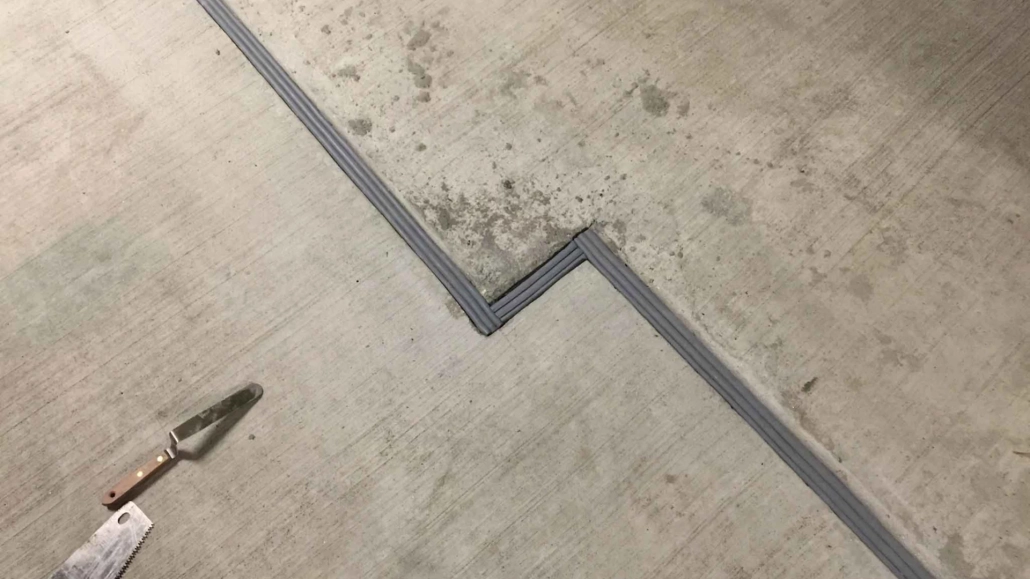
When an expansion joint fails, it does more than leak. It delivers water — and in most commercial structures, chloride-laden water — directly to the beams, columns, connections, and slab edges immediately below the joint line, concentrating the attack on the very elements least able to tolerate it. A failed joint is therefore not a maintenance nuisance but the starting point of a structural deterioration sequence that, left unaddressed, progresses from staining to spalling to measurable loss of capacity. Understanding how joint failure propagates into structural damage explains why joint renewal, though a small scope, is one of the highest-priority protective measures on a commercial building.
This is a central concern for facility managers, property managers, and engineers responsible for parking structures, podium decks, and plaza assemblies across the GTA and Southern Ontario.
Why Joints Concentrate Water at Critical Locations
An expansion joint is a deliberate discontinuity in the structure, and it typically runs directly over a line of structural support — a beam, a girder, or the bearing between two structural segments. This placement is structurally logical, but it means that when the joint seal fails, water is funnelled precisely onto the elements carrying the greatest load. Unlike a general area leak that disperses across a slab, a joint leak follows a concentrated line, saturating the same beam faces, column tops, and bearing seats repeatedly with every rain and snowmelt.
In parking structures and exposed decks, that water carries dissolved chlorides from de-icing salts. The joint effectively becomes a delivery channel for the single most aggressive agent of concrete deterioration, aimed at the structure’s most important components.
The Deterioration Sequence Below a Failed Joint
Once a joint admits water, the damage develops in a recognizable progression:
Surface staining and efflorescence. The first visible evidence is water tracking, mineral staining, and efflorescence on the soffit and supporting members below the joint. At this stage the structure is not yet damaged, but the warning is unambiguous.
Chloride penetration and corrosion initiation. Chloride-laden water penetrates the concrete of the beam or column below and accumulates at the reinforcing steel. Once the chloride threshold at the steel is exceeded, the passive protective layer breaks down and corrosion begins.
Cracking and delamination. Corroding steel expands, generating internal tensile stress that cracks and delaminates the surrounding concrete. On a beam soffit or column face, this appears as cracking parallel to the reinforcing, followed by hollow-sounding delaminated zones.
Spalling and section loss. Delaminated concrete detaches, exposing corroding steel directly. Section loss in the reinforcing reduces the load-carrying capacity of the member. On post-tensioned structures, water reaching anchorages and tendons introduces a particularly serious corrosion risk to primary structural elements.
Structural consequences. As deterioration concentrates at beams, bearings, and connections, the reduction in capacity can eventually require load restrictions, shoring, or structural strengthening — outcomes far removed from the modest seal that would have prevented them.
Why Joint-Driven Damage Is So Costly
Damage originating at joints is expensive for reasons beyond the repair itself. It targets structural rather than architectural elements, so the remediation is structural concrete repair — removal, reinforcing treatment, section restoration — rather than surface work. It occurs at beams, bearings, and connections that are often difficult to access and sometimes require temporary shoring during repair. And because a single failed joint runs the length of a structural line, the affected area is extensive rather than localized. A joint seal that might have cost a modest sum to replace can, through neglect, generate structural repairs costing many multiples of that amount, along with operational disruption during the work.
The Compounding Effect of Delay
Joint-driven deterioration follows a steepening cost curve. In the staining phase, the remedy is simply joint replacement. Once corrosion has initiated but concrete remains sound, joint replacement combined with limited concrete repair still contains the problem. After spalling and section loss, the scope expands to significant structural rehabilitation, and after capacity is affected, strengthening or load management enters the picture. Each phase of delay moves the project up this curve, and because the underlying joint continues to admit water throughout, delay does not hold the condition steady — it actively advances it.
Reading the Warning Signs Early
The value of monitoring lies in catching the sequence at the staining phase, before structural damage begins. Facility and property managers should treat the following as signals for prompt assessment: water dripping or tracking from joint lines onto levels below; staining, efflorescence, or mineral deposits on beams, columns, and soffits beneath joints; visible splitting, debonding, or displacement of the joint seal itself; and any spalling or rust staining on structural members in the vicinity of a joint. Because the earliest signs appear below the joint rather than on the trafficked surface, inspecting the underside of decks and the supporting structure is as important as inspecting the deck surface.
Preventing Structural Damage Through Joint Renewal
The strategy that prevents joint-driven structural deterioration is straightforward: treat expansion joints as finite-life protective components on a planned renewal cycle, and inspect the structure below them as part of routine assessment. Replacing a joint seal before it fails, or promptly after the first signs of leakage, keeps water away from the structural elements entirely. Where joint failure has already begun to affect the concrete below, combining joint replacement with concrete repair — executed as a coordinated scope — restores both the barrier and the structure before capacity is compromised. Injection systems can address active water paths at cracks and cold joints where leakage has migrated beyond the joint itself.
Protecting Structure at the Joint with Nusite Group
Nusite Group replaces expansion joint systems and repairs the structural deterioration they cause on commercial, institutional, and multi-residential structures across the GTA and Southern Ontario, with field experience since 1990. As a fully bonded specialty contractor, licensed across Ontario and insured to $10 million in liability coverage, we deliver joint replacement, concrete and structural repair, injection, and waterproofing as a coordinated scope — stopping water at the joint before it becomes a structural liability below.
Request an assessment of your expansion joints and the structure beneath them before leakage becomes structural damage.