How Expansion Joints Integrate with Waterproofing, Roofing, and Traffic Coating Systems
An expansion joint system does not work in isolation. It is one segment of a continuous water barrier that also includes waterproofing membranes, roofing systems, and traffic coatings, and its performance depends entirely on how well it connects to those adjacent systems. A technically sound joint surrounded by poorly detailed transitions will leak at the transitions; a continuous barrier is only as good as its weakest interface. On commercial buildings, the junctions between the expansion joint and the systems around it are where leaks most often begin — and where responsibility, on split scopes, most often falls into a gap.
For general contractors, consultants, and facility managers across the GTA and Southern Ontario, understanding these interfaces is essential to specifying, coordinating, and maintaining a watertight assembly.
The Joint as Part of a Continuous Barrier
Water management across a building surface relies on continuity. A traffic coating waterproofs the field of a parking deck; a membrane waterproofs a podium or below-grade wall; a roofing system waterproofs the roof. Wherever the structure must accommodate movement, an expansion joint interrupts these systems — and the joint system must both accommodate that movement and maintain the waterproofing continuity that the surrounding systems provide. The interface is therefore not an afterthought at the edge of two scopes; it is a designed transition that carries the full waterproofing function across the moving joint.
When this continuity is achieved, water sheds across the surface, over or into the joint system, and away to drainage without ever reaching the structure. When it is broken at a transition, the joint becomes an entry point regardless of how well the joint system itself performs.
Integration with Traffic Coatings
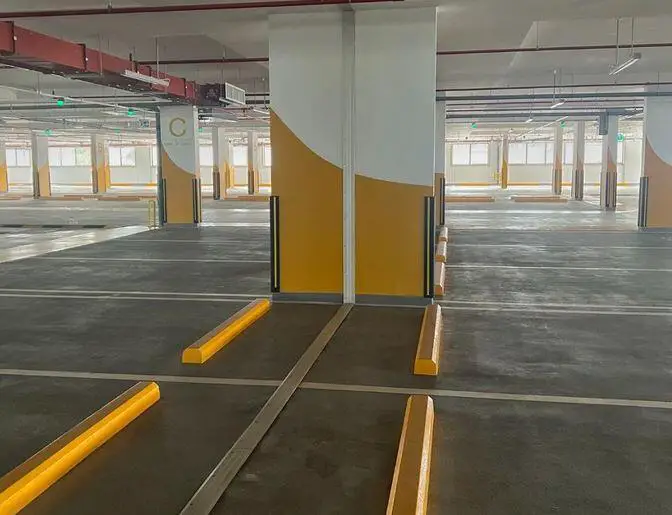
On parking decks and ramps, expansion joints and traffic coatings meet along every joint line. The coating cannot simply run over the joint — it has no capacity to accommodate the structural movement the joint exists to absorb, and would tear at the first thermal cycle. Instead, the coating must terminate into the joint system in a detailed transition: the coating is carried to the joint nosing, and the joint system’s flanges or membrane are lapped with or bonded to the coating so that water shedding across the deck passes over the sealed transition rather than beneath it. The joint nosing itself frequently requires concrete repair before installation, since a sound, correctly profiled nosing is what both the joint anchorage and the coating termination depend on.
Integration with Waterproofing Membranes
On podium decks, plazas, and below-grade structures, expansion joints must tie into sheet or fluid-applied waterproofing membranes. Where the membrane is buried beneath overburden, the joint system must maintain continuity below the wearing surface, often incorporating a membrane flashing or gland that is lapped into the primary membrane and detailed to shed water to the drainage layer. These buried transitions are especially unforgiving because they cannot be inspected once overburden is placed, which makes correct detailing and verification before cover-up critical. A membrane-to-joint transition that leaks beneath a planted podium delivers the same expensive overburden-removal problem as any other buried membrane failure.
Integration with Roofing Systems
At roof level, expansion joints cross or terminate into roofing membranes, and the transition must accommodate both the structural movement and the specific requirements of the roofing system — whether built-up, modified bitumen, single-ply, or a protected-membrane assembly. Roof expansion joints often incorporate raised curbs to keep the joint above the drainage plane, with the roofing membrane flashed up and into the joint cover. Coordinating the joint height, curb detailing, and membrane flashing with the roofing scope prevents the joint from becoming a low point where water collects or a discontinuity where the roofing membrane terminates without protection.
Why Interfaces Fail
Interface failures trace to a consistent set of causes. Incompatible materials at the transition — a joint sealant that does not bond to the adjacent membrane or coating — create a discontinuity from the outset. Poor sequencing, where one system is installed and cured before the interfacing system arrives without a plan for tying them together, leaves transitions improvised in the field. Unrepaired joint nosings provide no sound substrate for either the joint anchorage or the adjacent system termination. And divided responsibility, where different trades install the joint and the surrounding systems without coordinated detailing, means no single party is accountable for the junction. In each case, the joint system and the surrounding system may each be sound in isolation while the connection between them leaks.
The Coordination and Accountability Problem
On projects where expansion joints, waterproofing, roofing, and traffic coatings are procured as separate scopes, the interfaces fall precisely at the boundaries of responsibility. The joint contractor is responsible for the joint; the coating or membrane contractor is responsible for the field; but the tie-in between them is claimed by neither and coordinated by no one. This is the structural reason interface leaks are so common — not that any trade did poor work, but that the junction belonged to no one.
Two approaches address this. On split scopes, the general contractor and consultant must explicitly assign interface detailing and responsibility, and coordinate sequencing so transitions are executed as designed rather than improvised. Alternatively, consolidating the joint, waterproofing, and coating scopes with a single specialty contractor places the interfaces inside one party’s responsibility, where they are detailed and installed as continuous work rather than negotiated across a contract boundary.
Detailing and Verification Best Practice
Regardless of procurement approach, sound interface performance depends on a few disciplines: confirming material compatibility across all systems that meet at a joint during submittal review; repairing and profiling joint nosings before installation; sequencing the joint and surrounding systems so transitions can be lapped and bonded as intended; and inspecting and, where buried, testing transitions before they are concealed. These steps cost little relative to the scope and nothing relative to the cost of chasing an interface leak after construction.
Integrated Joint and Waterproofing Work with Nusite Group
Nusite Group installs expansion joint systems and the waterproofing, traffic coating, and concrete repair scopes that surround them across the GTA and Southern Ontario, with field experience since 1990. As a fully bonded specialty contractor, licensed across Ontario and insured to $10 million in liability coverage, we deliver joints and their adjacent systems as coordinated work — owning the interfaces so the completed assembly performs as one continuous barrier rather than a set of separately installed parts.
Request a consultation to review expansion joint and waterproofing integration on your project.