Traffic Coating Systems for Parking Garages, Ramps, and Podium Decks

Traffic coating systems are specified by location and exposure, not as a single uniform product applied across an entire structure. A parking garage, its ramps, and a podium deck each impose different demands — traffic volume, turning forces, loading, drainage, and whether pedestrians or vehicles use the surface — and a coating that is correct for a quiet parking stall is underbuilt for a ramp and overbuilt for a pedestrian terrace. Understanding how systems are matched to these zones is what separates a coating program that lasts its full service life from one that fails prematurely in the areas that were specified generically.
This distinction matters to general contractors pricing a scope, to consultants writing specifications, and to property managers planning renewal across the GTA and Southern Ontario.
Vehicular vs. Pedestrian Systems
Traffic coatings divide into two broad classes. Vehicular systems are built to resist tire abrasion, point loading, and turning forces, using a heavier aggregate-filled wear course and greater overall film thickness. Pedestrian systems are thinner, with lighter aggregate for slip resistance, and prioritize appearance and comfort underfoot on terraces, balconies, and walkways. Applying a pedestrian system in a vehicular zone guarantees early wear-through; applying a full vehicular build-up on a quiet terrace wastes cost and can feel unnecessarily coarse. Correct classification by use is the first specification decision.
Coating Zones Within a Parking Structure
A single parking structure contains several distinct exposure zones, each warranting its own treatment.
Parking stalls and low-traffic bays. Vehicles are stationary most of the time and movement is limited. A standard vehicular system provides ample durability here, and this zone typically represents the largest coated area in the structure.
Drive aisles. Continuous vehicle movement increases abrasion. Drive aisles warrant a robust vehicular system, often with an enhanced wear course relative to the stalls they serve.
Ramps and turning areas. These are the most aggressive zones in any garage. Vehicles apply torque while accelerating, braking, and turning, concentrating shear on the coating surface. Ramps require the heaviest-duty build-up — increased film thickness, higher aggregate density, and sometimes specialized high-durability chemistry — along with attention to slip resistance on the incline.
Entry and transition zones. Where vehicles enter from outside, they deposit the most salt, water, and grit. These areas combine heavy wear with maximum chloride exposure and benefit from durable systems and reliable drainage.
Suspended vs. slab-on-grade levels. Suspended slabs with occupied or structural space below require full waterproofing coatings. Slab-on-grade levels, with no space beneath to protect, are often treated with penetrating sealers or left uncoated, since the waterproofing function is not needed.
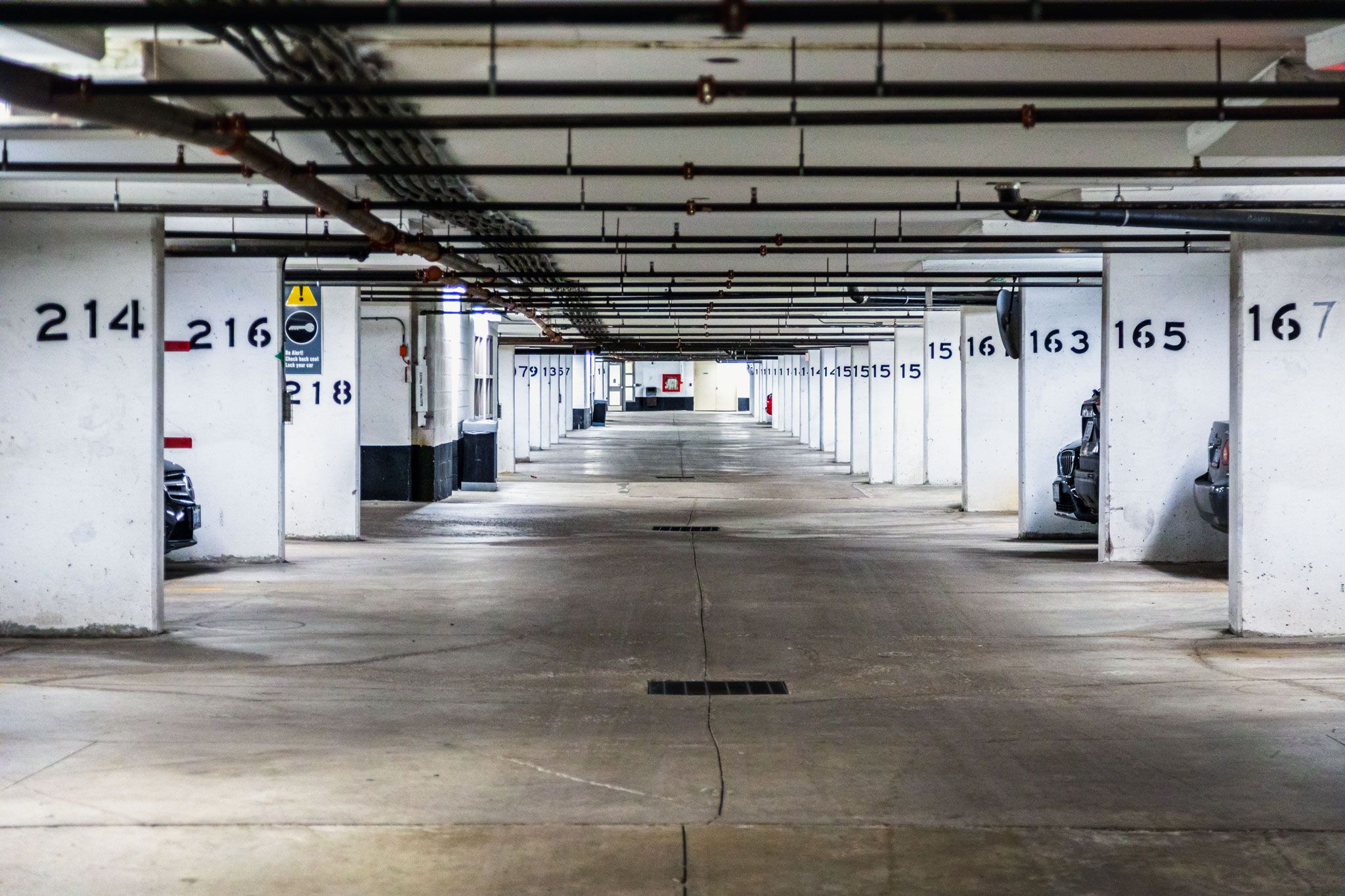
Ramps: The Zone That Fails First
Ramps deserve particular attention because they concentrate every wear mechanism at once. The incline itself adds gravitational load to braking and acceleration forces, tires scuff rather than roll cleanly through the transition curves at the top and bottom, and water sheds down the ramp carrying grit that acts as an abrasive. It is common to see a garage where the flat areas remain sound while the ramps are worn through to concrete. Specifying ramps as a distinct, upgraded zone — rather than extending the flat-area system onto them — is one of the most consequential decisions in a coating program, and one of the most frequently overlooked.
Podium Decks: Waterproofing First, Traffic Second
Podium decks introduce considerations that interior parking levels do not. Where a podium carries vehicle or pedestrian traffic directly on an exposed wearing surface, the traffic coating is also the exposed waterproofing over occupied space below — often a more demanding role than in a covered garage. Exposed podium coatings face full weather exposure, ultraviolet degradation, standing water, and the widest thermal swings in the structure, which places a premium on UV-stable aliphatic top coats and high-elongation base coats capable of bridging the larger cracks that thermal movement produces.
Where a podium is finished with pavers, planting, or a topping slab rather than an exposed coating, the waterproofing shifts to a buried membrane assembly beneath the overburden, and traffic coatings apply only to the exposed drive or walk surfaces. Many podiums combine both conditions, making the transition detail between the exposed coating and the buried membrane a critical point of coordination.
Details That Govern Performance Across All Zones
Regardless of zone, certain details determine whether a coating performs. Terminations at walls, columns, and curbs must be sealed and, where appropriate, mechanically anchored in a reglet. Drain surrounds must be detailed so water enters the drain rather than tracking beneath the coating. Cracks and joints must be treated — routed, filled, or detailed with reinforcing fabric — before the field coating is applied. And expansion joints must be handled as dedicated systems tied into the coating, not simply coated over, since coating alone cannot accommodate structural movement of that magnitude.
Matching Chemistry to Conditions
System chemistry is selected against the zone and the project constraints. Polyurethane systems suit the majority of vehicular and pedestrian applications in Ontario’s climate. Fast-cure chemistries such as polyurea or methyl methacrylate are chosen where return-to-service windows are tight or where cold-weather or low-temperature installation is required, since they cure far faster and, in the case of MMA, at lower temperatures than standard urethanes. Epoxy-urethane hybrids serve zones with chemical exposure or concentrated point loading, such as loading areas. The right choice balances durability, cure time, installation season, and cost against the demands of the specific zone.
Zone-Based Specification with Nusite Group
Nusite Group specifies and installs traffic coating systems by exposure zone on parking garages, ramps, and podium decks across the GTA and Southern Ontario, drawing on field experience since 1990. As a fully bonded specialty contractor, licensed across Ontario and insured to $10 million in liability coverage, we deliver traffic coatings alongside concrete rehabilitation and expansion joint systems so that every zone — from quiet stalls to heavily loaded ramps and exposed podium surfaces — receives the build-up its service conditions require.
Request a consultation to develop a zone-based coating specification for your structure.