Best waterproof membrane systems for bridge decks
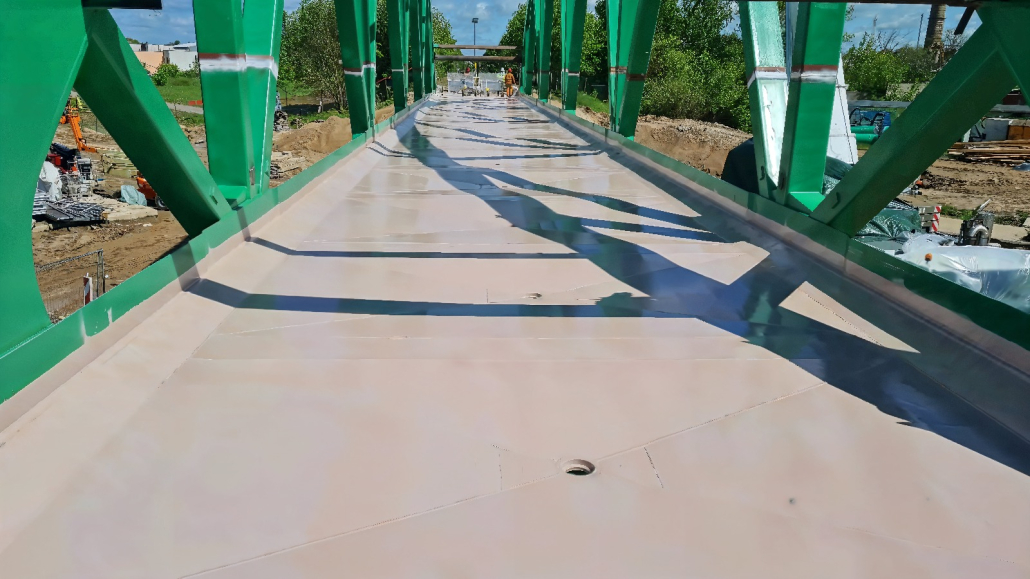
Bridge decks and elevated transportation structures endure among the most severe exposure conditions of any concrete structure: continuous traffic loading, constant thermal and structural movement, direct weather exposure, and heavy chloride loading from de-icing salts. The waterproofing membrane on a bridge deck must protect the structural slab and its reinforcing from this environment while withstanding the traffic and movement of the structure it serves. A membrane that fails allows chlorides into the deck, initiating the corrosion that deteriorates the slab and, over time, the structure’s capacity. Selecting and installing the right membrane system is therefore central to the durability and service life of the structure.
For contractors, engineers, and infrastructure owners working on bridge and elevated structures across the GTA and Southern Ontario, understanding the available membrane systems and what governs their selection informs both new construction and rehabilitation.
Why Bridge Decks Demand Specialized Waterproofing
Bridge deck waterproofing operates under a combination of demands that few other structures impose simultaneously. The membrane must bond to and protect a structural deck that flexes under live load and moves with temperature, resist the abrasion and stress of traffic transmitted through the wearing surface above it, withstand the most aggressive chloride exposure of any transportation structure, and tolerate direct weather including the full range of freeze-thaw cycling. It must also, in most cases, perform beneath an asphalt or concrete wearing surface applied over it, which subjects the membrane to heat during paving and to the loads transmitted through the pavement in service.
These combined demands mean bridge deck membranes are engineered specifically for the application, and general building waterproofing products are rarely suitable.
Main Types of Bridge Deck Membrane Systems
Hot-applied liquid membranes. Hot rubberized asphalt and modified bitumen systems are applied as a hot fluid that cures to form a monolithic, fully bonded membrane. Their seamless, self-healing character and strong bond to the deck make them a long-standing choice for bridge and elevated deck waterproofing, particularly where a robust, continuous barrier beneath an asphalt wearing course is required. Full bonding limits lateral water migration, which aids both performance and leak localization.
Cold liquid-applied membranes. Spray or roller-applied systems, including polyurethane, polyurea, and methyl methacrylate chemistries, cure without heat to form a seamless membrane. These systems offer rapid cure — important for minimizing lane or structure closures — and excellent detailing around the complex penetrations and terminations common on bridges. Fast-cure chemistries such as MMA are valuable where return-to-service windows are tight or where cold-weather application is required.
Sheet membranes. Preformed self-adhesive or torch-applied sheet membranes provide consistent, factory-controlled thickness and are used where their properties suit the deck and exposure. Their performance depends heavily on lap and seam integrity and on thorough bonding to the prepared deck.
Factors Governing System Selection
The appropriate system for a given deck depends on several interacting factors:
Wearing surface. Whether the deck is finished with hot asphalt, concrete, or an exposed traffic-coating surface strongly influences membrane choice, since the membrane must tolerate the wearing surface’s application and service conditions — hot-applied asphalt paving in particular demands a membrane that withstands paving temperatures.
Movement and flexibility. The deck’s structural movement and cracking behaviour determine the elongation and crack-bridging capability the membrane requires.
Closure constraints. Traffic management and the acceptable duration of closures often favour rapid-cure systems where downtime carries a high cost.
Installation season and conditions. Ontario’s climate constrains application windows; cold-tolerant or fast-cure chemistries extend the workable season.
Detailing complexity. Decks with numerous drains, expansion joints, curbs, and penetrations benefit from systems that detail readily around complex conditions.
Installation Demands That Determine Performance
As with all waterproofing, bridge deck membrane performance depends as much on installation as on product. Surface preparation is fundamental: the deck must be cleaned and profiled to the specified standard, with laitance, contaminants, and unsound concrete removed so the membrane bonds to a sound substrate. Moisture content must fall within the system’s limits, since applying over a deck that is still releasing moisture causes blistering and debonding. Detailing at drains, expansion joints, curbs, and penetrations must follow verified details, as these interruptions are where deck membranes most often fail. And the membrane must be protected from damage between installation and placement of the wearing surface. Where an asphalt or traffic-coating wearing course is applied, coordination with the paving operation is essential to protect the membrane from damage and excessive heat.
The Link to Deck Rehabilitation
On existing bridge and elevated decks, waterproofing is frequently part of a broader rehabilitation. Where chlorides have already penetrated and corrosion has deteriorated the deck, contaminated and delaminated concrete must be removed, reinforcing treated, and the deck restored before a new membrane and wearing surface are installed. Applying a membrane over a deteriorated deck without addressing the underlying condition conceals a problem that continues beneath it. As with parking structures, the durable outcome comes from rehabilitating the structure and then protecting it, executed as a coordinated scope.
Bridge Deck and Elevated Structure Waterproofing with Nusite Group
Nusite Group delivers waterproofing and concrete rehabilitation on bridge decks, elevated structures, and large-scale infrastructure across the GTA and Southern Ontario, with field experience since 1990. As a fully bonded specialty contractor, licensed across Ontario and insured to $10 million in liability coverage, we install membrane systems matched to deck, wearing surface, and exposure conditions, and integrate them with concrete rehabilitation where existing structures require restoration before protection.
Discuss your bridge deck or elevated structure project with Nusite Group, or request prequalification documentation for an upcoming bid.