How Waterproofing Failures Affect Building Envelope Performance in High-Rise Projects
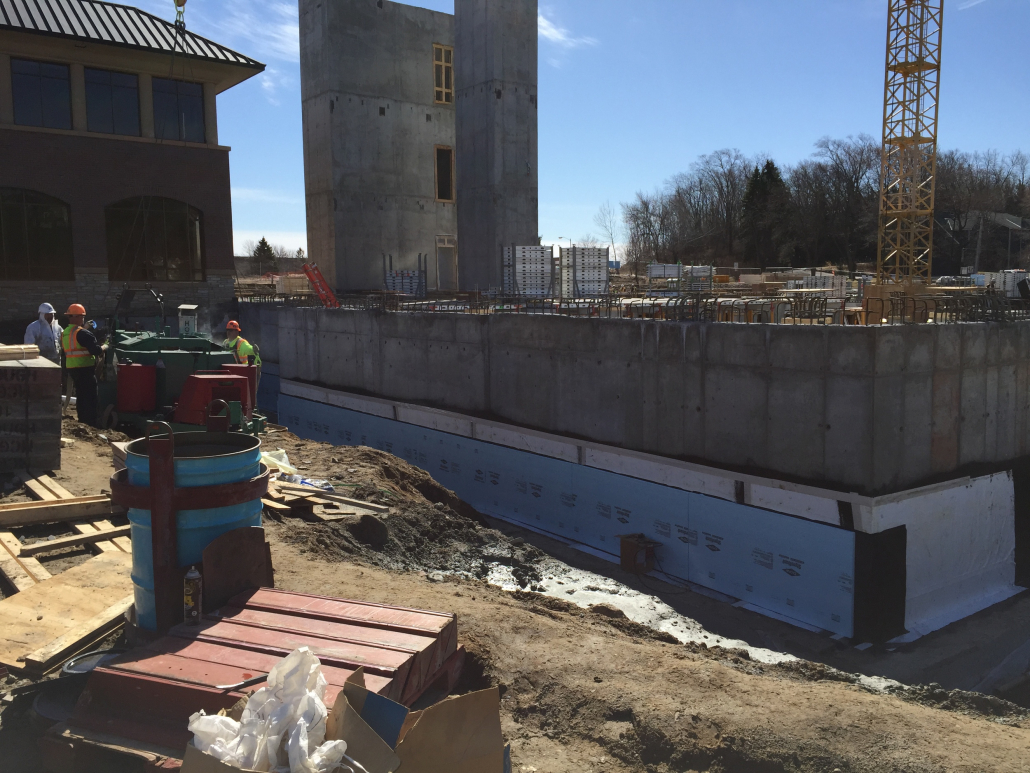
The building envelope of a high-rise is an integrated system, and a waterproofing failure at any point degrades the performance of the whole. A breach that begins as a localized leak does not stay localized: it admits water that migrates through the assembly, compromises the systems it contacts, and sets off a chain of structural, thermal, and operational consequences that reach well beyond the point of entry. Treating a waterproofing failure as an isolated repair — patching where water appears — misunderstands how the envelope works and how failures propagate through it. For high-rise and mid-rise projects, envelope performance depends on the continuity of the waterproofing, and that continuity is exactly what a failure destroys.
For general contractors, project managers, and property managers across the GTA and Southern Ontario, understanding how waterproofing failures affect the entire envelope is the basis for both sound construction and effective remediation.
The Envelope as an Integrated System
A building envelope is the continuous barrier that separates the interior from the ground, water, and weather. It comprises below-grade waterproofing, above-grade wall and cladding assemblies, roofing, and the transitions that connect them, along with the thermal insulation and air and vapour control layers integrated into these assemblies. Waterproofing is the water-control function woven through the entire envelope, and its defining requirement is continuity: water is excluded only if the barrier is unbroken across every surface and transition.
Because the envelope is integrated, its components do not fail in isolation. Water that breaches the waterproofing interacts with the structural, thermal, and control layers around it, so a failure of the water-control function becomes a failure of envelope performance more broadly.
How a Localized Failure Propagates
The most important characteristic of waterproofing failures is that water does not stay where it enters. Having breached the barrier, water follows gravity and the paths of least resistance through the assembly — tracking along the underside of slabs, running down structural elements, migrating laterally within wall cavities and beneath membranes, and travelling along pipes and conduits. The point where water appears is frequently far from the point where it entered, which is why chasing the visible symptom so often fails to resolve the problem.
This propagation means a single breach can affect a wide area and multiple systems. Water entering at a podium detail may saturate insulation across a broad zone, reach reinforcing steel in the slab, and emerge in an occupied space several metres away — three distinct problems from one failure. The localized breach and the widespread consequence are connected by the water’s ability to travel.
Structural Consequences
The most serious envelope consequence of waterproofing failure is structural. Water reaching embedded reinforcing steel — particularly water carrying chlorides — initiates corrosion. Corroding steel expands, cracking and spalling the surrounding concrete and progressively reducing structural capacity. In a high-rise, this affects the below-grade structure, podium slabs, and any concrete the migrating water reaches. Because the water travels, the structural damage is not confined to the area beneath the breach but extends along the pathways the water follows, and because it develops out of sight, it often advances significantly before discovery.
Thermal and Control-Layer Consequences
Waterproofing failures degrade the envelope’s thermal and moisture-control performance. Wet insulation loses much of its thermal resistance, so water intrusion creates zones of reduced R-value that increase heat loss and can cause condensation as temperature gradients shift. Moisture in the assembly also compromises air and vapour control layers, further undermining envelope performance and energy efficiency. Sustained moisture creates conditions for mould growth within the assembly, which affects indoor air quality and generates remediation obligations independent of the original water problem. A failure of the water-control layer thus cascades into the thermal and air-control functions the envelope is also meant to provide.
Operational and Occupancy Consequences
Envelope failures reach the building’s occupants and operations. Water emerging in occupied units, commercial tenancies, corridors, and amenity spaces causes damage to finishes and contents, generates tenant complaints, and can render spaces unusable. Water reaching electrical rooms, elevator shafts, and mechanical spaces can take building systems out of service, with consequences disproportionate to the size of the original breach. For the building operator, a waterproofing failure is rarely just a maintenance item — it is a disruption to the building’s function and to the experience of its occupants.
The Escalating Cost of Envelope Failures
Because waterproofing failures propagate and compound, their cost escalates sharply with time. A breach addressed promptly — while the consequence is still confined near the entry point — may require only a localized membrane, sealant, or joint repair. Left unaddressed, the same breach saturates insulation, corrodes reinforcing, damages interiors, and spreads along the water’s pathways, transforming a modest repair into concrete rehabilitation, insulation and finish replacement, and mould remediation across a wide area. The integrated nature of the envelope means the cost curve is steep: the longer water acts, the more systems it compromises and the larger the eventual scope.
Preventing Envelope Failures
Because envelope performance depends on waterproofing continuity, preventing failures means protecting that continuity at every stage. In new construction, this means treating the envelope as an integrated barrier: selecting appropriate systems for each condition, detailing the transitions between them explicitly, coordinating the trades that install and tie into one another’s work, protecting completed waterproofing from damage, and verifying concealed assemblies before they are covered. Interfaces and penetrations — where continuity is most easily broken — deserve particular attention.
In existing buildings, prevention means proactive assessment to find deficiencies before they propagate, and accurate diagnosis of the entry point rather than treatment of the symptom when leaks occur. Injection systems can restore continuity at active leaks in below-grade and concrete elements from the interior, and localized membrane, coating, sealant, and joint repairs address breaches before they widen. In both cases, the goal is the same: restore and maintain the unbroken barrier on which envelope performance depends.
Protecting Envelope Performance with Nusite Group
Nusite Group protects and restores building envelope performance across the full range of waterproofing scopes — below-grade, podium, parking, and structural — on high-rise, mid-rise, institutional, and industrial buildings throughout the GTA and Southern Ontario, with field experience since 1990. As a fully bonded specialty contractor, licensed across Ontario and insured to $10 million in liability coverage, we support new construction from preconstruction review through verified installation and diagnose and remediate envelope failures in existing buildings, with injection capability to restore continuity at active leaks.
Request a consultation or building assessment to protect the envelope performance of your project or property.