What Are Traffic Coating Systems and Where Are They Used?
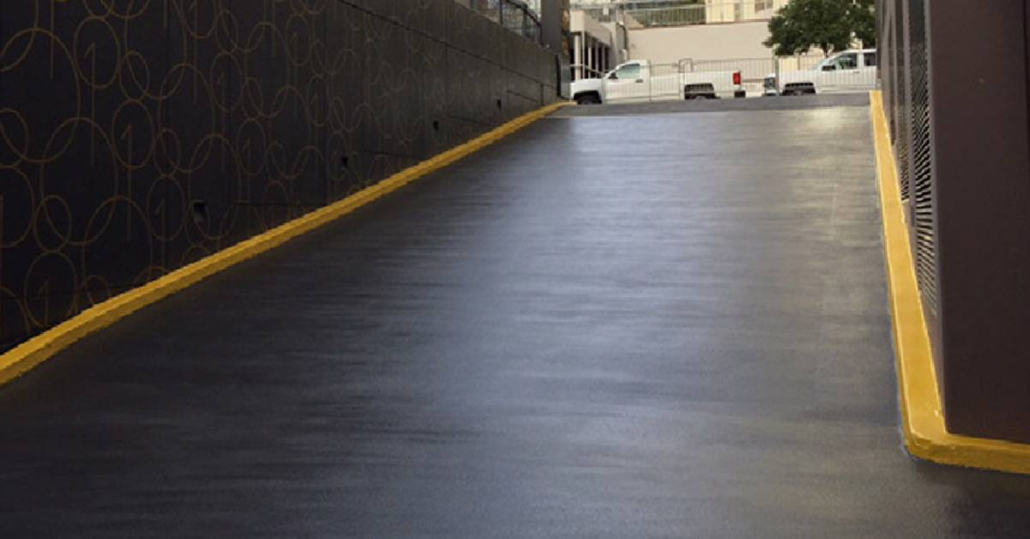
Traffic coating systems are fluid-applied elastomeric membranes installed over trafficked concrete surfaces to provide waterproofing, crack-bridging, and wear resistance in a single continuous assembly. They are used wherever vehicles or pedestrians travel across structural concrete that must remain watertight — most commonly suspended parking slabs, ramps, podium decks, plazas, and loading areas. Unlike concealed waterproofing membranes, traffic coatings serve as both the barrier and the wearing surface, which is why their specification and installation demand a different set of considerations from conventional membrane work.
For general contractors, project managers, and property managers responsible for commercial and institutional structures across the GTA and Southern Ontario, traffic coatings represent one of the highest-leverage protective investments available — and one of the most frequently misspecified.
How a Traffic Coating System Is Built
A traffic coating is a system, not a single product. A typical vehicular assembly consists of four functional layers, each applied in sequence over prepared concrete:
Primer. Establishes adhesion to the concrete substrate and manages surface porosity. Primer selection depends on substrate moisture content, surface profile, and the base coat chemistry.
Base coat. The waterproofing and crack-bridging layer. This elastomeric membrane carries the system’s movement capability, allowing it to span hairline cracks that develop in the slab without rupturing.
Intermediate or wear coat. A tougher layer broadcast with aggregate — typically silica sand or a proprietary equivalent — that provides abrasion resistance and slip resistance under tire loading.
Top coat. Locks the aggregate in place, provides UV resistance and colour, and forms the sacrificial surface that wears over time. Because the top coat is the layer that degrades first, a system approaching the end of its life can often be recoated rather than replaced — provided the deterioration is caught before the wear course is breached.
Pedestrian-traffic assemblies use thinner build-ups with lighter aggregate loading, while heavy-duty zones such as turning areas and ramps require increased film thickness and aggregate density.
Common Traffic Coating Materials
Polyurethane systems are the workhorse of the commercial market, valued for elongation, crack-bridging capability, and proven performance in freeze-thaw climates. Aromatic urethanes are typically used for base coats and aliphatic urethanes for top coats, since aliphatic chemistry resists UV degradation and colour change.
Polyurea and hybrid systems cure rapidly and offer high tensile strength, making them suitable where return-to-service windows are tight. They demand precise application equipment and experienced crews.
Methyl methacrylate (MMA) systems cure in a fraction of the time of urethanes and can be installed at low temperatures, which makes them valuable for cold-weather work and for facilities that cannot tolerate extended closures. Their odour during installation requires ventilation planning in enclosed structures.
Epoxy-urethane hybrids are used where chemical resistance or high compressive loading governs, such as loading docks and industrial floors subject to point loads.
Where Traffic Coating Systems Are Used
Suspended parking slabs. Any parking level with occupied or structural space below requires waterproofing, and traffic coatings are the standard solution. Slab-on-grade levels are often left uncoated or treated with penetrating sealers, since there is no space below to protect.
Ramps and turning bays. These experience the most aggressive tire scuffing and torque loading in a structure and generally warrant a heavier-duty system than adjacent flat areas.
Podium decks and plaza levels. Where podium surfaces carry vehicle or pedestrian traffic directly, traffic coatings provide the exposed waterproofing layer over occupied space below.
Terraces, balconies, and walkways. Pedestrian-grade systems protect structural slabs at amenity levels and exterior circulation routes.
Loading docks, mechanical rooms, and service areas. These zones combine water exposure with chemical spillage and concentrated loading, and often require specialized chemistry.
Why Trafficked Concrete Needs Protection
Reinforced concrete relies on an alkaline environment to keep embedded reinforcing steel passive. Chlorides from de-icing salts — carried into structures on vehicles throughout Southern Ontario winters — dissolve in meltwater, penetrate the concrete, and accumulate at the reinforcing steel. Once chloride concentration at the steel exceeds the corrosion threshold, typically cited at roughly 0.2 percent by weight of cement, corrosion initiates.
Corroding steel expands to several times its original volume, generating internal pressure that cracks and delaminates the surrounding concrete. Cracking admits more chloride-laden water, and the cycle accelerates. A traffic coating interrupts this process at the surface, keeping chlorides out of the concrete matrix entirely — which is why coating renewal is fundamentally cheaper than the concrete rehabilitation that follows its neglect.
Selection Criteria for Project Teams
Exposure zone. Traffic patterns within a single structure vary widely. Specifying one uniform system across parking stalls, drive aisles, ramps, and entry areas either overbuilds the low-wear zones or underbuilds the high-wear ones.
Movement and cracking. Structures with active cracking or significant thermal movement require systems with higher elongation and, at wider cracks, detail treatment or crack routing before coating.
Return-to-service requirements. Operating facilities with limited closure windows may justify the premium of fast-cure chemistry.
Installation season. Most urethane systems have minimum application temperatures and substrate moisture limits, which compresses the practical construction season in Ontario. Cold-weather chemistry or temporary enclosure and heating may be necessary for late-season work.
Substrate condition. Coatings do not repair concrete. Delaminated, spalled, or chloride-contaminated concrete must be removed and restored before any system is applied.
Installation Requirements That Determine Performance
Traffic coating failures are far more often installation failures than product failures. Four conditions govern the outcome:
Surface preparation. The substrate must be shot-blasted or mechanically profiled to the manufacturer’s specified surface profile, removing laitance, curing compounds, and prior coatings.
Moisture content. Concrete moisture and vapour drive must fall within manufacturer limits. Applying over a substrate that is still releasing moisture is a leading cause of blistering and debonding.
Ambient and surface temperature. Application outside the specified temperature range, or when the surface is near the dew point, compromises cure and adhesion.
Film thickness verification. Wet film measurement during application and adhesion testing on completed sections confirm that the installed system matches the specification rather than the estimate.
Service Life and Maintenance Planning
Traffic coating systems are renewable components with finite service lives, typically in the range of seven to fifteen years depending on chemistry, traffic volume, and installation quality. Managed proactively, a worn system is cleaned, spot-repaired, and recoated at the top coat level — a fraction of the cost of full removal and replacement. Managed reactively, the wear course is breached, water reaches the concrete, and the next intervention becomes a concrete rehabilitation project.
Property and facility managers benefit from annual visual inspections targeting ramps, turning areas, drain surrounds, and joint terminations, where wear concentrates first.
Traffic Coating Systems with Nusite Group
Nusite Group has installed and renewed traffic coating systems on parking structures, podium decks, and institutional facilities throughout the GTA and Southern Ontario since 1990. As a fully bonded specialty contractor, licensed across Ontario and insured to $10 million in liability coverage, we deliver traffic coatings as integrated scopes alongside concrete rehabilitation and expansion joint replacement — so the completed surface performs as one continuous protective system.
Request a consultation to review traffic coating requirements on your project or property.