How does blindside waterproofing compare to traditional exterior waterproofing?

Below-grade waterproofing represents a critical building envelope decision in commercial construction, yet the fundamental differences between blindside and traditional exterior waterproofing applications remain unclear to many property managers and general contractors. While both approaches aim to prevent groundwater infiltration into below-grade spaces, the installation sequences, quality control capabilities, performance characteristics, and long-term risk profiles differ substantially. For property managers, facility directors, and general contractors responsible for commercial office buildings, mixed-use developments, institutional facilities, and urban infill projects across the Greater Toronto Area, understanding these differences ensures appropriate waterproofing system selection, realistic performance expectations, and informed risk management on constrained construction sites where blindside applications may be necessary or where traditional exterior methods provide superior alternatives.
Fundamental Installation Sequence Differences
The defining distinction between blindside and traditional exterior waterproofing lies in when and how membranes are applied relative to foundation wall construction.
Traditional Exterior Waterproofing Sequence
Traditional exterior waterproofing follows a logical, accessible installation progression that has been the standard approach for generations of commercial construction. After excavation creates the building footprint, foundation footings are poured and cured. Foundation walls are then constructed using formed concrete, precast panels, or masonry assemblies. Once walls are complete and forms are removed, the exterior surfaces become accessible for waterproofing membrane application.
This sequence allows contractors to work on vertical concrete surfaces that are fully visible and accessible from the excavation. Waterproofing crews can inspect the substrate, prepare surfaces through cleaning or profiling, apply primer coatings, install waterproofing membranes using their preferred methods, and verify complete coverage before proceeding. After membrane installation and any required testing, protection boards are fastened over the waterproofing, and backfill operations restore soil against the foundation wall.
The critical advantage of this sequence is complete visibility and accessibility during every installation step. Quality control can verify substrate conditions before membrane application, inspect membrane coverage during installation, and test waterproofing integrity before concealment. If defects are discovered, repairs proceed easily while the membrane remains exposed and accessible.
Blindside Waterproofing Sequence
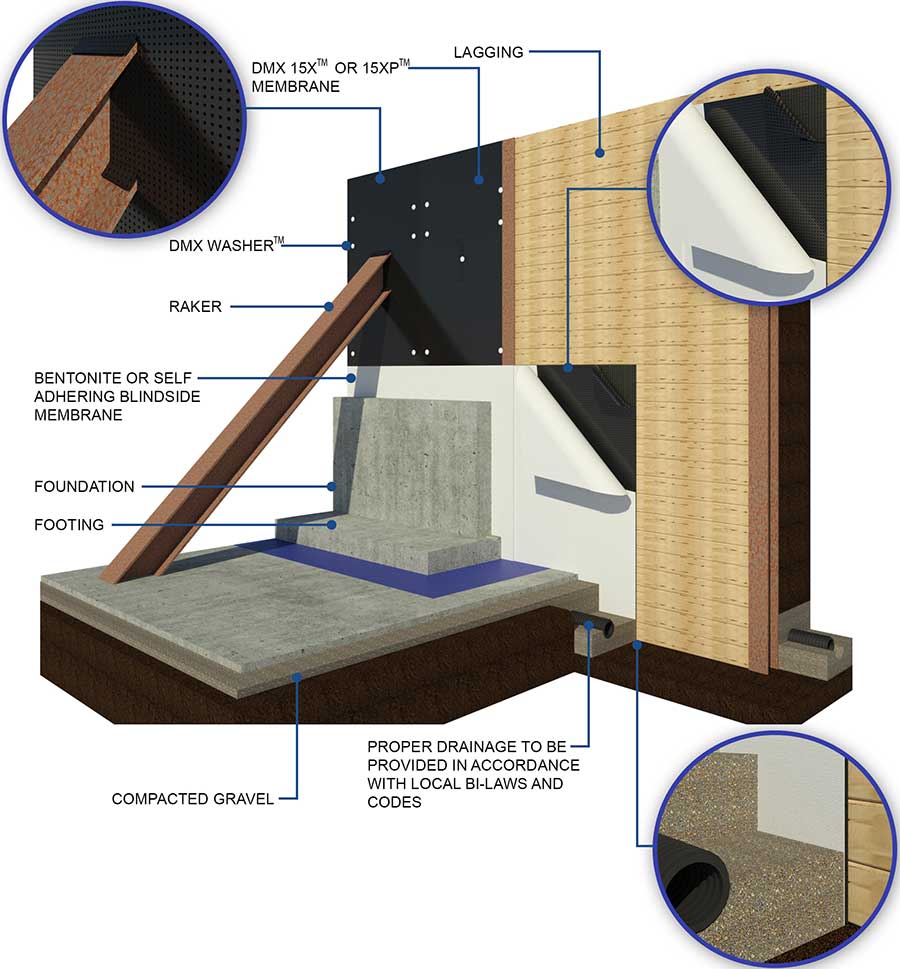
Blindside waterproofing reverses this traditional sequence out of necessity when site conditions prevent conventional approaches. Excavation support systems—sheet piling, soldier piles with lagging, or permanent foundation walls—are installed at the excavation perimeter first. Waterproofing membranes are then applied directly to these temporary support systems before any foundation wall construction occurs.
After membrane installation on the excavation support, structural foundation walls are poured against the waterproofing. Concrete placement occurs with the waterproofing membrane sandwiched between the excavation support and the new foundation wall. The membrane becomes permanently inaccessible once concrete is placed—creating the “blind” installation that defines this approach.
Critical Implications:
This reversed sequence creates fundamental quality control challenges. Once foundation concrete is poured, the waterproofing membrane can never be inspected, tested, or accessed for repair. Any installation defects, damage during concrete placement, or future membrane failures become permanent problems with extremely limited remediation options. Property managers and general contractors must accept higher risk with blindside applications because post-installation verification is impossible.
The approach also constrains material selection since not all waterproofing technologies function reliably when installed to temporary supports and subjected to concrete placement pressures. Systems must be specifically engineered and proven for blindside use rather than assuming any exterior waterproofing product will perform adequately in this demanding application.
Performance Comparison: Reliability and Longevity
Traditional Exterior Waterproofing Performance
Traditional exterior waterproofing benefits from installation conditions that promote reliable, long-term performance. Membranes applied to cured, stable concrete substrates develop optimal bonds and maintain integrity over decades of service. The concrete surface provides a permanent, dimensionally stable substrate that won’t shift, settle, or change significantly after membrane application.
Waterproofing membranes in traditional applications remain in compression from groundwater pressure, which actually enhances their waterproofing effectiveness. Water pressure pushes membranes against foundation walls rather than attempting to pull them away from substrates. This pressure advantage means minor installation imperfections often self-seal as water pressure compresses membranes into intimate contact with substrates.
Service Life Expectations:
Properly installed traditional exterior waterproofing systems routinely provide 30 to 50 year service life, with some premium membranes exceeding 50 years. Rubberized asphalt sheet membranes, modified bitumen systems, and HDPE or PVC sheet membranes all demonstrate multi-decade performance when installed using conventional methods on stable foundation walls. This proven longevity provides property managers with confidence in lifecycle cost analysis and capital planning.
The systems tolerate normal foundation settlement and structural movement within design parameters without membrane failure. Thermal cycling, freeze-thaw conditions, and hydrostatic pressure variations all occur within the performance envelope of quality exterior waterproofing systems. Protection boards shielding membranes from backfill damage and mechanical impacts further extend service life.
Blindside Waterproofing Performance Challenges
Blindside waterproofing operates under more demanding conditions that can affect long-term performance and reliability. Membranes installed on temporary excavation supports rather than permanent foundation walls face substrate stability concerns. Sheet piling may deflect under soil pressure, wood lagging can warp or deteriorate, and shotcrete surfaces may be irregular—all creating challenging conditions for waterproofing membrane adhesion and continuity.
Concrete placement against waterproofing membranes subjects them to significant pressures and potential mechanical damage. Concrete mix design, placement methods, and consolidation techniques all affect whether membranes survive concrete operations without damage. Even with careful installation and concrete placement procedures, some membrane displacement or damage risk exists that doesn’t occur with traditional exterior applications.
Performance Variables:
The permanent inaccessibility of blindside membranes means any installation defects or concrete-induced damage cannot be identified and corrected. Unlike traditional exterior systems where pre-backfill testing and inspection can verify waterproofing integrity, blindside installations rely entirely on process control during installation. This creates performance uncertainty absent from traditional approaches.
However, when properly executed using proven blindside-rated materials and experienced installation crews, blindside waterproofing can deliver reliable performance approaching traditional systems. Service life expectations of 20 to 40 years are reasonable for quality blindside installations, though the higher risk profile and performance variability compared to traditional methods justifies conservative assumptions in lifecycle planning.
Quality Control and Verification Capabilities
Traditional Exterior Waterproofing Quality Assurance
Traditional exterior waterproofing allows comprehensive quality control throughout installation, providing multiple verification opportunities before membranes become inaccessible. Substrate inspection confirms concrete curing, surface condition, and moisture levels meet waterproofing manufacturer specifications. Surface preparation can be verified ensuring proper profile, cleanliness, and defect repair before membrane application begins.
During membrane installation, continuous inspection monitors proper overlap dimensions, seam sealing techniques, fastener patterns, and membrane terminations at penetrations and transitions. Third-party inspections provide independent verification of installation quality when specified. Any deficiencies identified during installation can be corrected immediately while materials remain exposed and accessible.
Pre-Backfill Testing:
Perhaps most importantly, traditional exterior waterproofing enables pre-backfill performance testing that blindside applications cannot accommodate. Flood testing involves temporarily damming foundation walls and filling excavation zones with water to specified depths, then inspecting interior foundation surfaces for any water infiltration. This definitive waterproofing verification occurs before backfill conceals membranes, allowing repairs if leaks are discovered.
Electronic leak detection can identify membrane defects using low-voltage electrical testing or other non-destructive methods. Pull-off adhesion testing verifies membrane bond strength to substrates. These quality assurance measures provide confidence in waterproofing performance before construction proceeds—eliminating the uncertainty inherent in blindside applications where post-installation verification is impossible.
Photographic documentation establishes complete installation records showing membrane coverage, detail execution, and overall quality before concealment. This documentation supports warranty activation, future reference if building issues arise, and property management asset records.
Blindside Waterproofing Quality Control Limitations
Blindside waterproofing quality control faces fundamental limitations since membrane installation occurs before concrete placement makes verification impossible. Quality assurance must rely entirely on process control—ensuring proper materials, experienced crews, and careful installation procedures—rather than product testing and verification.
Pre-installation material verification confirms that waterproofing products are specifically rated for blindside use rather than standard exterior waterproofing materials. Installation monitoring documents proper surface preparation on excavation supports, correct membrane overlap and sealing, adequate fastening preventing displacement, and protection measures before concrete placement.
Limited Testing Options:
Some limited testing can occur on blindside installations. Small test sections may undergo flood testing before full foundation wall construction, providing some performance verification though not comprehensive system validation. Installation crews can document membrane continuity through visual inspection before formwork and reinforcing steel installation obscures waterproofing.
However, once concrete is placed, absolutely no verification is possible. The membrane becomes permanently inaccessible and untestable. This means any installation errors, concrete placement damage, or material defects go undetected until building occupancy when leaks may appear—years after construction when remediation proves extremely difficult and expensive.
General contractors and property managers must accept this higher risk profile with blindside applications. Mitigation strategies include specifying proven blindside systems with documented performance history, requiring experienced contractors with blindside installation expertise, implementing rigorous process control and documentation, and considering redundant waterproofing approaches providing backup protection.

Cost Comparison and Budget Implications
Material Cost Differences
Waterproofing materials specifically engineered and rated for blindside applications typically command 20 to 50 percent premiums over comparable exterior waterproofing products. This reflects enhanced performance requirements, specialized formulations, and manufacturer liability accepting blindside use. Bentonite panel systems, self-adhered rubberized asphalt membranes, and fluid-applied products designed for blindside installation all cost more than standard versions.
Premium materials for blindside applications include aggressive adhesive systems ensuring bond to diverse excavation support substrates, enhanced puncture resistance surviving concrete placement, proven performance under compression from concrete pressure, and self-healing properties compensating for minor installation imperfections. These performance enhancements justify material cost premiums for the demanding blindside application conditions.
Traditional exterior waterproofing material selection encompasses broader options including economy and mid-range products appropriate for conventional installation conditions. Standard rubberized asphalt membranes, conventional modified bitumen systems, and basic fluid-applied products all function adequately when installed using traditional methods—providing cost flexibility based on project budgets and performance requirements.
Installation Labor and Complexity
Blindside waterproofing installation generally costs 30 to 60 percent more than traditional exterior applications due to increased complexity, challenging working conditions, and enhanced quality control requirements. Waterproofing crews must work on temporary excavation supports that may be irregular, damp, or difficult to access. Installation proceeds in confined excavation spaces before foundation walls provide working platforms.
Protection of installed membranes during subsequent construction activities requires careful coordination and adds labor costs. Reinforcing steel installation, formwork placement, and concrete pumping operations all create membrane damage risk necessitating protection boards, restricted access zones, and construction sequencing that doesn’t apply to traditional exterior work.
Overall Project Cost Impact:
Total project cost comparison must account for excavation and site work differences between approaches. Blindside waterproofing enables construction directly to property lines without exterior working space, potentially eliminating excavation and backfill operations that traditional methods require. For constrained urban sites, this excavation savings may offset waterproofing premium costs.
Property managers should expect blindside waterproofing to cost 50 to 150 percent more than traditional exterior systems when comparing equivalent foundation areas under similar conditions. However, site-specific factors including excavation costs, adjacent property impacts, and schedule considerations affect total project economics. Comprehensive cost analysis comparing all project implications determines whether blindside or traditional approaches provide better value for specific applications.
Risk Assessment and Mitigation Strategies
Traditional Exterior Waterproofing Risk Profile
Traditional exterior waterproofing presents relatively low risk when properly designed and installed using proven systems and qualified contractors. The visible, accessible installation allows real-time quality control identifying and correcting deficiencies before concealment. Pre-backfill testing verifies performance eliminating uncertainty about waterproofing effectiveness.
If waterproofing failures do occur after building occupancy, traditional exterior membranes can theoretically be accessed through excavation for repair. While excavation proves expensive and may face site constraints in developed areas, the possibility exists unlike permanently inaccessible blindside systems. This repairability provides risk mitigation absent from blindside approaches.
Primary Risk Factors:
Traditional exterior waterproofing risks relate primarily to foundation settlement, structural movement exceeding design parameters, and mechanical damage from backfill operations or utility installations. These risks are well-understood with established mitigation strategies including proper protection board installation, controlled backfill procedures, and utility coordination ensuring excavation activities don’t damage waterproofing.
Material selection from established manufacturers with proven track records, experienced contractor installation, and comprehensive quality control protocols reduce traditional exterior waterproofing risk to minimal levels. Property managers can reasonably expect reliable performance when these fundamentals are addressed.
Blindside Waterproofing Risk Mitigation
Blindside waterproofing’s higher inherent risk requires proactive mitigation strategies that property managers and general contractors should implement on all such projects. Material selection should favor proven systems with documented blindside performance history rather than experimenting with unproven products. Manufacturer technical support during design and installation provides valuable expertise.
Contractor qualifications become critical for blindside success. Specification should require demonstrated blindside installation experience, references from previous similar projects, and crew training in blindside techniques. Some manufacturers offer certification programs for contractors installing their blindside systems—these credentials indicate qualified installers.
Enhanced Oversight:
Third-party inspection services provide independent quality verification during critical installation phases. Inspectors monitor substrate preparation, membrane application, protection board installation, and concrete placement procedures ensuring compliance with specifications. While inspectors cannot verify the concealed final result, they document proper installation process providing reasonable confidence in likely performance.
Some projects specify redundant waterproofing approaches combining blindside exterior systems with interior negative-side waterproofing treatments. This belt-and-suspenders strategy provides backup protection if exterior blindside systems develop leaks. While redundancy increases costs substantially, it essentially eliminates waterproofing failure risk for critical applications where moisture infiltration would cause severe consequences.
Contingency planning should address potential waterproofing failures. Interior drainage systems, dehumidification provisions, and moisture monitoring capabilities provide fallback moisture management if blindside waterproofing proves inadequate. These provisions add project cost but reduce long-term risk.
Appropriate Applications: When to Use Each Approach
Traditional Exterior Waterproofing Applications
New construction projects should default to traditional exterior waterproofing unless specific site constraints necessitate blindside approaches. Buildings positioned away from property lines, projects with excavation access around foundation perimeter, and sites without adjacent structures all enable traditional methods providing superior quality control, performance verification, and long-term reliability.
The approach suits all below-grade applications where exterior access exists including parking structures, building foundations with occupied spaces below grade, elevator pits, mechanical vaults, and utility tunnels. Any application where waterproofing integrity is critical and exterior access can be achieved should specify traditional exterior methods over blindside alternatives.
Strategic Advantages:
For property owners with long-term holding strategies and focus on lifecycle performance, traditional exterior waterproofing justifies any incremental site work costs through superior durability, reduced risk, and proven reliability. Buildings housing critical operations, sensitive equipment, or valuable contents benefit from the performance advantages traditional methods provide.
Projects where excavation support systems are temporary and will be removed after foundation construction automatically favor traditional exterior waterproofing since membranes can be applied to completed foundation walls. This represents the vast majority of suburban and low-density commercial construction where property line setbacks provide working space.
Blindside Waterproofing Necessity Indicators
Blindside waterproofing becomes necessary when property line construction prevents exterior access to foundation walls. Urban infill development, downtown Toronto projects, and high-density mixed-use buildings constructed to lot boundaries cannot accommodate traditional exterior waterproofing. Zero-lot-line commercial development, where maximizing building footprint within property limits drives design, requires blindside approaches on property line walls.
Adjacent existing structures create blindside requirements when neighboring buildings have foundations at or near shared property lines. Excavation would undermine adjacent foundations requiring extensive underpinning, making exterior waterproofing access technically infeasible or prohibitively expensive. Party walls, buildings sharing foundations, and structures constructed directly against neighbors all necessitate blindside waterproofing.
Permanent Excavation Support:
Certain geotechnical or site conditions require permanent excavation support systems that preclude traditional exterior waterproofing. Secant pile walls, tangent pile walls, or diaphragm walls that become permanent foundation elements must receive waterproofing on their interior faces before foundation walls are constructed—definitionally a blindside application.
Contaminated soil sites sometimes specify permanent excavation support avoiding soil disturbance during construction. Environmental remediation strategies may require minimal earth moving, driving permanent support systems with interior blindside waterproofing rather than conventional excavation, waterproofing, and backfill sequences.
Heritage buildings or archaeological sites where exterior excavation might damage significant resources favor blindside approaches preserving existing conditions. Occupied buildings remaining operational during foundation work or underpinning projects may use blindside waterproofing minimizing disruption and maintaining existing grade conditions.
Material Options Comparison
Traditional Exterior Waterproofing Material Flexibility
Traditional exterior waterproofing accepts the broadest range of waterproofing technologies, allowing system selection optimized for specific performance requirements, substrate conditions, and budget parameters. Sheet membrane systems including rubberized asphalt, modified bitumen, HDPE, and PVC all perform reliably on vertical concrete substrates installed using conventional methods.
Fluid-applied membranes using polyurethane, modified asphalt emulsion, or cementitious formulations create seamless waterproofing suitable for complex geometries or numerous penetrations. Bentonite waterproofing systems function effectively on traditional exterior applications. Crystalline waterproofing provides integrated concrete treatment approach. This material diversity allows engineers and contractors to select optimal systems for each project’s unique conditions.
Cost Optimization:
Material selection for traditional exterior applications can balance performance and cost across product tiers. Economy materials suitable for low-criticality applications, mid-range systems for typical commercial construction, and premium materials for demanding conditions all have appropriate uses. Project-specific requirements drive system selection rather than limitation to only premium products capable of surviving blindside conditions.
Installation method flexibility further expands options. Self-adhered systems, torch-applied membranes, mechanically fastened assemblies, and spray-applied coatings all function in traditional exterior applications. Contractors can leverage their preferred installation techniques and equipment rather than being constrained to specific methods necessary for blindside work.
Blindside Waterproofing Material Constraints
Blindside applications limit material selection to systems specifically engineered and proven for installation on excavation supports and survival of concrete placement operations. Not all exterior waterproofing products function reliably in blindside conditions—manufacturers must explicitly rate products for blindside use and accept liability for this demanding application.
Common blindside systems include bentonite panel membranes designed for mechanical fastening to sheet piling or lagging, self-adhered rubberized asphalt membranes with aggressive adhesives bonding to diverse substrates, fluid-applied membranes creating seamless barriers on irregular surfaces, and certain PVC or HDPE sheet membranes with appropriate backing and installation methods.
Performance Requirements:
Blindside materials must adhere reliably to varied excavation support substrates including steel sheet piling, wood or steel lagging, shotcrete surfaces, and existing concrete walls. This versatility requirement eliminates many systems optimized only for smooth, dry concrete substrates. Materials must survive concrete placement pressures, heat from concrete hydration, and potential concrete vibration without displacement, damage, or bond failure.
The limited material palette for blindside applications often increases costs and may constrain optimization for specific conditions. However, the available proven systems provide adequate performance when properly installed—the constraint is selection limitation rather than inadequate technology.
Long-Term Maintenance and Accessibility
Traditional exterior waterproofing, once concealed by backfill, becomes largely inaccessible similar to blindside systems. However, at grade transitions where membranes may be partially exposed, traditional systems remain theoretically accessible through excavation. If waterproofing failures occur requiring remediation, excavation can expose traditional exterior membranes for repair or replacement—though this proves expensive and may face site constraints.
Interior spaces can be monitored for any water infiltration indicating waterproofing failure. Moisture mapping, infrared thermography, and visual inspection identify leak locations. For traditional exterior systems, targeted excavation can address specific failure points. Full foundation excavation for complete membrane replacement represents an extreme scenario rarely necessary with quality traditional installations.
Blindside Remediation Limitations:
Blindside waterproofing failures present far more challenging remediation scenarios. Exterior excavation to access membranes proves nearly impossible since the conditions necessitating blindside approaches—property lines, adjacent structures—remain permanent constraints preventing excavation. The membrane sandwiched between excavation support and foundation wall cannot be reached without demolishing the foundation itself.
Interior negative-side waterproofing becomes the primary remediation approach for failed blindside systems. Crystalline waterproofing, cementitious coatings, or cavity drainage systems applied to interior foundation surfaces manage water infiltration from exterior. While these interior treatments control visible leaks, they don’t restore the exterior membrane function or protect foundation walls from moisture exposure.
The remediation difficulty emphasizes the critical importance of quality blindside installation initially. Unlike traditional exterior systems where post-construction repair remains possible though expensive, blindside failures may be essentially irreparable. This permanence drives the enhanced quality control, proven materials, and experienced contractor requirements appropriate for blindside projects.
Frequently Asked Questions
When should I insist on traditional exterior waterproofing instead of accepting blindside approaches?
Insist on traditional exterior waterproofing whenever site conditions reasonably permit exterior foundation access. Buildings housing critical operations, sensitive equipment, archives, or valuable contents justify investment in superior quality control and performance verification traditional methods provide. Properties with long ownership horizons where lifecycle performance outweighs initial cost should specify traditional approaches even if excavation proves challenging. New construction on sites with setbacks from property lines, without adjacent structures, or with removable excavation support systems should default to traditional methods. Accept blindside approaches only when genuine constraints make traditional waterproofing impossible or economically unreasonable—true property line construction, permanent adjacent structures, or permanent excavation support systems. Challenge specifications proposing blindside waterproofing on projects where traditional access exists, as cost savings from reduced excavation may not justify performance and risk trade-offs over building service life.
How much more does blindside waterproofing cost compared to traditional exterior methods?
Blindside waterproofing typically costs 50 to 150 percent more than traditional exterior systems when comparing equivalent foundation areas. Material premiums account for 20 to 50 percent increases, with blindside-rated products costing more than standard exterior waterproofing materials. Installation labor adds 30 to 60 percent due to challenging working conditions, enhanced quality control, and construction coordination requirements. Protection measures, specialized installation techniques, and risk mitigation protocols further increase costs. However, total project economics must consider excavation and site work differences. Blindside applications eliminating exterior working space may reduce or eliminate excavation costs that traditional methods require. For constrained urban sites where property acquisition, underpinning, or excavation support would be necessary for traditional access, blindside approaches may prove more economical overall despite higher waterproofing costs. General contractors should evaluate comprehensive project costs including all site work implications rather than comparing waterproofing installation costs in isolation.
Can blindside waterproofing be as reliable as traditional exterior waterproofing?
When properly designed and installed using proven materials and experienced contractors, blindside waterproofing can approach traditional exterior system reliability, though inherent limitations create higher performance variability and risk. Quality blindside installations using manufacturer-approved systems, qualified installation crews, and rigorous process control deliver 20 to 40 year service life—acceptable for most commercial applications. However, the inability to verify installation quality before concrete placement and permanent inaccessibility for inspection, testing, or repair create uncertainty absent from traditional approaches. Property managers should expect slightly higher failure risk with blindside systems and implement appropriate mitigation including material selection favoring proven products, contractor qualification requirements, third-party inspection, and potentially redundant waterproofing for critical applications. Blindside waterproofing provides essential capability for constrained sites but doesn’t achieve the quality assurance levels that traditional exterior methods with pre-backfill testing deliver.
If blindside waterproofing fails, what remediation options exist?
Remediation options for failed blindside waterproofing are extremely limited since exterior membranes cannot be accessed without foundation demolition. Interior negative-side waterproofing becomes the primary solution including crystalline waterproofing penetrating concrete and blocking water pathways, cementitious waterproofing coatings on interior foundation surfaces, crack injection sealing specific infiltration points, and cavity drainage systems managing water rather than preventing infiltration. These interior treatments control visible leaks protecting occupied spaces but don’t restore exterior waterproofing or protect foundation walls from moisture exposure and potential deterioration. Some buildings install interior drainage systems collecting infiltrating water and directing it to sump pumps for removal. In extreme cases where structural concerns arise from ongoing water exposure, exterior excavation may be attempted if adjacent property access can be negotiated, though this proves prohibitively expensive and often technically impossible. The difficulty of blindside failure remediation emphasizes critical importance of quality initial installation and consideration of redundant waterproofing on buildings where moisture infiltration would cause severe consequences.
Make Informed Waterproofing Decisions
Nusite Group has delivered traditional exterior and blindside waterproofing solutions on commercial office buildings, mixed-use developments, institutional facilities, and urban infill projects across the GTA and Southern Ontario since 1990. Our installations provide reliable below-grade moisture protection using appropriate waterproofing methods matched to site conditions, access constraints, and performance requirements.
Fully bonded, licensed across Ontario, and insured to $10 million in liability coverage, Nusite Group operates as a dependable waterproofing specialist for property managers, facility directors, and general contractors who require expert guidance on below-grade waterproofing strategy selection balancing performance, risk, cost, and practical site constraints on urban commercial projects throughout Toronto and the Greater Toronto Area.
Request a consultation to discuss your below-grade waterproofing requirements or explore how Nusite Group can support your project with traditional exterior membrane systems, blindside waterproofing solutions, or hybrid approaches optimized for your specific building conditions, site constraints, and performance objectives.