Positive Side Waterproofing vs Negative Side Waterproofing

Foundation and below-grade waterproofing represents one of the most critical building envelope decisions in commercial construction, yet the fundamental choice between positive side and negative side waterproofing approaches remains poorly understood by many property managers and general contractors. This distinction determines not just installation methodology but also performance expectations, cost implications, and long-term maintenance requirements.
For property managers, facility directors, and general contractors responsible for commercial office buildings, institutional facilities, parking structures, and mixed-use developments across the Greater Toronto Area, understanding when each waterproofing approach is appropriate—and recognizing the limitations of each—ensures successful below-grade moisture control protecting occupied spaces, mechanical systems, and structural elements from water damage.
Defining Positive Side and Negative Side Waterproofing
The distinction between positive and negative side waterproofing relates to where waterproofing systems are installed relative to water pressure direction and the structural element being protected.
Positive Side Waterproofing
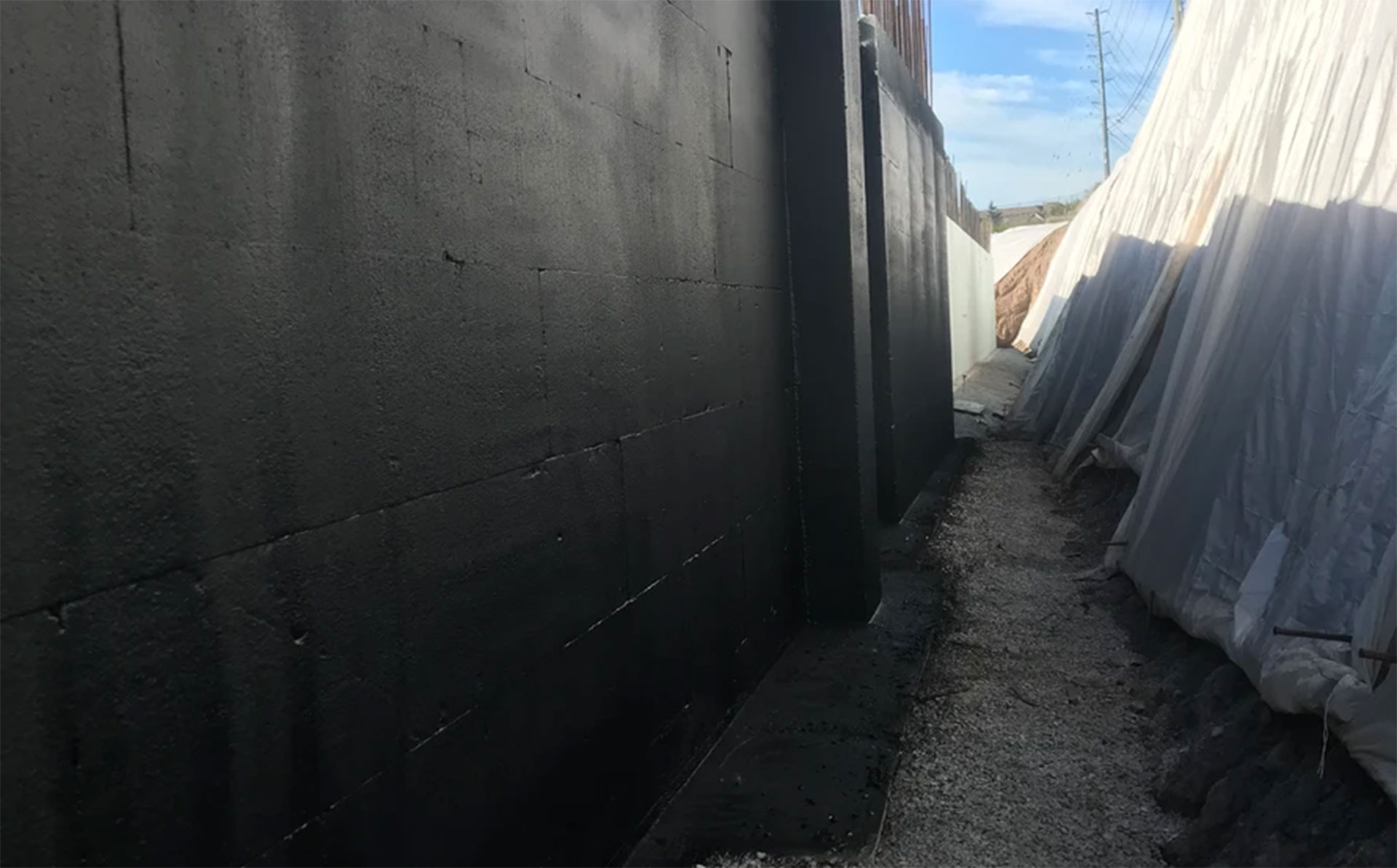
Positive side waterproofing places the waterproofing membrane or system on the exterior face of foundation walls or below-grade structures—the side where water pressure acts and where moisture first contacts the building. This represents the conventional and generally preferred approach for below-grade waterproofing. When groundwater or surface water infiltration flows toward a building foundation, it first encounters the waterproofing membrane on the exterior wall surface before reaching the structural concrete or masonry.
This configuration allows the waterproofing membrane to prevent water from ever entering the structural assembly. The membrane remains in compression from water pressure, which actually improves its waterproofing effectiveness. The structural wall remains dry, protecting embedded reinforcing steel from corrosion and concrete from freeze-thaw damage. Any water that reaches the membrane is diverted by the waterproofing and directed to perimeter drainage systems rather than penetrating into building assemblies.
Positive side systems can be applied during new construction after foundation walls are poured and formed, or added to existing buildings through excavation exposing exterior foundation surfaces. The waterproofing membrane is typically protected by drainage boards, insulation, or protection courses before backfill is placed against the foundation.
Negative Side Waterproofing
Negative side waterproofing installs waterproofing systems on the interior face of foundation walls or below-grade structures—the opposite side from where water pressure acts. Water infiltrates through the structural wall, encountering the waterproofing membrane only after passing through concrete or masonry. The membrane operates under tension from water pressure attempting to pull it away from the substrate rather than compress it against the wall.
This approach becomes necessary when exterior access to foundation walls is impossible or impractical. Urban construction on property lines, adjacent existing structures, permanent excavation support systems, and remedial waterproofing on existing buildings without excavation feasibility all create scenarios requiring negative side solutions. While less ideal than positive side waterproofing from a pure performance perspective, negative side systems provide essential waterproofing capability when exterior applications cannot be executed.
The fundamental challenge with negative side waterproofing is that structural elements remain exposed to water infiltration. Concrete or masonry walls become saturated with moisture even though the interior waterproofing prevents visible water entry into occupied spaces. This moisture exposure can cause concrete deterioration, reinforcement corrosion, and reduced structural durability over time, though at slower rates than completely unwaterproofed foundations.
Performance Comparison: Advantages and Limitations
Positive Side Waterproofing Advantages
Positive side waterproofing delivers several performance benefits making it the preferred approach when site conditions permit. The waterproofing membrane prevents water from ever entering the structural wall assembly, keeping concrete and reinforcing steel dry and protected. This eliminates moisture-related deterioration including freeze-thaw damage, reinforcement corrosion, and efflorescence.
Water pressure acts to compress the membrane against the structural wall, improving waterproofing effectiveness rather than stressing the membrane bond. This pressure advantage means positive side systems are less sensitive to minor installation imperfections—water pressure naturally seals the membrane against the substrate. The structural wall remains dry, maintaining its full design strength and durability without moisture-induced degradation.
System Flexibility:
Positive side waterproofing accepts a wider range of membrane technologies and installation methods compared to negative side applications. Sheet membranes, fluid-applied systems, bentonite panels, and cementitious crystalline products all function effectively on positive side applications. Installation quality control is straightforward because membranes can be inspected before protection boards and backfill conceal them. Flood testing can verify waterproofing integrity before construction proceeds.
The approach addresses water at its source—the exterior building envelope—rather than attempting to manage water after it has already penetrated structural elements. This fundamental advantage makes positive side waterproofing more reliable and durable over building service life.
Positive Side Waterproofing Limitations
Despite its performance advantages, positive side waterproofing faces practical limitations in many commercial construction scenarios. Exterior application requires excavation access to foundation walls, which may be impossible on constrained urban sites, against property lines, or adjacent to existing structures. For existing buildings requiring waterproofing remediation, excavation often proves prohibitively expensive or technically infeasible without underpinning adjacent structures.
Installation timing constraints affect construction schedules. Waterproofing cannot proceed until foundation walls are poured and cured. Weather exposure during installation and before protection creates quality control challenges—rain during membrane application can compromise adhesion and performance. Cold weather limits installation seasons for many membrane types.
Once installed and concealed by backfill, positive side waterproofing becomes inaccessible for inspection, testing, or repair. If leaks develop after building occupancy, locating and repairing failures requires excavation, which in urban environments may be impossible or extremely costly. This inaccessibility emphasizes the importance of quality installation initially, but creates risk if problems develop later.
Negative Side Waterproofing Advantages
Negative side waterproofing’s primary advantage is accessibility. Installation proceeds from building interiors without excavation, underpinning, or disruption to adjacent properties. This makes negative side approaches essential for remedial waterproofing on existing buildings experiencing groundwater infiltration where exterior excavation proves impractical.
Application can occur any time after foundation construction, allowing flexibility in construction scheduling. Weather doesn’t affect installation of interior systems. The waterproofing remains accessible throughout building life for inspection, maintenance, and repair if needed. If leaks develop, they can be addressed from inside without excavation.
For buildings on property lines, against existing structures, or in dense urban contexts where exterior access is permanently restricted, negative side waterproofing provides the only viable moisture control option. The approach enables waterproofing of foundations that would otherwise remain unprotected, managing water infiltration and protecting interior spaces even if structural elements remain exposed to moisture.
Negative Side Waterproofing Limitations
The fundamental limitation of negative side waterproofing is that structural elements remain exposed to water infiltration and saturation. Concrete and masonry walls absorb groundwater despite interior waterproofing preventing visible leaks into occupied spaces. This moisture exposure causes several long-term concerns.
Reinforcing steel embedded in concrete remains vulnerable to corrosion from chloride intrusion or carbonation despite interior waterproofing. Over decades, this hidden corrosion can compromise structural capacity even though no visible water appears inside the building. Freeze-thaw cycling affects exterior portions of foundation walls in Toronto’s climate, potentially causing concrete deterioration that progresses from outside inward.
Performance Challenges:
Water pressure acts to pull negative side membranes away from substrates rather than compress them in place. This tension stresses membrane bonds and can cause delamination failures if water pressure becomes sufficient. Hydrostatic pressure management becomes critical—negative side systems must be designed for anticipated pressure levels, and supplemental drainage systems may be necessary controlling pressure.
Installation requires dry interior conditions. Active water infiltration must be stopped before negative side membranes can be applied. Some systems require multiple application stages addressing active leaks before full waterproofing can proceed. The approach treats symptoms—managing water that has already entered building assemblies—rather than preventing water entry at the source.
Material selection is more limited for negative side applications. Many effective positive side membrane technologies don’t function under negative pressure. Systems must be specifically engineered for negative side use with proven performance under tension conditions. This limitation can increase material costs and reduce system options compared to positive side applications.
Material Systems for Each Application
Positive Side Waterproofing Systems
Positive side applications accept the broadest range of waterproofing technologies, allowing system selection optimized for specific project conditions, performance requirements, and budget parameters.
Sheet Membrane Systems:
Rubberized asphalt sheet membranes provide proven waterproofing through self-adhered or torched application, creating flexible membranes accommodating foundation movement. These systems offer excellent water resistance, self-sealing properties at punctures, and cold-weather installation capability with proper formulations.
Modified bitumen membranes using APP or SBS polymers deliver enhanced flexibility and durability. Multi-ply installations create redundant waterproofing layers. Torch application provides reliable adhesion even on damp substrates.
HDPE and PVC sheet membranes create continuous waterproofing through mechanically fastened or adhered installation with heat-welded seams. These systems provide superior chemical resistance valuable in contaminated soil conditions and long service life expectations exceeding 50 years.
Fluid-Applied Membranes:
Spray or roller-applied liquid membranes create seamless waterproofing conforming to any substrate geometry. Polyurethane, modified asphalt emulsion, and polymer-modified cementitious formulations suit various conditions. These systems excel on complex foundation geometries, foundations with numerous penetrations, and situations where sheet membrane installation proves difficult.
Bentonite Waterproofing:
Sodium bentonite clay panels or spray-applied bentonite create waterproofing through clay swelling when exposed to water. The systems provide self-healing properties, accommodation of substrate irregularities, and relatively simple installation. They suit applications with adequate moisture for bentonite hydration but face limitations in very dry soils or aggressive chemical environments.
Cementitious Crystalline Systems:
Crystalline waterproofing applied to concrete surfaces reacts with moisture and concrete chemistry forming crystals that block water pathways. These systems provide permanent waterproofing integrated into concrete matrix, ability to seal hairline cracks through continued crystal growth, and breathable membranes allowing vapor transmission. They particularly suit water tank and reservoir applications but also function effectively on foundation walls.
Negative Side Waterproofing Systems
Negative side applications require materials specifically engineered to function under tension and water pressure pulling membranes away from substrates. System selection is more limited but technologies proven for negative side use deliver reliable performance when properly installed.
Cementitious Crystalline Waterproofing:
Crystalline technology represents one of the most effective negative side approaches. Applied as slurry coat to interior foundation surfaces, these systems penetrate concrete pores and react with moisture forming crystals that block water movement. The crystalline structure integrates into concrete matrix rather than forming a surface film, eliminating delamination concerns.
These systems can be applied to actively damp substrates, continuing to function as long as concrete remains intact. Self-healing capability allows the crystalline structure to seal new hairline cracks that develop after application. Vapor permeability prevents moisture trapping within wall assemblies. The approach particularly suits remedial waterproofing on existing buildings with active groundwater infiltration.
Cementitious Waterproofing Membranes:
Polymer-modified cementitious coatings create waterproof barriers on negative side applications through thick-build application (1/8 to 1/4 inch typically). These systems bond mechanically and chemically to concrete substrates, resist hydrostatic pressure when properly formulated, and provide rigid waterproofing suitable for stable foundations.
Installation involves surface preparation, multiple coat application building specified thickness, and proper curing before water exposure. The systems accommodate minor substrate cracks but lack flexibility for actively moving joints or significant structural movement.
Epoxy and Polyurethane Injection Systems:
For actively leaking cracks or construction joints, injection systems provide targeted waterproofing without full-wall membrane application. Hydrophobic polyurethane foams react with water expanding to fill voids and create flexible waterproof barriers. Epoxy injection creates structural crack repair while stopping water infiltration.
These systems address specific leak locations rather than providing comprehensive foundation waterproofing. They often combine with other negative side approaches—injection stops active leaks allowing membrane application to dry substrates.
Cavity Drainage Membranes:
Dimpled HDPE membranes installed on interior foundation walls create air gaps between concrete and interior finishes. Water infiltrating through foundation walls enters the drainage cavity and flows to collection systems at floor level. Sump pumps remove collected water.
This approach manages water rather than creating a true waterproof barrier. It suits applications with persistent groundwater infiltration where waterproof membranes have failed or prove impractical. The system protects interior finishes and occupied spaces while accepting that foundation walls remain saturated.
Application Decision Framework
When Positive Side Waterproofing Is Appropriate
New construction projects should default to positive side waterproofing unless specific constraints prevent exterior application. Buildings constructed away from property lines, sites with excavation access around full foundation perimeter, and projects without adjacent structure limitations all enable positive side systems delivering optimal long-term performance.
Remedial waterproofing on existing buildings where excavation is feasible and cost-justified benefits from positive side approaches. If foundation excavation can be executed without underpinning requirements, adjacent property impacts, or prohibitive costs, positive side membrane installation provides superior performance justifying the effort.
Critical Applications:
Buildings with occupied spaces directly below grade including retail areas, mechanical rooms, storage facilities, or parking all benefit from positive side waterproofing’s superior moisture protection. Facilities housing sensitive equipment, archival materials, or operations intolerant of any moisture exposure justify investment in positive side systems even if excavation proves challenging.
Properties with long ownership horizons where lifecycle cost analysis favors initial investment in premium waterproofing should specify positive side approaches. The superior durability and reduced long-term maintenance justify higher initial costs over 50 to 100 year building service life.
When Negative Side Waterproofing Becomes Necessary
Urban construction on property lines where foundations align with or extend to property boundaries requires negative side approaches. No excavation space exists externally for positive side application. Toronto’s downtown core, North York Centre, and other intensification zones feature numerous buildings constructed directly to property lines necessitating negative side waterproofing.
Existing buildings adjacent to the construction site preventing excavation access create negative side requirements. Party walls, neighboring structures with foundations at shared property lines, and occupied buildings that cannot be disturbed all eliminate exterior waterproofing access.
Remedial Scenarios:
Existing buildings experiencing groundwater infiltration where excavation proves cost-prohibitive or technically infeasible rely on negative side solutions. Underpinning requirements, adjacent property limitations, or extreme excavation costs often make interior waterproofing the only practical remediation approach.
Buildings with permanent excavation support systems including sheet piling, soldier piles, or diaphragm walls that cannot be removed require interior waterproofing. Heritage structures where exterior excavation might damage character-defining features or disturb archaeological resources favor negative side approaches preserving building fabric.
Interim waterproofing solutions addressing immediate leak problems while deferring comprehensive positive side work sometimes use negative side systems. Emergency repairs during winter months when excavation is impractical may employ interior injection or coating systems until spring allows exterior waterproofing installation.
Hybrid Approaches
Some projects combine positive and negative side waterproofing strategies, applying each where appropriate based on site constraints. Buildings might use positive side waterproofing on accessible foundation walls away from property lines while employing negative side systems on property line walls lacking exterior access.
Redundant waterproofing systems incorporating both positive and negative side protection provide belt-and-suspenders approaches for critical applications. Exterior positive side membranes function as primary waterproofing while interior negative side treatments provide backup protection if exterior systems develop leaks. This redundancy suits applications where waterproofing failure consequences are severe—data centers, critical mechanical rooms, or archives housing irreplaceable materials.
Installation Considerations and Best Practices
Positive Side Installation Methodology
Positive side waterproofing installation begins with foundation wall preparation ensuring clean, sound surfaces. Concrete curing must be complete with adequate moisture levels for membrane adhesion but not excessive wetness preventing bond. Surface defects including honeycomb, form tie holes, or rough spots require repair with compatible patching materials before membrane application.
Membrane installation follows manufacturer specifications regarding substrate moisture limits, ambient temperature ranges, and application techniques. Self-adhered sheet membranes require proper overlap dimensions and seam rolling ensuring continuous waterproofing. Fluid-applied systems need specified thickness build through multiple coats with adequate cure time between applications.
Critical Details:
Foundation penetrations for utilities, mechanical systems, or structural elements require careful waterproofing detailing. Boots, flashings, or membrane wraps around pipes, conduits, and embedments prevent water infiltration at these vulnerable points. Waterstops at construction joints and transition details where membranes terminate or change plane demand attention ensuring continuity.
Protection board installation over waterproofing membranes prevents damage during backfill operations and provides long-term mechanical protection. Drainage boards combining protection with water management create paths for groundwater flow to perimeter drains rather than accumulating against membranes.
Backfill procedures must avoid membrane damage from rocks, equipment impact, or excessive compaction force against protection boards. Controlled backfill using appropriate materials and compaction methods preserves waterproofing integrity while achieving geotechnical requirements.
Negative Side Installation Requirements
Negative side waterproofing faces unique installation challenges requiring different approaches than positive side work. Active water infiltration must be addressed before membrane application can proceed. Crack injection or other leak sealing techniques stop water flow creating dry substrate conditions necessary for waterproofing adhesion.
Surface preparation on interior foundation walls often proves more extensive than positive side work. Existing finishes, coatings, or concrete laitance require removal exposing sound concrete suitable for waterproofing bond. Mechanical preparation through sandblasting, scarification, or grinding achieves specified surface profile.
Moisture Management:
Even after active leaks are stopped, interior foundation surfaces may retain moisture from saturated concrete. Some negative side systems tolerate damp substrates while others require complete drying before application. Dehumidification, surface heaters, or extended wait times may be necessary achieving specified moisture limits.
Application techniques for negative side membranes must ensure proper coverage and thickness achieving water pressure resistance. Cementitious systems typically require multiple coats building total thickness to 1/8 or 1/4 inch depending on anticipated hydrostatic pressure. Crystalline systems need proper saturation and curing ensuring crystal formation throughout intended depth.
Interior drainage systems often supplement negative side waterproofing, collecting any water that infiltrates through foundation walls and directing it to sump basins for pump discharge. These systems provide redundancy recognizing that negative side membranes may not achieve complete waterproofing under high hydrostatic pressure conditions.
Performance Expectations and Limitations
Property managers should maintain realistic performance expectations for both waterproofing approaches. Positive side waterproofing, when properly designed and installed, should prevent groundwater infiltration throughout building service life with minimal maintenance. Periodic inspection of exposed membrane areas at grade transitions, monitoring for settlement or structural movement affecting waterproofing, and maintaining perimeter drainage systems constitute primary maintenance requirements.
Negative side waterproofing provides moisture control preventing visible water entry into occupied spaces but may not achieve complete dryness in all conditions. Residual dampness in concrete walls, occasional seepage during extreme weather events, and gradual moisture transmission through even well-installed systems represent limitations inherent to the approach. Dehumidification in below-grade spaces may be necessary controlling humidity from moisture transmission.
Service Life Considerations:
Positive side membrane systems properly installed typically provide 30 to 50+ year service life depending on membrane type and exposure conditions. Sheet membranes, bentonite systems, and fluid-applied products all deliver multi-decade performance when foundation settlement and structural movement remain within design parameters.
Negative side systems face more variable service life expectations. Cementitious coatings may last 15 to 30 years before requiring maintenance or renewal. Crystalline systems potentially provide indefinite service as long as concrete remains intact, though surface reapplication may be necessary if concrete surface deterioration exposes underlying material. Cavity drainage systems have mechanical components (pumps, drainage boards) requiring periodic maintenance and eventual replacement.
Frequently Asked Questions
Can negative side waterproofing be as effective as positive side waterproofing?
Negative side waterproofing manages water infiltration and prevents visible leaks into occupied spaces but cannot match positive side waterproofing’s comprehensive protection. Structural elements remain exposed to moisture saturation with negative side approaches, creating long-term durability concerns absent from positive side installations. However, properly designed and installed negative side systems effectively control interior water infiltration and protect occupied spaces from damage. For applications where positive side waterproofing proves impossible due to site constraints, negative side systems provide essential moisture control. Property managers should recognize negative side as a pragmatic solution for constrained conditions rather than an equivalent alternative to positive side waterproofing. When exterior access exists, positive side approaches deliver superior performance justifying their specification.
What happens if positive side waterproofing fails after backfill?
Positive side waterproofing failures after backfill presents significant remediation challenges. Locating leak sources requires careful investigation since membranes are concealed by backfill and protection boards. Excavation to access failed membranes proves expensive and may be impossible in developed urban areas with adjacent structures, utilities, or property constraints. Some failures can be addressed through negative side remediation—applying interior waterproofing managing water that infiltrates through failed exterior systems. Crack injection from interior may seal specific leak pathways. However, comprehensive repair typically requires excavation, membrane repair or replacement, and restoration of protection boards and backfill. This emphasizes the critical importance of quality positive side installation initially and consideration of negative side backup systems for critical applications where failure consequences are severe.
How do you choose between positive side and negative side waterproofing for an existing building with water infiltration?
The decision depends primarily on excavation feasibility and cost-effectiveness. Evaluate exterior access considering adjacent property constraints, required underpinning if excavation would undermine neighboring structures, utility interference and relocation requirements, and landscaping, hardscaping, or site feature restoration costs. Compare total excavation and positive side waterproofing costs against negative side installation expenses. For small leak areas or localized infiltration, negative side approaches often prove more economical. For widespread foundation waterproofing failures or situations where structural durability concerns exist, positive side remediation may justify excavation investment. Property managers should obtain comprehensive assessments and cost estimates for both approaches. Buildings with long remaining service life and significant occupied space below grade generally justify positive side investment. Near-term redevelopment candidates or buildings with limited below-grade use may accept negative side solutions minimizing remediation costs.
Can you combine positive side and negative side waterproofing on the same building?
Yes, hybrid approaches combining both waterproofing types prove effective and increasingly common on complex urban projects. Buildings might use positive side waterproofing on accessible foundation walls while employing negative side systems on property line walls lacking exterior access. This optimizes performance where possible while accommodating site constraints. Some critical applications specify redundant waterproofing with both positive side primary membranes and negative side backup systems providing fail-safe protection. The belt-and-suspenders approach suits facilities housing sensitive equipment, archival materials, or operations intolerant of any moisture exposure. Installation coordination ensures transition details between positive and negative side systems maintain waterproofing continuity. General contractors managing hybrid installations should engage experienced waterproofing specialists understanding both system types and their integration requirements. While redundant systems increase initial costs, they effectively eliminate waterproofing failure risk for critical applications.
Protect Your Below-Grade Investment
Nusite Group has delivered positive side and negative side waterproofing solutions on commercial office buildings, institutional facilities, parking structures, and mixed-use developments across the GTA and Southern Ontario since 1990. Our installations protect below-grade spaces, structural elements, and building systems from groundwater infiltration using appropriate waterproofing approaches matched to site conditions and performance requirements.
Fully bonded, licensed across Ontario, and insured to $10 million in liability coverage, Nusite Group operates as a dependable waterproofing specialist for property managers, facility directors, and general contractors who require proven expertise on below-grade moisture control challenges including constrained urban sites, property line construction, and remedial waterproofing on existing buildings.
Request a consultation to discuss your below-grade waterproofing requirements or explore how Nusite Group can support your project with positive side membrane systems, negative side waterproofing solutions, or hybrid approaches optimized for your specific building conditions and performance objectives.