Blindside Waterproofing vs Negative Side Waterproofing

Below-grade waterproofing on constrained urban sites requires methods that depart from conventional positive-side application. Two approaches frequently arise in dense commercial development—blindside waterproofing and negative side waterproofing—and while both address conditions where exterior foundation access is restricted, they differ fundamentally in installation sequence, performance characteristics, and appropriate application. For general contractors, project managers, property managers, and facility managers responsible for high-rise towers, mixed-use complexes, and institutional developments throughout the GTA and Southern Ontario, understanding this distinction ensures correct system specification within Division 7 building envelope scopes and aligns waterproofing strategy with project constraints and long-term performance objectives.
Clarifying Two Frequently Confused Approaches
Blindside and negative side waterproofing are sometimes conflated because both arise when traditional positive-side exterior waterproofing cannot be applied to accessible foundation walls. However, they represent distinct strategies addressing different stages of construction and different fundamental relationships to water pressure. Understanding where each fits within the waterproofing hierarchy is essential to correct specification.
Positive side waterproofing—the conventional baseline—places the membrane on the exterior face of foundation walls where water pressure acts. This keeps structural concrete dry and holds the membrane in compression against the wall. Both blindside and negative side approaches become relevant when positive-side exterior application to completed foundation walls is impossible, but they solve this constraint in fundamentally different ways.
Blindside waterproofing is a positive-side method applied out of sequence. The membrane is installed to excavation support systems before foundation walls are cast, so the waterproofing still ends up on the water-bearing exterior side of the structure—it simply gets installed before the wall rather than after. Negative side waterproofing, by contrast, places the membrane on the interior face of the foundation wall, on the opposite side from water pressure, managing water after it has already passed through the structural concrete. This distinction drives every meaningful difference between the two approaches.
Blindside Waterproofing: Pre-Construction Positive-Side Application
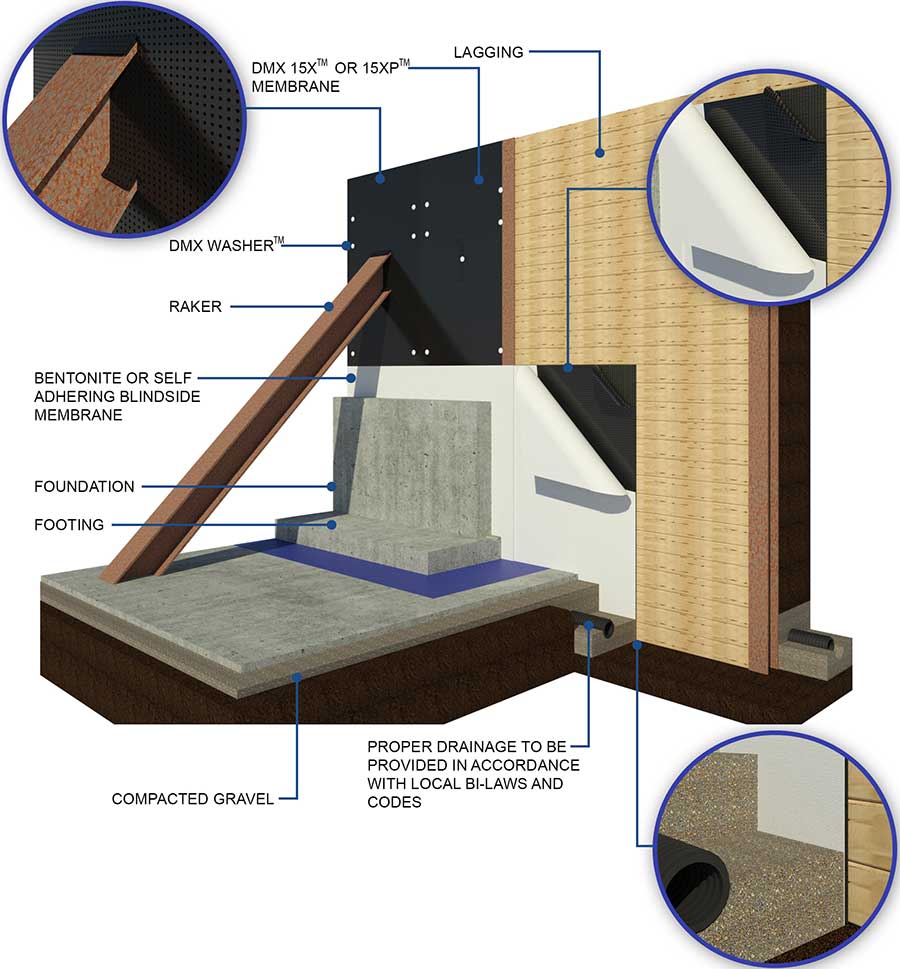
Blindside waterproofing installs the waterproofing membrane against excavation support systems—sheet piling, soldier piles with lagging, or permanent shoring walls—before structural foundation walls are constructed. Foundation concrete is then cast directly against the membrane, sandwiching the waterproofing permanently between the excavation support and the new wall.
The term “blindside” reflects the defining characteristic: once concrete is placed, the membrane becomes permanently inaccessible. There is no opportunity for inspection, testing, or repair after foundation construction. The waterproofing must perform reliably with no post-installation verification, which drives the requirement for proven blindside-rated materials and experienced installation.
Critically, blindside waterproofing remains a positive-side system in its performance relationship to water. Because the membrane sits on the soil side of the foundation wall, groundwater pressure compresses it against the structural concrete rather than pulling it away. The structural wall remains protected from moisture, shielding embedded reinforcement from corrosion and concrete from freeze-thaw exposure. This is the key advantage that distinguishes blindside from negative side approaches—blindside preserves the protective benefits of positive-side waterproofing despite the constrained installation sequence.
When Blindside Waterproofing Applies
Blindside waterproofing becomes necessary during new construction when foundation walls extend to property lines or abut existing structures, eliminating any exterior space for conventional positive-side application. In the GTA’s dense development context—downtown Toronto, North York Centre, Mississauga City Centre, and other intensification nodes—high-rise towers and mixed-use complexes are routinely constructed to lot boundaries, making blindside application essential on property-line walls.
The approach also applies where permanent excavation support systems such as secant pile walls, tangent pile walls, or diaphragm walls become part of the final structure. Because these systems remain in place, waterproofing must be applied to their interior faces before foundation walls are constructed—a blindside application by definition. Common blindside technologies include bentonite panel systems, self-adhered HDPE-backed membranes, and certain fluid-applied systems engineered for installation against excavation support and survival of concrete placement.
Negative Side Waterproofing: Interior Application Against Water Pressure
Negative side waterproofing installs the waterproofing system on the interior face of foundation walls or below-grade structures—the side opposite water pressure. Water infiltrates through the structural concrete or masonry, encountering the waterproofing only after passing through the wall. The membrane operates under tension as water pressure attempts to pull it away from the substrate rather than compress it against the wall.
This fundamental relationship to water pressure defines both the utility and the limitations of negative side waterproofing. Because installation occurs from the building interior, no excavation, underpinning, or disturbance to adjacent properties is required. The waterproofing remains accessible throughout the building’s service life for inspection, maintenance, and repair. This accessibility makes negative side approaches the primary solution for remedial waterproofing on existing buildings experiencing groundwater infiltration where exterior excavation is impractical.
The defining limitation is that structural elements remain exposed to water. Concrete and masonry walls become saturated even though interior waterproofing prevents visible water entry into occupied spaces. Over time, this moisture exposure can drive reinforcement corrosion and freeze-thaw deterioration within the wall, progressing from the exterior inward. Negative side waterproofing manages the symptom—water reaching the interior—rather than preventing water from entering the structural assembly.
When Negative Side Waterproofing Applies
Negative side waterproofing is most commonly specified for remedial applications on existing buildings where below-grade spaces experience groundwater infiltration and exterior excavation proves cost-prohibitive or technically infeasible. Where adjacent structures, property-line constraints, or extreme excavation costs eliminate exterior access to existing foundations, interior negative side systems provide the practical moisture-control solution.
The approach also serves as remediation when blindside or positive-side systems have failed and exterior access cannot be regained. Common negative side technologies include cementitious crystalline waterproofing that penetrates concrete and forms crystals blocking water pathways, polymer-modified cementitious coatings, crack injection systems addressing localized infiltration, and cavity drainage membranes that collect infiltrating water and direct it to interior drainage and sump systems.
Comparative Analysis: Performance and Application
The most important distinction between these approaches is their relationship to the structural wall. Blindside waterproofing protects the structure by keeping the foundation wall dry, while negative side waterproofing leaves the structure exposed to moisture and manages water only after it has penetrated the concrete. For high-rise towers and major complexes where structural durability over a multi-decade service life is paramount, this difference carries significant weight.
Blindside waterproofing, as a positive-side method, benefits from water pressure compressing the membrane against the wall, enhancing waterproofing effectiveness and protecting embedded reinforcement. Its principal disadvantage is the permanent inaccessibility of the membrane after concrete placement, which eliminates post-installation verification and makes future repair extremely difficult. This drives the requirement for rigorous process control, proven materials, and experienced installation during original construction.
Negative side waterproofing offers accessibility for inspection and repair throughout building life and enables installation without excavation, but operates under the disadvantage of membrane tension from water pressure and leaves structural elements saturated. Material selection is more limited, as systems must be specifically engineered to resist hydrostatic pressure acting to separate the membrane from the substrate.
In application terms, the two approaches generally serve different project phases. Blindside waterproofing is a new-construction method specified when foundation walls cannot be accessed externally during the build—property-line construction, adjacent structures, or permanent shoring. Negative side waterproofing is predominantly a remedial method applied to existing buildings, though it also functions as a backup component in redundant systems. On many complex urban projects, the two are not competing alternatives but complementary tools applied at different stages of a structure’s life.
Integration Within Division 7 Building Envelope Scopes
Both blindside and negative side waterproofing fall within Division 7 of the construction specifications framework governing thermal and moisture protection systems. For general contractors and project managers coordinating large-scale commercial and institutional projects, these waterproofing scopes must integrate with structural concrete, excavation support, drainage systems, and building envelope transitions. Below-grade waterproofing rarely exists in isolation—it interfaces with foundation drainage, elevator pit waterproofing, plaza and podium deck systems above, and the broader building envelope assembly.
On high-rise and mixed-use complexes, blindside waterproofing on property-line walls frequently coordinates with conventional positive-side waterproofing on accessible foundation portions and with podium deck waterproofing systems at transition levels. Negative side systems may be specified as redundant backup protection on critical below-grade spaces—mechanical rooms, electrical vaults, or occupied areas—where moisture infiltration consequences justify dual-system protection. This redundant strategy combines a blindside exterior membrane as primary protection with interior negative side treatment as backup, essentially eliminating waterproofing failure risk for the most critical applications.
Coordinating these systems across the building envelope requires a specialty contractor capable of executing multiple waterproofing methodologies and integrating them at transitions. Nusite Group’s combined expertise in commercial waterproofing and concrete and structural rehabilitation enables this coordination, ensuring continuity across blindside, positive-side, negative side, and deck waterproofing scopes within unified Division 7 execution.
Specification Considerations for Urban Commercial Projects
System selection follows directly from project conditions. New construction on constrained urban sites where foundation walls extend to property lines or abut existing structures requires blindside waterproofing to maintain positive-side protection of structural elements. This is the appropriate specification for the property-line foundations of high-rise towers and mixed-use complexes throughout Toronto’s dense development areas.
Remedial waterproofing on existing buildings experiencing groundwater infiltration, where exterior excavation is impractical, calls for negative side systems applied from the interior. The choice here reflects the reality that the structure already exists and exterior access has been foreclosed by adjacent development or site constraints.
For critical below-grade spaces within major complexes, redundant approaches combining blindside primary protection with negative side backup provide fail-safe moisture control where consequences of infiltration are severe. While redundant systems increase initial cost, they deliver risk mitigation appropriate to data centers, critical mechanical infrastructure, and occupied spaces intolerant of moisture exposure.
In all cases, the permanent inaccessibility of blindside systems and the structural exposure inherent in negative side approaches both argue for proven materials, experienced installation, and rigorous quality control during execution. Property managers and facility managers should recognize that below-grade waterproofing decisions made during construction or remediation carry consequences across the full service life of the structure, making correct specification and quality execution a long-term performance investment rather than a commodity procurement.
Nusite Group’s Below-Grade Waterproofing Expertise
With over 30 years of commercial waterproofing and concrete rehabilitation experience, Nusite Group delivers below-grade waterproofing solutions on high-rise towers, mixed-use complexes, and institutional developments throughout the GTA and Southern Ontario. Our work addresses the full range of below-grade conditions, from blindside applications on constrained property-line construction to negative side remediation on existing structures.
We provide comprehensive waterproofing services including blindside systems for property-line and permanent-shoring applications, negative side systems for remedial and backup protection, conventional positive-side membrane waterproofing, and integrated drainage and elevator pit waterproofing. Our technical approach evaluates site constraints, structural requirements, and long-term performance objectives, recommending waterproofing strategies aligned with each project’s conditions and Division 7 scope.
Our project teams coordinate with general contractors, project managers, structural engineers, and excavation contractors, integrating waterproofing systems across the building envelope and maintaining continuity at critical transitions. As a specialty partner on large-scale commercial and institutional projects, we deliver technically grounded below-grade waterproofing execution that protects structural elements, occupied spaces, and building systems throughout the service life of the structure.
Frequently Asked Questions
Is blindside waterproofing a type of positive side or negative side waterproofing?
Blindside waterproofing is a positive-side method applied out of normal sequence. Although the membrane is installed before the foundation wall is cast—against the excavation support system rather than the completed wall—it still ends up on the exterior, water-bearing side of the structure. Groundwater pressure therefore compresses the membrane against the foundation wall, and the structural concrete remains protected from moisture. This is the fundamental difference from negative side waterproofing, which places the membrane on the interior face where it operates under tension and leaves the structural wall exposed to water. Understanding this distinction is essential, because the two approaches are frequently confused despite serving different functions and delivering different protective benefits.
When should negative side waterproofing be used instead of blindside waterproofing?
The choice is generally determined by project phase rather than direct preference. Blindside waterproofing applies during new construction when foundation walls cannot be accessed externally—property-line construction, adjacent structures, or permanent shoring systems. Negative side waterproofing applies predominantly to existing buildings requiring remedial moisture control where exterior excavation is impractical or cost-prohibitive. On existing structures experiencing groundwater infiltration with no feasible exterior access, negative side interior systems provide the practical solution. The two are rarely competing alternatives for the same condition; rather, they address different circumstances. On some complex projects, negative side systems also serve as redundant backup protection alongside blindside primary waterproofing for critical below-grade spaces.
Can both approaches be used together on the same project?
Yes. On large-scale commercial and institutional projects, redundant waterproofing strategies combine blindside primary protection with negative side backup for critical below-grade spaces. This belt-and-suspenders approach suits mechanical rooms, electrical vaults, data infrastructure, and occupied areas where moisture infiltration consequences are severe. The blindside exterior membrane provides primary positive-side protection during construction, while interior negative side treatment provides backup if the primary system develops a leak. Because the blindside membrane is permanently inaccessible after concrete placement, this redundancy provides valuable risk mitigation. Coordinating these systems requires a specialty contractor capable of executing both methodologies and integrating them properly within the broader Division 7 building envelope scope.
How do these waterproofing scopes affect structural durability on high-rise and mixed-use complexes?
The structural durability implications are significant and represent the core distinction between the two approaches. Blindside waterproofing, as a positive-side method, keeps the foundation wall dry, protecting embedded reinforcement from corrosion and concrete from freeze-thaw deterioration—critical for structures expected to perform across multi-decade service lives. Negative side waterproofing leaves the structural wall saturated, managing water only after it penetrates the concrete, which can drive gradual reinforcement corrosion and freeze-thaw damage over time. For high-rise towers and major complexes where structural longevity is paramount, this difference informs both new-construction specification and remedial strategy. Where negative side methods are necessary on existing structures, supplemental measures and monitoring help manage the ongoing moisture exposure to structural elements.
Specify the Right Below-Grade Strategy
Nusite Group delivers commercial waterproofing, concrete and structural rehabilitation, and building envelope solutions on high-rise towers, mixed-use complexes, and institutional developments throughout the GTA and Southern Ontario. Our below-grade waterproofing expertise spans blindside, negative side, and positive-side systems, integrated within comprehensive Division 7 scopes that protect structural elements and occupied spaces across the service life of the structure.
Fully bonded, licensed across Ontario, and insured to $10 million in liability coverage, Nusite Group operates as a trusted specialty partner for general contractors, project managers, property managers, and facility managers who require technical expertise and proven execution on complex below-grade waterproofing projects.
Request a consultation to discuss your project’s below-grade waterproofing requirements or to explore how Nusite Group can support your high-rise or mixed-use development with blindside, negative side, or integrated waterproofing systems engineered for constrained urban sites.
Established in 1990, Nusite Group delivers commercial waterproofing, concrete and structural rehabilitation, and building envelope solutions on commercial and institutional projects throughout the GTA and Southern Ontario. This technical overview clarifies the differences between blindside and negative side waterproofing, the conditions that necessitate each, their respective performance profiles, and the considerations that guide specification on complex urban construction projects.