What Are the Main Types of Coatings for Concrete Parking Decks?

Concrete parking decks represent critical infrastructure within commercial, institutional, and mixed-use developments throughout the GTA and Southern Ontario. These elevated and at-grade structures endure continuous vehicular traffic, de-icing chemical exposure, freeze-thaw cycling, and structural movement while protecting occupied spaces, building systems, and structural elements below. Selecting the appropriate coating system determines whether a parking deck delivers decades of reliable waterproofing performance or requires premature, costly intervention. For general contractors, project managers, property managers, and facility managers responsible for parking structures, understanding the primary coating technologies—and their appropriate applications—is essential to specifying systems that align with project requirements, exposure conditions, and long-term performance objectives.
Established in 1990, Nusite Group delivers traffic coating systems, waterproofing, and concrete rehabilitation on commercial and institutional parking structures throughout the GTA and Southern Ontario. This technical overview explains the main coating categories for concrete parking decks, their performance characteristics, selection criteria, and the considerations that determine optimal system specification within large-scale building projects.
The Dual Function of Parking Deck Coatings
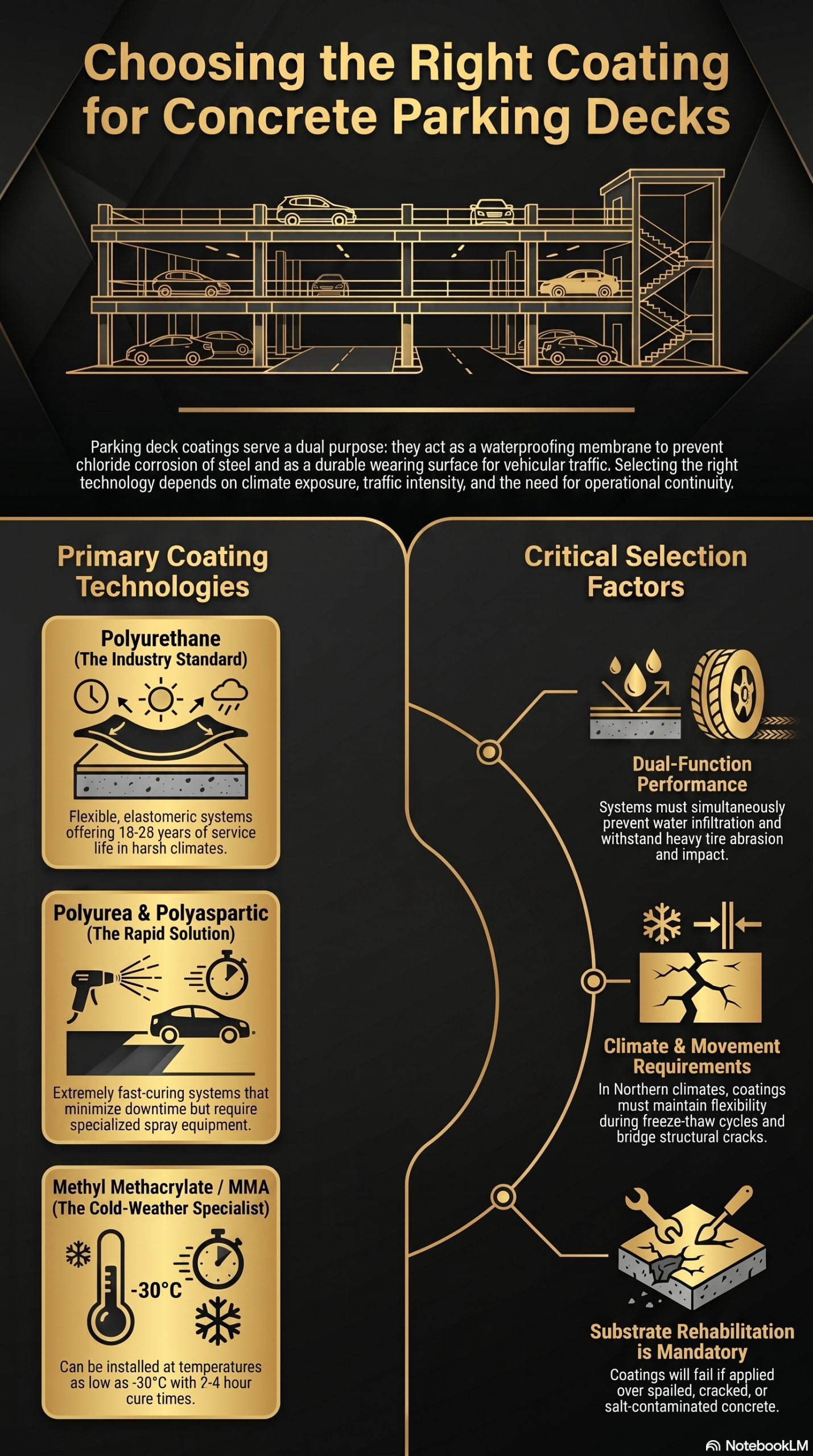
Parking deck coatings differ fundamentally from protective floor coatings because they must perform two critical functions simultaneously. As waterproofing membranes, they prevent water and chloride infiltration through structural concrete, protecting embedded reinforcing steel from corrosion and shielding occupied spaces, parking levels, and building systems below from moisture intrusion. As durable wearing surfaces, they withstand vehicular tire abrasion, turning forces, snow removal equipment, and impact while providing slip resistance for vehicular and pedestrian safety.
This dual requirement distinguishes parking deck coating selection from standard concrete protection decisions. A system must accommodate structural deck movement, thermal expansion and contraction, and concrete cracking without losing waterproofing integrity—all while maintaining a wearing surface that resists the mechanical demands of daily traffic. The coating categories detailed below address these requirements through different material technologies, each suited to specific exposure conditions, traffic patterns, and project constraints.
Polyurethane Traffic Coating Systems
Polyurethane traffic coatings represent the most widely specified technology for concrete parking decks in commercial and institutional applications. These systems use two-component aliphatic or aromatic polyurethane resins to create flexible, elastomeric membranes that accommodate substrate movement while delivering waterproofing and chemical resistance.
A complete polyurethane traffic coating system consists of several integrated layers. Surface preparation establishes a sound bonding profile, followed by an epoxy or polyurethane primer that penetrates and seals the concrete substrate. A flexible polyurethane base coat provides the primary waterproofing membrane, with broadcast aggregate—typically silica sand or aluminum oxide—creating slip resistance and a wear-resistant surface. An intermediate coat embeds and seals the aggregate, and a UV-resistant aliphatic polyurethane topcoat provides the final wearing surface and color. Total system thickness typically reaches 80 to 120 mils, providing substantial material depth for long-term durability.
The performance characteristics of polyurethane systems make them particularly well-suited to Southern Ontario’s climate. These coatings maintain flexibility at low temperatures, preventing cracking during winter extremes, and accommodate concrete substrate movement through elongation properties ranging from 100 to 200 percent. Excellent chemical resistance allows them to tolerate de-icing salt exposure, automotive fluids, and petroleum products without degradation. UV-stable aliphatic topcoat formulations resist yellowing on exposed deck levels and rooftop parking. With proper specification and maintenance, polyurethane traffic coating systems provide 15 to 25 years of service life.
Polyurethane systems suit open-air parking deck levels, rooftop parking, elevated structures, and ramps exposed to full weather and de-icing chemical contact. Their balance of flexibility, durability, and proven performance establishes them as the baseline standard for most commercial parking deck waterproofing applications.
Polyurea and Polyaspartic Systems
Polyurea and polyaspartic traffic coatings offer enhanced durability and rapid cure characteristics valuable for projects requiring minimal operational disruption. These two-component aliphatic systems cure through extremely fast chemical reactions, often achieving traffic-ready hardness within hours rather than days.
The rapid cure capability provides significant advantages for parking structures where extended closures disrupt operations or revenue. Spray application builds specified thickness efficiently, and the seamless monolithic membrane eliminates seams vulnerable to water infiltration and chemical attack. High tensile strength and superior abrasion resistance deliver maximum durability under heavy vehicular traffic, while crack-bridging properties accommodate substrate movement. Temperature-insensitive cure characteristics allow installation across broader temperature ranges than conventional polyurethane systems, extending the construction season in Southern Ontario’s climate.
These performance advantages come with considerations that affect specification. Material costs typically exceed standard polyurethane systems by 20 to 40 percent. The very short pot life—measured in seconds to minutes for polyurea—requires specialized spray equipment and highly experienced installation crews. Surface preparation requirements are more stringent because rapid cure limits membrane penetration into the substrate. For parking structures where operational continuity is critical or where maximum durability justifies premium investment, polyurea and polyaspartic systems deliver compelling performance, particularly in phased rehabilitation projects where weekend or overnight installation minimizes facility downtime.
Methyl Methacrylate (MMA) Systems
Methyl methacrylate traffic coating systems provide unique cold-weather installation capability and rapid cure characteristics that address challenging project conditions. These reactive resin systems cure through free-radical polymerization, a process unaffected by temperature or moisture, enabling installation at temperatures well below freezing when conventional coating systems cannot be applied.
The system consists of MMA primer establishing substrate bond, an MMA base coat with broadcast aggregate for texture and wear resistance, and an MMA topcoat sealing the assembly. Total application thickness typically reaches 60 to 100 mils, with the complete installation—including cure—achievable in two to four hours. This allows same-day return to traffic in many applications.
The cold-weather capability of MMA systems addresses a significant constraint in Southern Ontario’s climate. These coatings cure reliably at temperatures of -30°C and below, enabling winter installation when parking structure repairs cannot be deferred until spring. The rapid cure minimizes weather exposure risk during installation, and moisture tolerance allows application to damp substrates where residual moisture would prevent other systems from bonding. These characteristics make MMA particularly suitable for emergency waterproofing repairs during winter months and for projects with compressed installation windows.
The considerations affecting MMA specification include strong odor during installation, which requires ventilation planning and may necessitate occupant coordination in enclosed structures. Material costs rank among the highest of traffic coating options, and specialized installation expertise limits contractor availability. For projects where installation timing, cold-weather requirements, or rapid cure justify premium costs, MMA systems provide reliable performance unavailable from conventional technologies.
Cementitious and Epoxy-Based Systems
While elastomeric polyurethane, polyurea, and MMA systems dominate parking deck applications requiring flexibility and movement accommodation, certain conditions warrant cementitious or epoxy-based approaches.
Epoxy systems deliver maximum abrasion resistance and compressive strength, performing well in enclosed parking levels with minimal temperature fluctuation, service ramps, and loading areas where mechanical demands exceed movement concerns. However, epoxy’s rigidity creates cracking potential under thermal cycling or substrate movement, and UV sensitivity causes yellowing in exposed applications. These limitations restrict epoxy systems to controlled interior environments rather than open-air or rooftop decks exposed to Southern Ontario’s temperature extremes.
Cementitious systems, including polymer-modified concrete overlays and high-build structural overlays, address parking decks requiring both waterproofing substrate preparation and structural restoration. These systems provide waterproof barriers when properly formulated and can correct surface profile deficiencies or add structural capacity. They suit heavy-duty vehicular traffic on ramps and drive lanes and serve as substrates for membrane waterproofing systems in comprehensive rehabilitation projects. Their greater thickness requires structural load verification, and longer cure times affect project schedules.
Selecting the Appropriate System
System selection for concrete parking decks requires evaluating several project-specific factors. The intended use and exposure condition is the primary determinant—open-air and rooftop decks exposed to full weather and de-icing chemicals require flexible, UV-stable polyurethane or polyurea systems, while enclosed levels with controlled environments may accommodate epoxy or cementitious approaches. Traffic intensity affects coating thickness, aggregate broadcast requirements, and material selection, with high-traffic structures justifying premium systems delivering maximum abrasion resistance.
Climate exposure in the GTA and Southern Ontario imposes specific requirements. Freeze-thaw cycling demands membranes that maintain flexibility at low temperatures, while de-icing salt exposure requires chemical-resistant formulations preventing chloride penetration to structural reinforcement. Substrate condition determines preparation requirements and whether concrete rehabilitation must precede coating installation. Installation timing and operational constraints may favor rapid-cure polyurea or MMA systems where conventional coatings cannot accommodate project schedules or weather conditions.
Lifecycle cost analysis should guide specification beyond initial installation expense. A premium system with extended service life and minimal maintenance often delivers superior long-term value compared to a lower-cost system requiring frequent recoating or premature replacement. For property managers and facility managers responsible for parking structures as long-term assets, evaluating total ownership costs over 15 to 25 year horizons provides the appropriate framework for coating selection.
Integration with Concrete Rehabilitation
Parking deck coating installation requires sound concrete substrates capable of supporting bonded membrane systems. Many parking structures, particularly those constructed before modern waterproofing standards, require concrete rehabilitation before coatings can be applied. Spalled concrete, cracked slabs, delaminated areas, and corroded reinforcement must be restored to provide reliable foundations for waterproofing systems.
This integration of concrete rehabilitation and traffic coating installation represents a critical coordination requirement in parking structure projects. Substrate repair must meet coating manufacturer specifications for surface profile, soundness, and moisture conditions. Slope correction may be necessary to establish positive drainage preventing water accumulation that accelerates coating wear. Drainage system rehabilitation, expansion joint replacement, and structural strengthening often accompany coating installation in comprehensive parking structure rehabilitation programs.
Nusite Group’s combined expertise in concrete and structural rehabilitation and traffic coating systems enables integrated project delivery, coordinating substrate restoration with waterproofing installation through single-source execution. This approach ensures substrate preparation meets system requirements while maintaining unified accountability and warranty coverage across the complete scope.
Nusite Group’s Parking Deck Coating Expertise
With over 30 years of experience in traffic coating systems, waterproofing, and concrete rehabilitation, Nusite Group delivers parking deck coating solutions on commercial, institutional, and mixed-use parking structures throughout the GTA and Southern Ontario. Our installations protect structural concrete, occupied spaces, and building systems while providing durable wearing surfaces engineered for Southern Ontario’s demanding climate.
We provide comprehensive parking deck coating systems including polyurethane traffic coatings, rapid-cure polyurea and polyaspartic systems, MMA systems for challenging installation conditions, and cementitious or epoxy-based systems for specialized applications. Our technical approach matches system selection to exposure conditions, traffic intensity, substrate requirements, and operational constraints, ensuring specifications align with project performance objectives. Integrated concrete rehabilitation capabilities address deteriorated substrates before coating installation, providing complete parking structure solutions through coordinated execution.
Our project teams execute coating installations within operational parking structures, implementing phased construction to maintain partial facility access, coordinating with property management to minimize disruption, and applying quality control protocols ensuring long-term performance. We work with general contractors, project managers, property managers, and facility managers as a specialty partner delivering technically grounded waterproofing and coating solutions.
Frequently Asked Questions
Which coating system is best for an open-air rooftop parking deck in Southern Ontario?
Open-air and rooftop parking decks exposed to full weather, UV radiation, and de-icing chemicals are best served by polyurethane traffic coating systems with UV-stable aliphatic topcoats. These systems maintain flexibility through freeze-thaw cycling, accommodate thermal movement, resist chloride penetration, and prevent yellowing under sun exposure. For projects requiring rapid installation or enhanced durability, polyurea and polyaspartic systems provide alternatives with similar exposure resistance and faster cure times. Epoxy systems should generally be avoided for exposed applications due to UV sensitivity and rigidity that creates cracking under thermal cycling. The appropriate selection depends on traffic intensity, structural movement characteristics, and project schedule, which a qualified traffic coating contractor can evaluate against specific deck conditions.
How does deck movement affect coating selection?
Structural movement is a primary consideration in parking deck coating selection because elevated decks experience thermal expansion and contraction, structural deflection under load, and concrete shrinkage and cracking. Elastomeric systems—polyurethane, polyurea, and polyaspartic—accommodate this movement through flexibility and elongation properties, maintaining waterproofing integrity as the substrate moves. Rigid systems such as epoxy lack this flexibility and develop cracks when subjected to substrate movement, compromising waterproofing performance. For elevated parking structures with significant movement, flexible elastomeric coatings are essential. Expansion joints require specialized treatment with high-movement joint systems rather than coating bridging, as these joints accommodate movement magnitudes exceeding coating capacity.
When is concrete rehabilitation required before coating installation?
Concrete rehabilitation is required when substrate conditions cannot support reliable coating adhesion and performance. Spalled or delaminated concrete, cracked slabs, corroded reinforcing steel, and inadequate drainage slopes all require correction before coating application. Parking structures constructed before modern waterproofing standards, or those exhibiting deterioration from chloride intrusion and freeze-thaw damage, frequently require significant rehabilitation. The scope of concrete repair directly affects project budget and schedule, making comprehensive condition assessment essential before specification. Coating systems applied over deteriorated substrates fail prematurely regardless of coating quality. Coordinating concrete rehabilitation with coating installation through an integrated specialty contractor ensures substrate preparation meets system requirements while maintaining unified project accountability.
What service life should be expected from parking deck coating systems?
Service life depends on system type, traffic intensity, exposure conditions, and maintenance quality. Polyurethane traffic coating systems typically provide 15 to 25 years of service in commercial parking applications. Polyurea and polyaspartic systems deliver comparable or extended service life with enhanced durability. MMA systems generally provide 15 to 20 years. High-traffic areas benefit from topcoat renewal every 5 to 10 years, extending overall system life before complete replacement becomes necessary. Service life expectations assume proper substrate preparation, quality installation, and consistent maintenance including drainage management, prompt repair of localized damage, and salt residue removal. Deferred maintenance significantly shortens service life, while proactive maintenance programs extend coating performance and protect the underlying structural investment.
Specify the Right System for Your Parking Structure
Nusite Group delivers traffic coating systems, waterproofing, and concrete rehabilitation on commercial, institutional, and mixed-use parking structures throughout the GTA and Southern Ontario. Our installations protect structural concrete and occupied spaces while providing durable performance engineered for Southern Ontario’s freeze-thaw cycling, de-icing chemical exposure, and temperature extremes.
Fully bonded, licensed across Ontario, and insured to $10 million in liability coverage, Nusite Group operates as a trusted specialty partner for general contractors, project managers, property managers, and facility managers who require technical expertise and proven execution on parking deck coating and rehabilitation projects.
Request a consultation to discuss your parking structure requirements or to explore how Nusite Group can support your project with polyurethane, polyurea, MMA, or specialized coating systems integrated with comprehensive concrete rehabilitation.