Concrete Slab Repair Explained: Techniques for a Stronger Foundation
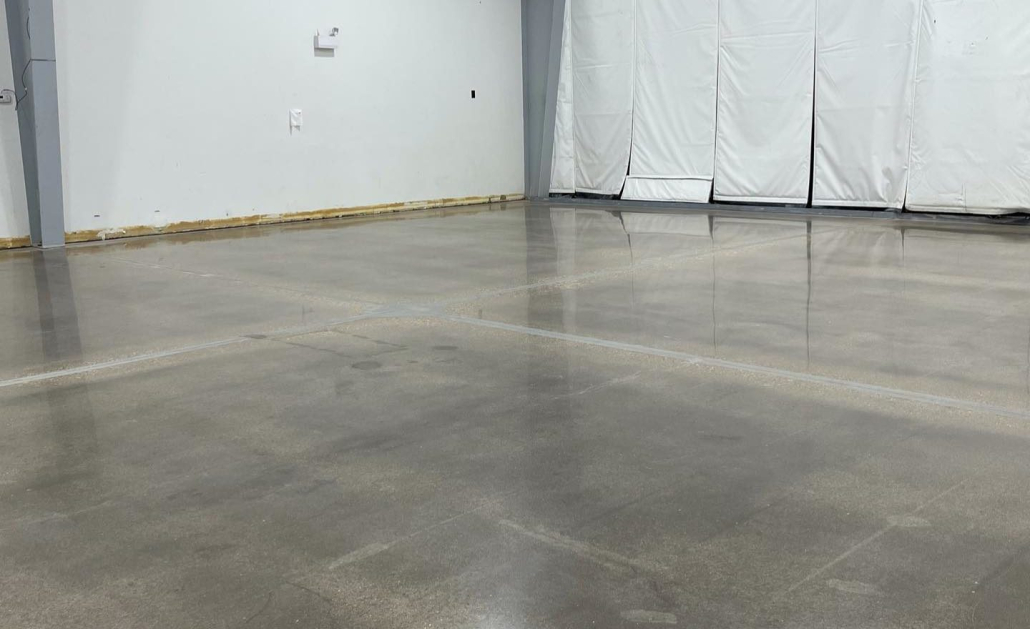
Concrete slab deterioration in commercial and industrial facilities directly impacts operational efficiency, safety compliance, and asset longevity. For property managers, facility directors, and general contractors responsible for manufacturing plants, warehouse distribution centers, institutional buildings, and multi-tenant commercial properties across the Greater Toronto Area, understanding when slab damage requires intervention—and which repair methodologies restore structural performance—is essential to maintaining functional building infrastructure.
Established in 1990, Nusite Group has executed concrete and structural rehabilitation projects on commercial and industrial properties throughout the GTA and Southern Ontario. This technical overview explains the causes of concrete slab failure, assessment protocols for determining repair scope, and proven techniques that restore load-bearing capacity and extend service life.
Common Causes of Concrete Slab Deterioration in Commercial Facilities
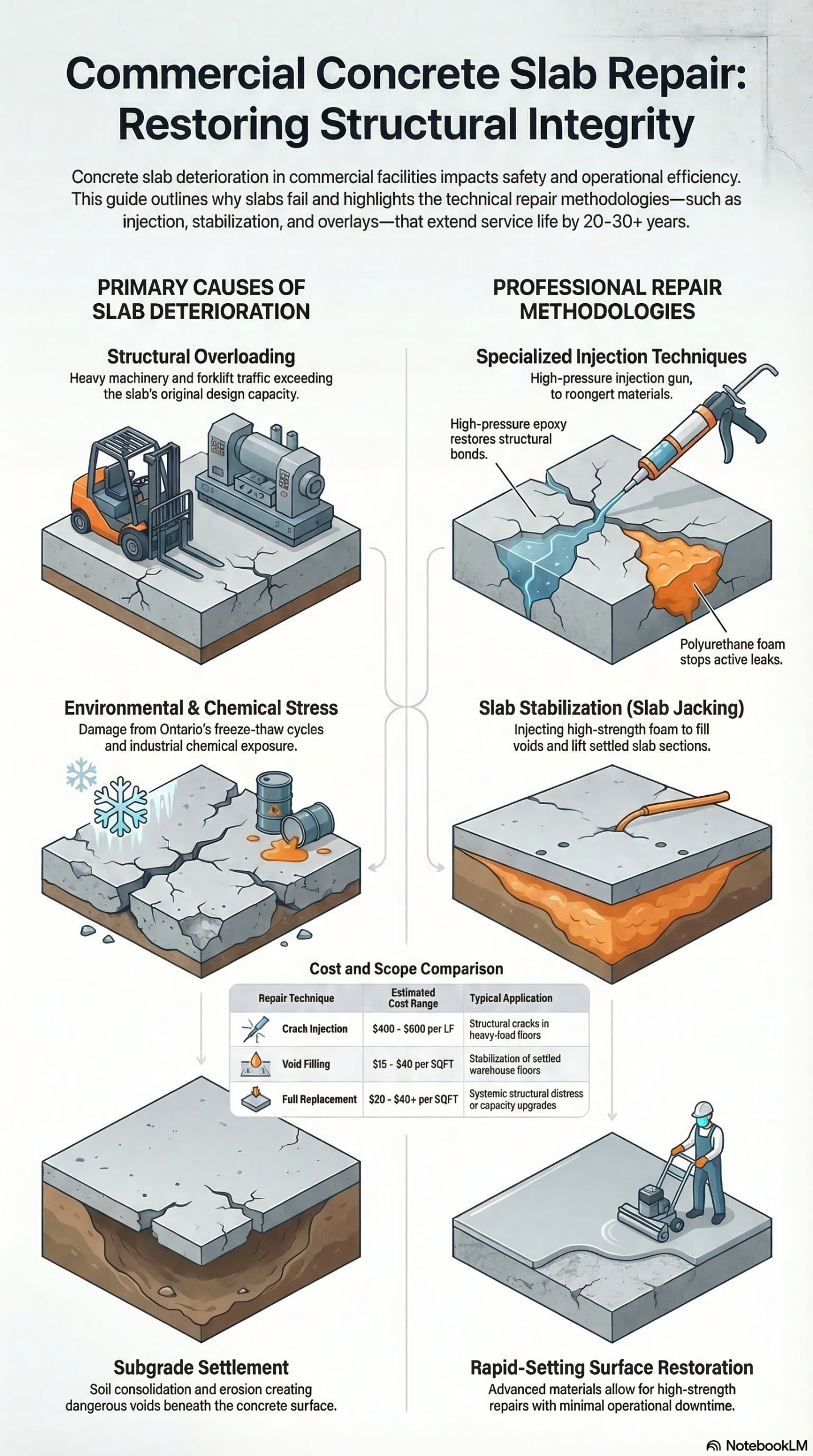
Structural Loading Beyond Design Capacity
Industrial facilities frequently experience slab distress when operational requirements evolve beyond original design parameters:
- Heavy equipment installation in manufacturing plants where machinery loads exceed slab design capacity
- High-bay warehouse racking systems concentrating point loads on floor slabs
- Forklift traffic patterns causing repetitive impact stress in loading and distribution areas
- Increased storage densities in institutional or commercial buildings
For general contractors managing facility expansions or tenant improvements, verifying existing slab capacity before introducing new loads prevents premature structural failure.
Freeze-Thaw Damage and Climate Stress
Ontario’s temperature extremes subject concrete slabs to repeated freeze-thaw cycling, particularly in:
- Loading dock areas exposed to weather during truck operations
- Exterior plaza decks and elevated slabs on commercial buildings
- Parking garage floor slabs subjected to de-icing salt and moisture infiltration
- Cold storage and refrigerated warehouse floors with extreme thermal gradients
Water intrusion into concrete pores expands during freezing, creating internal pressure that fractures aggregate bonds and degrades structural integrity over successive winter seasons.
Chemical Attack and Industrial Exposure
Manufacturing facilities, food processing plants, automotive service centers, and chemical storage warehouses subject concrete slabs to aggressive exposures:
- Acid etching from chemical spills or process runoff
- Salt deterioration in food processing and de-icing chemical storage areas
- Petroleum product degradation in automotive facilities and truck maintenance bays
- Alkali-aggregate reaction in slabs exposed to moisture and reactive aggregates
These conditions accelerate surface deterioration, reduce compressive strength, and compromise slab waterproofing—particularly in facilities where floor drains and containment systems concentrate chemical exposure.
Subgrade Settlement and Soil Consolidation
Concrete slabs cast on unstable or poorly compacted subgrade experience settlement distress:
- Differential settlement creating voids beneath slabs and reducing bearing support
- Soil consolidation from groundwater fluctuations or organic material decomposition
- Erosion and piping removing soil from beneath slab edges and control joints
- Poor initial compaction during original construction—common in older industrial buildings
For warehouse and distribution facilities where slab flatness tolerances affect material handling equipment operation, even minor settlement creates operational inefficiencies and safety hazards.
Concrete Slab Damage Assessment Methodology
Visual Inspection and Condition Survey
Professional slab assessment begins with systematic visual documentation:
- Crack mapping—identifying crack patterns, widths, and locations relative to structural elements
- Spalling and delamination surveys—documenting areas where concrete surface has separated from underlying material
- Joint condition assessment—evaluating control joints, construction joints, and isolation joints for deterioration
- Surface wear patterns—identifying traffic lanes, impact zones, and areas of accelerated deterioration
- Moisture intrusion points—locating active water infiltration or efflorescence indicating subgrade moisture
For property managers planning capital improvements, condition surveys establish baseline data for budgeting, scope development, and repair prioritization.
Structural Testing and Material Analysis
Beyond visual inspection, engineering assessment includes:
Non-Destructive Testing (NDT)
- Ground-penetrating radar (GPR) to detect voids beneath slabs and locate reinforcement
- Impact-echo testing to identify delaminated concrete
- Concrete scanning to map embedded utilities and post-tensioning cables
Material Testing
- Core sampling to determine compressive strength and verify concrete quality
- Petrographic analysis to diagnose chemical attack or freeze-thaw damage
- Chloride penetration testing in parking structures and industrial facilities
Load Testing
- Plate bearing tests to verify subgrade support capacity
- Deflection measurements under operational loads for industrial floors
General contractors managing tenant improvement projects or facility rehabilitations should require these assessments to avoid under-scoping repairs or overlooking systemic structural deficiencies.
Concrete Slab Repair Techniques for Commercial Applications
Crack Injection and Structural Restoration
Similar to foundation crack repair, concrete slab cracks require material-specific injection methodologies:
Epoxy Injection for Structural Cracks High-pressure epoxy injection restores monolithic behavior to cracked slabs, bonding crack faces and preventing progressive failure. This technique is critical for:
- Industrial floor slabs supporting heavy equipment
- Parking garage slabs where structural integrity must be maintained
- Institutional building slabs experiencing settlement-induced cracking
Installation involves surface sealing, port placement at regular intervals, and pressure injection to achieve complete crack penetration.
Polyurethane Injection for Active Leaks When slab cracks exhibit water infiltration—common in below-grade slabs, elevator pits, and mechanical rooms—hydrophobic polyurethane foam injection provides flexible waterproofing while accommodating minor slab movement.
Concrete Removal and Replacement
Severely deteriorated slab sections require complete removal and reconstruction:
Partial Depth Repair When deterioration affects only the surface layer (typically 1-3 inches deep), partial depth repair involves:
- Saw-cutting square perimeter edges to sound concrete
- Removing deteriorated material to expose clean substrate
- Surface preparation including sandblasting or scarification
- Application of bonding agent
- Placement of repair mortar or polymer-modified concrete
- Curing and surface finishing
This approach is common for spalled loading dock areas, forklift traffic lanes, and chemically damaged zones in manufacturing facilities.
Full Depth Replacement When structural damage extends through the slab thickness:
- Complete slab removal in affected areas
- Subgrade preparation and compaction verification
- Reinforcement installation matching original design or engineered upgrades
- Concrete placement using compatible mix designs
- Control joint installation to prevent random cracking
- Proper curing and surface treatments
For warehouse and industrial facilities requiring minimal operational disruption, rapid-setting concrete technologies enable accelerated construction timelines and faster return to service.
Slab Stabilization and Void Filling
Settlement-induced voids beneath concrete slabs compromise load distribution and create ongoing structural risk. Modern stabilization techniques include:
Polyurethane Foam Injection (Slab Jacking) Lightweight, high-strength polyurethane foam is injected beneath settled slabs to:
- Fill voids and restore subgrade support
- Lift settled slab sections to original elevation
- Provide permanent load-bearing capacity
- Resist moisture infiltration and future erosion
This method is particularly effective for warehouse floors, loading docks, and pedestrian plazas where settlement creates trip hazards or affects drainage patterns.
Compaction Grouting For larger industrial facilities or parking structures, compaction grouting involves:
- Drilling through slabs to subgrade level
- Injecting low-slump grout under pressure to densify loose soils
- Systematic grid pattern installation to achieve uniform support
- Verification testing to confirm bearing capacity improvement
Property managers benefit from void filling technologies because they restore slab performance without complete replacement—reducing costs and operational downtime.
Overlay Systems and Surface Restoration
When concrete slabs exhibit surface wear but retain structural integrity, overlay systems provide renewed performance:
Polymer-Modified Concrete Overlays Thin bonded overlays (1/4 to 2 inches thick) restore surface flatness, abrasion resistance, and chemical protection. Applications include:
- Manufacturing floors requiring smooth, durable surfaces
- Food processing facilities needing chemical-resistant, sanitary floors
- Institutional buildings upgrading flooring without complete replacement
Material selection depends on exposure conditions—epoxy mortars for chemical resistance, polyurethane systems for flexible environments, cementitious overlays for general restoration.
Traffic Coating Systems For parking garage slabs and exterior plaza decks, traffic coating membranes provide:
- Waterproofing over structural concrete
- Slip-resistant wearing surface
- Chemical resistance to de-icing salts
- Thermal expansion/contraction accommodation
These systems protect underlying concrete from freeze-thaw damage while extending service life between major rehabilitation cycles.
Corrosion Mitigation for Reinforced Slabs
When chloride intrusion or carbonation causes steel reinforcement corrosion within slabs, specialized repair protocols apply:
Cathodic Protection Systems Impressed current or galvanic anode systems prevent ongoing corrosion without complete concrete removal. This technology is common in parking structures where chloride contamination is widespread.
Corrosion Inhibitor Application Topical or migrating corrosion inhibitors penetrate concrete and form protective barriers around embedded steel, slowing deterioration rates in moderately contaminated slabs.
Concrete Removal and Repassivation For localized corrosion zones:
- Remove concrete around corroded reinforcement
- Clean and treat steel with corrosion inhibitor coatings
- Install repair mortar with enhanced corrosion resistance
- Apply surface sealers to prevent further chloride ingress
General contractors managing parking garage rehabilitations or coastal/winter-exposed structures should prioritize corrosion assessment and mitigation to prevent accelerated deterioration.
Material Selection for Commercial Slab Repairs
Compatibility and Performance Requirements
Repair materials must match or exceed original concrete properties:
- Compressive strength equal to or greater than parent concrete
- Thermal expansion coefficient compatible to prevent differential movement
- Elastic modulus matching existing slab to avoid stress concentrations
- Permeability appropriate for exposure conditions and waterproofing requirements
For industrial facilities with specialized operational demands—cold storage, chemical exposure, heavy equipment loads—material selection requires engineering input to ensure long-term performance.
Rapid-Setting Technologies for Operational Continuity
Commercial and industrial facilities often cannot tolerate extended downtime. Rapid-setting repair materials enable:
- High-early-strength concrete achieving 3000-4000 psi in 4-6 hours
- Rapid-setting polymer mortars allowing traffic in 1-2 hours
- Ultra-rapid repair systems providing structural capacity within minutes for emergency repairs
These materials command higher costs but deliver operational value by minimizing production shutdowns, tenant disruptions, and revenue loss.
Climate Considerations for GTA Concrete Slab Repairs
Cold Weather Installation Challenges
Ontario’s winter conditions constrain concrete repair scheduling:
- Concrete placement below 5°C requires heated enclosures, insulated curing blankets, and accelerated admixtures
- Freeze-thaw damage to fresh repairs if protection is inadequate
- Reduced bond strength between repair materials and frozen substrates
For property managers planning slab rehabilitation, spring and fall shoulder seasons often provide optimal conditions—moderate temperatures and reduced precipitation without summer heat stress or winter freezing risk.
Moisture Management in Below-Grade Slabs
High groundwater tables and seasonal water table fluctuations in the GTA create ongoing challenges for below-grade slab repairs:
- Hydrostatic pressure forcing moisture through slab cracks and joints
- Efflorescence and salt deposits degrading repair material bonds
- Vapor transmission affecting flooring adhesives and coatings
Effective below-grade slab repair requires integrated waterproofing—under-slab vapor barriers, perimeter drainage, crystalline admixtures, and surface sealers—to control moisture migration.
Nusite Group’s Approach to Commercial Concrete Slab Rehabilitation
With over 30 years of experience in concrete and structural rehabilitation, Nusite Group has executed slab repair projects on manufacturing facilities, warehouse distribution centers, parking structures, institutional campuses, and commercial properties throughout the GTA and Southern Ontario.
Diagnostic Assessment and Engineering Coordination
We collaborate with structural engineers, materials testing laboratories, and geotechnical consultants to determine root causes of slab deterioration. For general contractors managing complex rehabilitation projects, this diagnostic rigor ensures repair scopes address underlying conditions, not just surface symptoms.
Injection and Stabilization Expertise
Our field teams execute epoxy crack injection, polyurethane void filling, and slab stabilization using manufacturer-certified equipment. Quality control protocols verify complete material penetration, proper curing, and structural performance restoration.
Occupied Facility Execution
Industrial and commercial facilities rarely tolerate complete operational shutdowns. We phase slab repair work to maintain production continuity, coordinate with facility operations, and implement safety protocols for occupied environments. For warehouse and distribution facilities, we schedule repairs around shipping cycles and material handling operations.
Integrated System Solutions
Concrete slab repair is coordinated with waterproofing, drainage, and surface protection systems to provide comprehensive performance restoration. For property managers, this integrated approach maximizes capital investment and extends asset service life.
Frequently Asked Questions
How do I know when a concrete slab in my commercial building needs repair versus complete replacement?
Assessment depends on deterioration extent and slab function. Localized cracking, spalling, or settlement affecting less than 25-30% of slab area typically justifies targeted repair. Widespread deterioration, systemic structural distress, or slabs inadequate for current loading requirements may necessitate complete replacement. Property managers should engage structural engineers for formal capacity evaluations, particularly when operational requirements have changed since original construction. Nusite Group coordinates engineering assessments to provide objective recommendations balancing repair costs against replacement value.
Can concrete slab repairs be performed while a facility remains operational?
Yes. Most commercial slab repair techniques—crack injection, partial depth repair, void filling—can be executed in phases to maintain operational continuity. Rapid-setting materials enable repairs during overnight shifts or weekend shutdowns. For manufacturing facilities and warehouse operations, we develop phased repair schedules that isolate work zones while maintaining traffic flow in adjacent areas. Full-depth replacement projects require longer cure times but can still be sequenced to minimize disruption.
What is the typical lifespan of commercial concrete slab repairs?
Properly executed repairs using compatible materials should provide 20-30+ years of service when root causes are addressed. Epoxy injection repairs restore permanent structural integrity. Polymer-modified overlays typically last 15-25 years depending on traffic and exposure. Void filling and stabilization systems provide indefinite performance if drainage and soil conditions remain stable. Longevity depends on ongoing maintenance—joint sealing, surface protection, drainage system upkeep—and prevention of loading beyond slab design capacity.
How much does commercial concrete slab repair cost compared to replacement?
Repair costs vary widely based on deterioration severity, facility occupancy, and access constraints. Crack injection ranges $400-$800 per linear foot. Partial depth repairs run $50-$150 per square foot. Void filling costs $15-$40 per square foot depending on depth and volume. Full replacement typically exceeds $20-$40 per square foot including demolition, disposal, and new construction. For occupied facilities, repair costs must account for operational impacts, production downtime, and phasing requirements. General contractors should request comprehensive assessments that compare lifecycle costs, not just initial repair versus replacement expenses.
Protect Your Commercial Property Investment
Nusite Group has delivered concrete and structural rehabilitation solutions on institutional, industrial, and commercial properties across the GTA and Southern Ontario since 1990. Our experience includes slab crack repair, structural stabilization, surface restoration, and waterproofing on occupied buildings where operational continuity and long-term performance are critical.
Fully bonded, licensed across Ontario, and insured to $10 million in liability coverage, Nusite Group operates as a dependable specialty contractor for property managers, facility directors, and general contractors who require technical expertise and proven execution on complex concrete rehabilitation projects.
Request a consultation to discuss your facility’s concrete slab conditions or explore how Nusite Group can support your structural repair and restoration requirements.