How to Fix a Foundation Crack Before It Becomes a Major Structural Issue

Foundation cracks in commercial and industrial buildings represent more than cosmetic concerns—they signal potential structural degradation, moisture intrusion pathways, and long-term asset risk. For property managers, facility directors, and general contractors responsible for multi-tenant office buildings, manufacturing facilities, institutional campuses, and warehouse structures across the Greater Toronto Area, understanding when foundation cracks require intervention is critical to preventing costly structural failures.
Established in 1990, Nusite Group has executed concrete and structural rehabilitation projects on commercial and industrial properties throughout the GTA and Southern Ontario. This technical overview explains how to assess foundation crack severity, when immediate repair is necessary, and what repair methodologies address both symptoms and underlying structural conditions.
Understanding Foundation Crack Types in Commercial Structures
Structural vs. Non-Structural Cracking
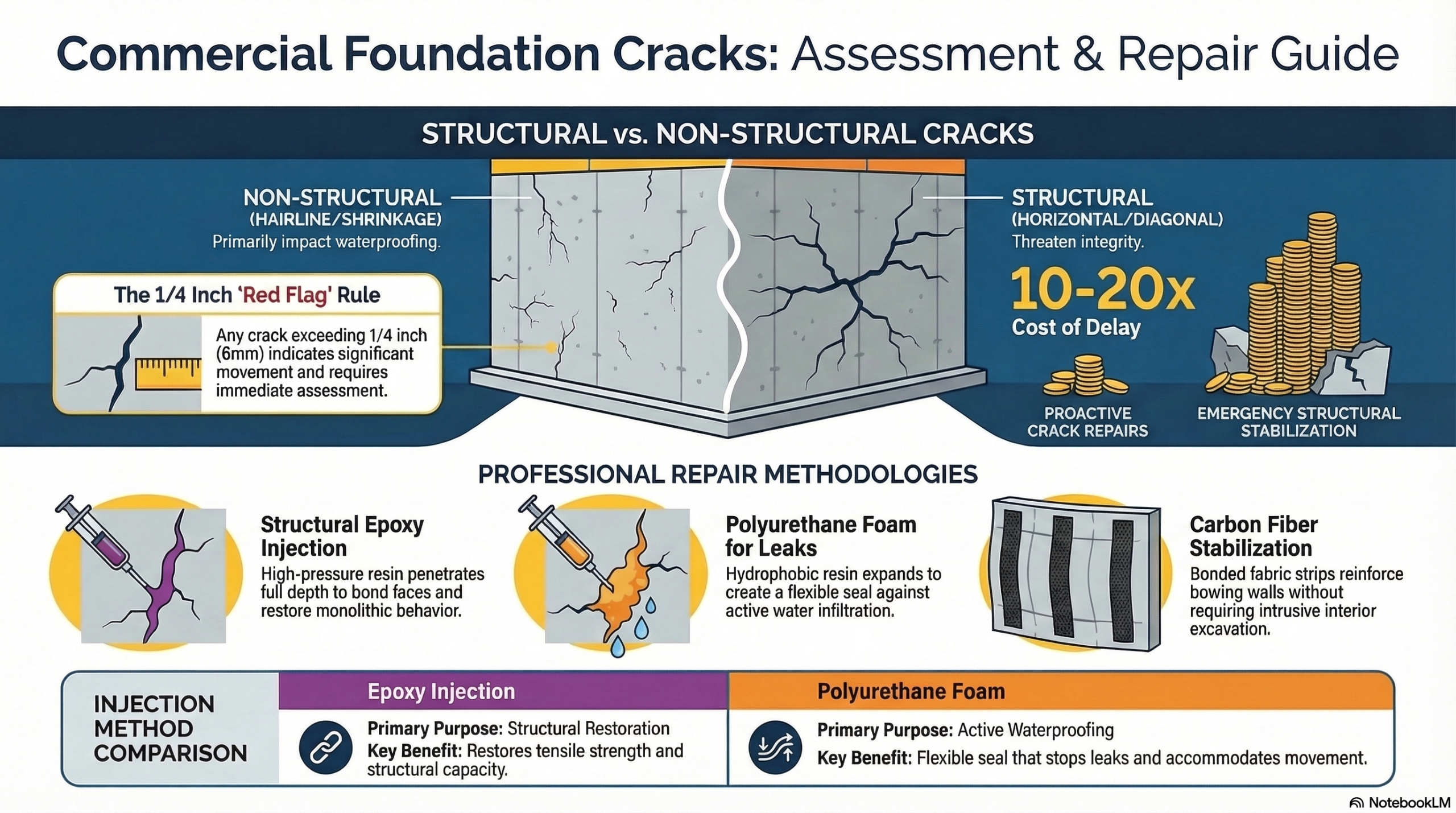
Not all foundation cracks present equal risk. Distinguishing between structural and non-structural cracking determines repair urgency and methodology.
Non-Structural Cracks:
- Shrinkage cracks from concrete curing (typically hairline, static)
- Settlement cracks from minor soil consolidation (stable, non-progressive)
- Surface crazing from thermal cycling or carbonation
These cracks may compromise waterproofing but do not immediately threaten structural integrity. However, they still require monitoring and preventative sealing to avoid moisture penetration and progressive deterioration.
Structural Cracks:
- Horizontal cracks in foundation walls indicating lateral soil pressure
- Diagonal cracks from differential settlement or bearing failure
- Vertical cracks with displacement or offset
- Cracks accompanied by wall bowing, bulging, or movement
- Progressive cracking that widens over time
For commercial buildings—particularly older industrial facilities, warehouse structures, and institutional buildings with heavy floor loads—structural cracks demand immediate engineering assessment and repair intervention.
Common Crack Patterns in GTA Commercial Properties
Ontario’s freeze-thaw cycling, expansive clay soils, and groundwater fluctuations create specific foundation distress patterns:
Freeze-Thaw Spalling and Cracking Moisture infiltration into concrete pores expands during freezing, creating internal pressure that fractures foundation walls. This is particularly problematic in older commercial buildings with inadequate waterproofing or drainage systems.
Differential Settlement Non-uniform soil bearing capacity—common in Toronto’s varied geotechnical conditions—causes foundations to settle unevenly. Manufacturing facilities with heavy equipment loads, multi-story office buildings, and structures built on fill are especially vulnerable.
Hydrostatic Pressure Cracking Groundwater pressure against below-grade foundation walls can exceed design thresholds, particularly in buildings lacking functional perimeter drainage. Parking garage substructures, below-grade storage areas, and buildings in high water table zones experience this condition frequently.
When Foundation Cracks Require Immediate Action
Warning Signs That Demand Professional Assessment
Property managers and facility teams should escalate foundation crack concerns when observing:
- Crack width exceeding 1/4 inch (6mm)—wider cracks indicate significant structural movement
- Active water infiltration through cracks during precipitation or snow melt
- Progressive crack growth documented over weeks or months
- Horizontal cracks in foundation walls, especially mid-height or near the top
- Cracks accompanied by interior floor slab movement, door/window misalignment, or ceiling distress
- Stair-step cracking in masonry foundation systems
- Visible wall displacement—bowing, leaning, or offset
For industrial facilities with manufacturing operations, warehouse buildings with racked storage systems, or institutional buildings housing critical functions, delayed intervention can lead to operational shutdowns and catastrophic structural failure.
The Risk of Deferred Foundation Repairs
Foundation cracks rarely self-correct. Progressive deterioration follows predictable patterns:
- Moisture intrusion through cracks leads to concrete freeze-thaw damage, steel reinforcement corrosion, and interior water damage
- Crack widening from continued structural movement reduces load-bearing capacity
- Secondary structural damage propagates to floor slabs, columns, and superstructure elements
- Soil infiltration through foundation cracks causes voids and further settlement
- Complete structural failure requiring emergency shoring, tenant evacuation, and extensive reconstruction
For general contractors managing occupied commercial buildings, the cost differential between early crack repair and emergency structural stabilization can exceed 10-20 times the initial intervention expense.
Foundation Crack Assessment Methodology
Professional Structural Evaluation
Before any repair work proceeds, qualified structural engineers should evaluate:
- Crack pattern, width, length, and location relative to foundation design
- Rate of crack progression using baseline measurements and monitoring over time
- Structural loading conditions including building use, equipment weight, and occupancy loads
- Geotechnical conditions through soil borings and bearing capacity analysis
- Drainage and waterproofing adequacy around the foundation perimeter
- Reinforcement condition using concrete scanning or exploratory probes
This assessment determines whether cracks result from isolated concrete defects, ongoing structural movement, or systemic foundation failure requiring comprehensive rehabilitation.
Crack Monitoring Systems
For commercial properties where crack severity is uncertain, monitoring systems provide objective data:
- Crack gauges measure width changes over time
- Tiltmeters detect foundation wall movement
- Survey benchmarks track settlement patterns
- Photographic documentation establishes baseline conditions
Property managers benefit from monitoring data when making capital planning decisions, scheduling repair work during operational lulls, and substantiating structural claims with insurance carriers.
Foundation Crack Repair Technologies
Epoxy Injection for Structural Crack Repair
Epoxy injection is the primary method for restoring structural integrity to cracked concrete foundations. This process involves:
- Surface preparation to clean and open crack faces
- Installation of injection ports at intervals along the crack
- High-pressure injection of two-part structural epoxy resin that penetrates the full crack depth
- Curing and finishing to restore concrete monolithic behavior
Properly executed epoxy injection bonds crack faces, restores tensile strength, and prevents crack reopening under load. For industrial facilities and commercial buildings where foundation walls support significant superstructure loads, epoxy injection is the only repair method that fully restores structural capacity.
Polyurethane Foam Injection for Active Leaks
When foundation cracks exhibit active water infiltration, polyurethane foam injection provides flexible waterproofing:
- Hydrophobic polyurethane resin is injected under pressure
- Foam expansion fills crack voids and penetrates surrounding concrete
- Flexible seal accommodates minor structural movement without recracking
- Immediate water cutoff stops active leaks during installation
This method is effective for below-grade parking structures, elevator pits, and mechanical rooms where water intrusion disrupts operations. However, polyurethane injection addresses waterproofing, not structural restoration—structural cracks require epoxy treatment first.
Crack Routing and Sealing
For non-structural surface cracks, routing and sealing prevents moisture intrusion and progressive deterioration:
- Diamond blade routing creates a uniform channel along the crack
- Cleaning and priming prepares bonding surfaces
- Polyurethane or silicone sealant fills the routed channel
- Surface finishing protects the repair and restores appearance
This approach is common for warehouse floors, loading dock areas, and industrial slab-on-grade foundations where surface sealing suffices for crack management.
Carbon Fiber Reinforcement for Foundation Wall Stabilization
When foundation cracks result from structural overload or wall bowing, carbon fiber reinforcement systems provide additional strength:
- Carbon fiber fabric or laminate strips are bonded to interior foundation wall surfaces
- Epoxy saturation creates a composite system that resists tension and flexure
- Minimal installation disruption compared to traditional steel bracing or wall replacement
For multi-tenant office buildings, institutional facilities, and occupied industrial buildings, carbon fiber systems offer structural reinforcement without interior excavation or tenant displacement.
Addressing Root Causes: Beyond Crack Repair
Effective foundation crack repair must address underlying conditions causing structural distress.
Drainage System Rehabilitation
Many foundation cracks stem from inadequate drainage allowing hydrostatic pressure buildup. Comprehensive solutions include:
- Exterior perimeter drain installation or rehabilitation to lower groundwater levels
- Grading improvements directing surface water away from foundations
- Downspout disconnection and extension preventing concentrated water loading
- Interior drainage systems for buildings where exterior access is impractical
Property managers overseeing commercial properties should coordinate foundation crack repair with drainage system upgrades to prevent crack recurrence.
Soil Stabilization and Underpinning
When differential settlement drives foundation cracking, soil stabilization or underpinning becomes necessary:
- Helical piers or push piers transfer foundation loads to competent bearing strata
- Compaction grouting densifies loose soils beneath foundations
- Chemical grouting stabilizes water-sensitive soils
These interventions are capital-intensive but essential for industrial buildings with heavy equipment, multi-story commercial structures, and institutional facilities where ongoing settlement threatens operational continuity.
Waterproofing System Integration
Foundation crack repair should integrate with comprehensive below-grade waterproofing:
- Exterior membrane application over repaired foundation walls
- Blindside waterproofing for foundations against property lines
- Bentonite or crystalline systems for inaccessible foundation zones
For commercial buildings in Toronto’s dense urban core, where excavation is constrained by adjacent properties and utilities, interior waterproofing systems combined with crack injection may be the only viable approach.
Nusite Group’s Approach to Commercial Foundation Crack Repair
With over 30 years of experience in concrete and structural rehabilitation, Nusite Group has addressed foundation distress on institutional, industrial, and commercial properties throughout the GTA and Southern Ontario. Our methodology prioritizes diagnostic accuracy, structural restoration, and long-term performance.
Engineering Coordination and Assessment
We collaborate with structural engineers, geotechnical consultants, and building envelope specialists to determine root causes of foundation cracking. For general contractors managing complex rehabilitation projects, this coordination ensures repair scopes address both immediate symptoms and underlying structural conditions.
Injection System Expertise
Our field teams execute high-pressure epoxy injection, polyurethane foam injection, and curtain wall injection systems using manufacturer-certified equipment and materials. Quality control protocols verify complete crack penetration, proper curing, and structural bond integrity.
Integrated Waterproofing Solutions
Foundation crack repair is coordinated with below-grade waterproofing systems—exterior membranes, drainage boards, perimeter drains—to provide comprehensive moisture protection. For property managers, this integrated approach maximizes capital investment and extends asset service life.
Occupied Building Execution
Commercial and industrial facilities rarely tolerate full operational shutdowns. We sequence foundation repair work to minimize tenant disruption, coordinate with facility operations, and implement safety protocols for occupied environments.
Frequently Asked Questions
How do I know if a foundation crack in my commercial building is structural or cosmetic?
Width, location, and progression determine crack severity. Hairline cracks (less than 1/16 inch) that remain stable over time are typically cosmetic. Cracks exceeding 1/4 inch, horizontal cracks, cracks with visible displacement, or cracks that widen over weeks indicate structural issues. Property managers should engage structural engineers for formal assessment rather than relying on visual inspection alone. Nusite Group coordinates with engineering consultants to provide property managers and facility teams with objective structural evaluations.
Can foundation cracks be repaired from the interior without exterior excavation?
Yes. Epoxy and polyurethane injection systems are installed from the interior, eliminating excavation costs and site disruption. This is particularly advantageous for commercial buildings in Toronto’s urban core where exterior access is limited by adjacent structures, utilities, and property lines. However, interior-only repairs must be combined with drainage improvements and waterproofing strategies to address root causes of foundation distress.
What is the typical cost range for commercial foundation crack repair?
Costs vary based on crack type, accessibility, building occupancy, and scope complexity. Epoxy injection for structural cracks typically ranges from $400-$800 per linear foot for commercial applications. Polyurethane injection for waterproofing runs $300-$600 per linear foot. Complex projects involving underpinning, drainage systems, or carbon fiber reinforcement require comprehensive assessments. General contractors should budget for engineering evaluations, testing, and long-term monitoring as part of total project costs.
How long does foundation crack repair last in commercial buildings?
Properly executed epoxy injection repairs restore structural integrity permanently when underlying conditions are addressed. Polyurethane waterproofing systems provide 10-20+ years of service depending on building conditions and drainage adequacy. Carbon fiber reinforcement systems are considered permanent structural upgrades. Durability depends on drainage system maintenance, groundwater management, and prevention of new structural loading that exceeds original design capacity.
Protect Your Commercial Property Investment
Nusite Group has delivered concrete and structural rehabilitation solutions on institutional, industrial, and commercial properties across the GTA and Southern Ontario since 1990. Our experience includes foundation crack repair, structural stabilization, and below-grade waterproofing on occupied buildings where operational continuity and long-term performance are critical.
Fully bonded, licensed across Ontario, and insured to $10 million in liability coverage, Nusite Group operates as a dependable specialty contractor for property managers, facility directors, and general contractors who require technical expertise and proven execution on complex structural rehabilitation projects.
Request a consultation to discuss your building’s foundation conditions or explore how Nusite Group can support your structural repair and waterproofing requirements.