What is Blindside Waterproofing and its Primary Purpose?
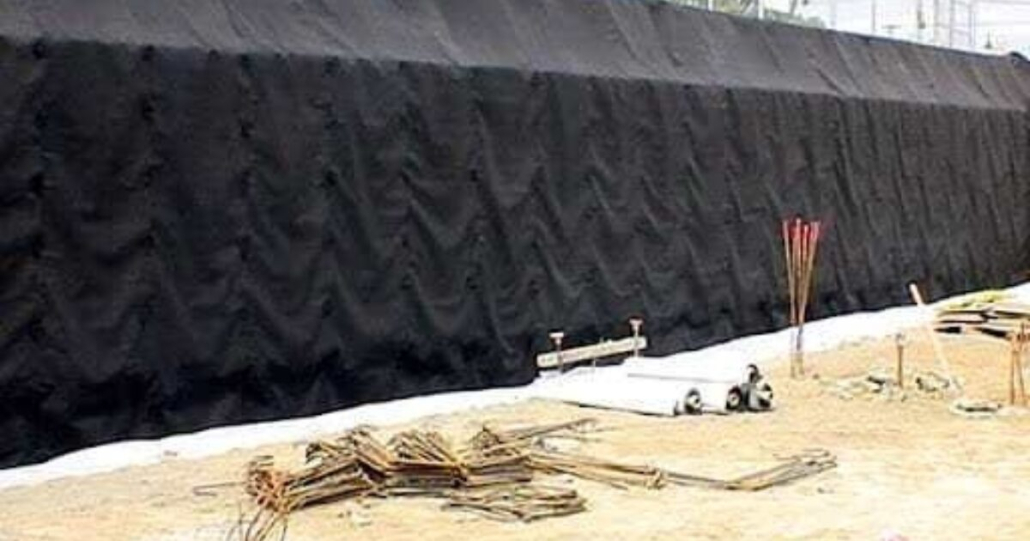
Blindside waterproofing represents one of the most technically demanding waterproofing applications in commercial construction, yet it remains essential for urban development across the Greater Toronto Area. Unlike conventional below-grade waterproofing where membranes are applied to foundation walls after construction and before backfill, blindside waterproofing must be installed to temporary excavation support systems before concrete foundation walls are cast against them.
This construction sequence creates unique challenges requiring specialized materials, installation techniques, and quality control protocols. For general contractors, property managers, and facility directors responsible for commercial office buildings, mixed-use developments, institutional facilities, and high-density urban construction projects, understanding blindside waterproofing applications, available system technologies, and performance requirements ensures successful building envelope execution on constrained urban sites.
Understanding Blindside Waterproofing: Definition and Construction Context
Blindside waterproofing refers to waterproofing systems applied to the excavation support side of foundation walls before concrete placement, creating a “blind” installation where the waterproofing membrane will become inaccessible once concrete is poured. The term “blindside” derives from the installer’s inability to see or access the waterproofing after concrete placement—there is no opportunity for inspection, testing, or repair of the membrane once the foundation wall is cast.
This construction approach becomes necessary when site conditions prevent conventional waterproofing application. In standard foundation waterproofing, excavation occurs creating space around the foundation, concrete walls are poured and cured, waterproofing membranes are applied to the exterior wall surface, protection board is installed, and backfill is placed against the protected assembly. This sequence allows waterproofing installation on accessible, vertical concrete surfaces with full visibility and quality control.
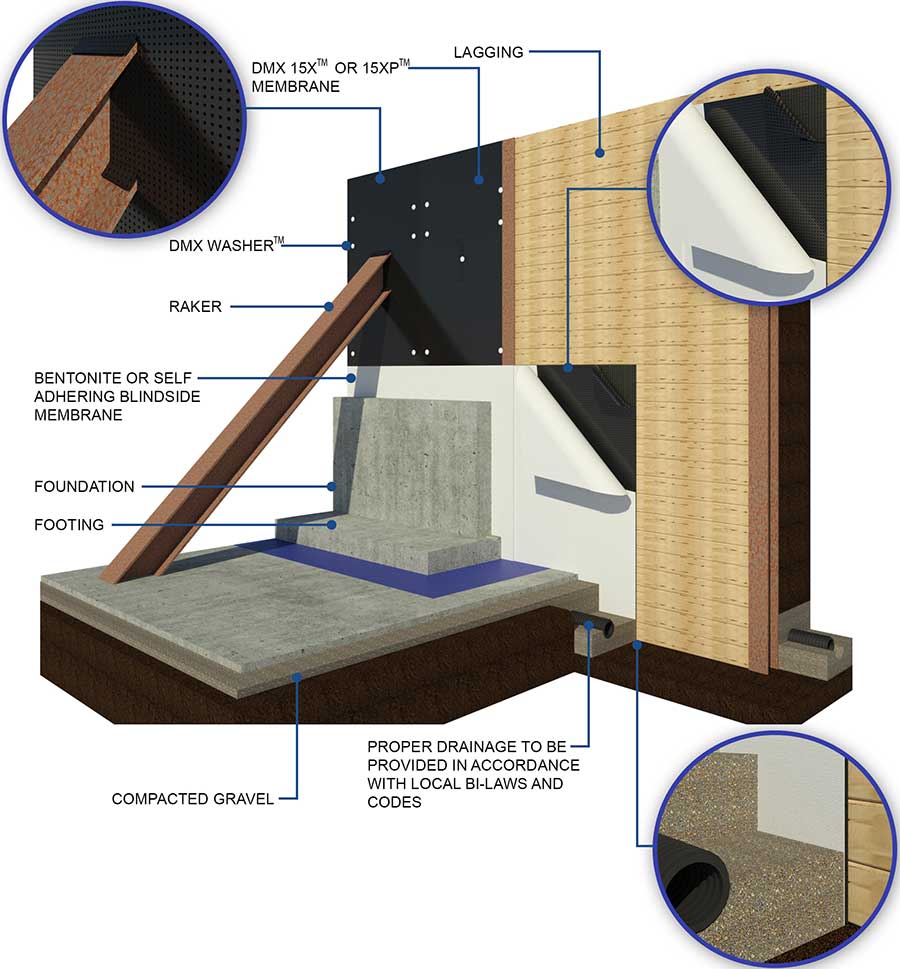
Blindside waterproofing reverses this sequence because excavation cannot extend beyond the foundation wall line. Temporary excavation support systems like sheet piling, soldier piles and lagging, or slurry walls are installed at the excavation perimeter. Waterproofing membranes are applied directly to these temporary support systems. Foundation concrete walls are cast against the waterproofing creating the final foundation assembly. The temporary support system remains in place, and the waterproofing membrane is permanently sandwiched between the support system and foundation wall.
When and Why Blindside Waterproofing Becomes Necessary
Urban construction in the GTA frequently encounters site conditions making conventional waterproofing impractical or impossible. These conditions drive blindside waterproofing application on a significant portion of commercial development projects in Toronto’s dense urban core.
Property Line Construction
The most common scenario requiring blindside waterproofing involves buildings constructed directly to property lines. When foundation walls align with or extend to property boundaries, no excavation space exists on the exterior side for conventional waterproofing application. Municipal zoning regulations in Toronto’s downtown core and intensification areas often encourage or require building placement maximizing developable area within lot boundaries. This regulatory environment, combined with high land costs making every square foot valuable, results in foundations positioned directly at property lines.
Adjacent property owners hold legal rights preventing excavation that would undermine their buildings or encroach on their land. Even temporary excavation for waterproofing installation and backfill becomes legally and practically impossible when the adjacent property contains existing buildings with foundations at or near the shared property line. Blindside waterproofing allows foundation construction and waterproofing installation entirely within the development site boundaries.
Adjacent Existing Structures
Beyond legal property line constraints, existing structures adjacent to new construction sites create physical barriers preventing exterior waterproofing access. Heritage buildings that cannot be demolished or relocated, occupied buildings that must remain operational during adjacent construction, party walls shared between properties, and existing underground infrastructure including subway tunnels or utility corridors all create conditions where conventional excavation and waterproofing prove impossible.
The GTA’s mature urban environment means new development frequently occurs on infill sites surrounded by existing buildings. Downtown Toronto, North York Centre, Mississauga City Centre, and other intensification nodes feature new construction inserted into built environments where adjacent structures constrain excavation and construction sequencing. Blindside waterproofing enables these infill projects by eliminating the need for exterior access to foundation walls.
Excavation Support Systems Remaining Permanent
Certain geotechnical or site conditions require permanent excavation support systems that preclude conventional waterproofing. Deep excavations in poor soil conditions may use secant pile walls, tangent pile walls, or diaphragm walls that become permanent foundation elements. When these structural support systems remain in place as part of the final building, waterproofing must be applied to their interior faces before foundation walls are constructed—a blindside application by definition.
Contaminated soil conditions sometimes necessitate leaving excavation support systems in place to avoid disturbing or exposing contaminated materials during removal. Environmental regulations and site remediation strategies may specify minimal soil disturbance, making permanent excavation support with interior blindside waterproofing the preferred construction approach.
Blindside Waterproofing System Technologies
Multiple waterproofing technologies have been adapted for blindside applications, each offering distinct advantages and limitations based on site conditions, performance requirements, and construction sequencing.
Bentonite Sheet Membrane Systems
Bentonite waterproofing represents one of the earliest and most widely used blindside technologies. These systems consist of corrugated HDPE or polypropylene panels with bentonite clay between the corrugations or bonded to the panel surface. When exposed to water, bentonite clay swells to many times its dry volume, forming a dense, impermeable gel that seals the waterproofing layer.
Installation and Performance Characteristics:
The panels are mechanically fastened to excavation support systems including sheet piling, wood or steel lagging, or shotcrete-covered soil. Joints between panels overlap with bentonite contained in the corrugations creating continuity. Foundation concrete is poured directly against the panels, with concrete pressure compressing bentonite and creating intimate contact between membrane and concrete. Hydration from groundwater or concrete moisture activates bentonite swelling, sealing any minor gaps or imperfections.
The self-healing properties of bentonite provide significant advantage in blindside applications. Minor membrane damage during construction, small voids at panel joints, or imperfect concrete placement all become sealed as bentonite hydrates and expands. This forgiving nature suits the blind installation conditions where perfect execution cannot be verified before concrete placement. The system accommodates irregular substrate surfaces common with excavation support systems, requires no special surface preparation beyond basic cleaning, and provides proven performance with decades of successful installations.
However, bentonite systems have limitations requiring consideration. Performance depends on adequate water presence for bentonite hydration—extremely dry soil conditions may not provide sufficient moisture. Highly contaminated groundwater or aggressive chemical exposures can degrade bentonite effectiveness. The system adds minimal thickness, providing limited crack-bridging capability compared to thicker membrane systems. Installation must protect panels from prolonged rain exposure before concrete placement, as pre-hydration can compromise performance.
Self-Adhered Rubberized Asphalt Membranes
Self-adhered rubberized asphalt sheet membranes designed specifically for blindside applications provide fully bonded waterproofing with reliable performance across various conditions. These membranes consist of rubberized asphalt waterproofing compound laminated to a tough HDPE backing sheet with an aggressive self-adhesive layer.
The HDPE backing provides puncture resistance, dimensional stability, and a surface suitable for concrete bonding. Rubberized asphalt waterproofing compound delivers proven water resistance and some self-healing capability. Aggressive adhesive systems bond the membrane to diverse substrates including steel sheet piling, wood lagging, concrete, shotcrete, and gypsum board protection layers. Self-adhesive technology eliminates hot work, allows installation in varied temperature conditions, and creates immediate bond preventing membrane displacement before concrete placement.
Key Advantages:
These systems accommodate substrate irregularities through conformable membrane composition and aggressive adhesives. The membranes bridge minor substrate cracks or gaps, providing more continuity than rigid panel systems. Installation proceeds rapidly without specialized equipment or heating apparatus, reducing schedule impact. Quality control during installation allows verification of seam overlaps, surface adhesion, and membrane continuity before concrete conceals the work. Some formulations offer superior chemical resistance compared to bentonite systems, suiting sites with contaminated groundwater or aggressive soil conditions.
Limitations include sensitivity to surface preparation—adhesion requires clean, dry substrates free of frost, ice, or standing water. Membrane application during cold weather requires special formulations or installation techniques. The systems are less forgiving of substrate irregularities compared to bentonite’s self-healing properties. Cost typically exceeds bentonite systems, though improved reliability may justify premium pricing for critical applications.
Fluid-Applied Membrane Systems
Fluid-applied waterproofing membranes offer seamless blindside solutions particularly valuable for complex geometries, numerous penetrations, or unusual substrate conditions. These liquid-applied products cure in place creating monolithic membranes conforming to any substrate configuration.
Available chemistries include spray-applied polyurethane or polyurea creating thick, elastomeric waterproofing layers; modified asphalt emulsions providing self-healing asphalt-based membranes; and cementitious crystalline waterproofing systems reacting with concrete moisture forming crystals that block water pathways. Spray-applied systems build specified thickness through multiple passes, with reinforcement fabrics at transitions or critical areas. The seamless installation eliminates vulnerability at seams present in sheet membrane systems.
Application Advantages:
Complex substrate geometries including curved excavation support systems, irregular surfaces from shotcrete or lagging, and numerous penetrations or transitions all suit fluid-applied membrane approaches better than rigid sheet systems. Application proceeds rapidly on large areas using spray equipment. Thickness can be varied addressing specific exposure conditions—thicker application at anticipated high water pressure zones. Some chemistries bond to wet or damp substrates, valuable in excavations with active seepage.
Challenges include application thickness control requiring skilled crews and quality oversight. Surface preparation, weather conditions during application, and cure time before concrete placement all critically affect performance. Multiple coat application extends installation timelines compared to single-pass sheet membrane systems. Material costs often exceed sheet membrane alternatives, though labor savings on complex projects may offset premium pricing.
Thermoplastic and PVC Sheet Membranes
PVC and thermoplastic sheet membranes adapted for blindside application provide proven waterproofing technology with heat-welded seams creating monolithic assemblies. Standard PVC roofing membranes designed for high-performance applications are reinforced, mechanically fastened to substrates, and heat-welded at seams. Some manufacturers offer blindside-specific formulations with enhanced bonding properties ensuring intimate contact with concrete.
Heat-welded seams provide superior reliability compared to adhesive-dependent systems, creating fusion bonds stronger than the parent membrane. This seam integrity suits blindside applications where post-installation verification is impossible. The membranes offer excellent chemical resistance, proven durability with roofing installations exceeding 30 years, and high tear and puncture resistance. Mechanical fastening provides positive attachment preventing membrane displacement during construction activities or concrete placement.
Installation requires skilled crews familiar with heat welding techniques and specialized welding equipment. Surface preparation and substrate compatibility must be carefully evaluated, as fastening to sheet piling, wood lagging, or other temporary systems requires appropriate fastener selection and spacing. Cold weather installation presents challenges with membrane flexibility and welding equipment performance. Cost typically positions these systems at the premium end of blindside options, justified primarily for applications demanding maximum reliability and chemical resistance.
Installation Methodology and Quality Control
Successful blindside waterproofing depends on rigorous installation protocols and quality control despite the inherent challenges of blind application conditions. The installation sequence begins with excavation support system preparation ensuring surfaces suitable for membrane application. Sheet piling, soldier piles with lagging, or cast-in-place concrete walls must be inspected, cleaned of soil and debris, and assessed for damage or irregularities requiring remediation.
Critical Installation Steps:
Membrane installation proceeds following manufacturer specifications regarding surface preparation, ambient temperature limits, substrate moisture conditions, and application techniques. For sheet membrane systems, proper overlap dimensions, seam sealing methods, mechanical fastening patterns, and membrane terminations at horizontal and vertical transitions require strict adherence to specifications. Quality control inspections verify each installation phase before proceeding—substrate preparation approval before membrane application begins, membrane continuity verification before concrete formwork installation, and protection measures before concrete placement.
The membrane must be protected during subsequent construction activities. Protection boards, reinforcing steel installation, formwork placement, and concrete pumping operations all create potential for membrane damage. Rigid protection boards mechanically fastened over the waterproofing membrane, inspection walks and embedment restriction zones preventing damage from construction traffic, and careful rebar cage installation avoiding punctures or tears all form essential protection protocols.
Concrete placement represents the critical final installation phase. Concrete mix design should avoid excessive slump creating high hydrostatic pressures potentially displacing membranes. Placement rates and lift heights should be controlled preventing sudden pressure surges. Concrete consolidation must achieve intimate contact with membranes without causing damage. Internal vibration rather than form vibration prevents excessive membrane stress. Proper concrete curing follows placement, with adequate moisture and temperature control ensuring concrete develops design strength and bonds appropriately with waterproofing systems.
Performance Verification and Risk Mitigation
Blindside waterproofing’s fundamental challenge is the inability to verify performance after installation—once concrete is placed, the membrane becomes permanently inaccessible for inspection, testing, or repair. This reality drives comprehensive pre-placement verification and risk mitigation strategies.
Pre-concrete placement verification should include thorough membrane continuity inspection documenting complete coverage, proper seam overlaps and sealing, adequate fastening preventing displacement, protection board installation where specified, and photographic documentation of all conditions. Third-party inspection services provide independent verification that installation meets specifications and manufacturer requirements, particularly valuable for risk management and warranty activation.
Some waterproofing manufacturers offer flood testing protocols for blindside installations. Test sections of foundation wall with waterproofing installed are subjected to controlled water pressure before full concrete placement. Successful flood testing provides confidence in system integrity, though practical limitations restrict testing to accessible areas rather than the entire installation.
Post-construction moisture monitoring systems installed within foundation wall assemblies provide long-term performance verification. Moisture sensors embedded at the waterproofing layer, mid-wall, and interior face detect any water infiltration indicating membrane failure. While monitoring doesn’t prevent failures, it enables early detection and remediation before interior damage occurs. For critical commercial buildings, parking structures, or institutional facilities, monitoring systems justify their cost through risk reduction.
Risk mitigation also involves redundancy strategies. Dual waterproofing systems with both blindside exterior membranes and interior negative-side waterproofing provide backup protection if either system fails. This belt-and-suspenders approach suits applications where waterproofing failure consequences are severe—below-grade parking, critical equipment rooms, or occupied spaces intolerant of water infiltration. While redundant systems increase initial costs significantly, they essentially eliminate waterproofing failure risk.
Common Challenges and Solutions
Blindside waterproofing installations face several recurring challenges requiring proactive solutions and careful construction coordination. Substrate irregularities from excavation support systems create gaps, voids, or protrusions that challenge waterproofing continuity. Solutions include shimming low areas with compatible materials before membrane application, grinding or cutting protruding elements flush with general substrate plane, and applying thicker fluid-applied systems conforming to irregular surfaces.
Membrane terminations at grade transitions, construction joints, and utility penetrations represent vulnerability points where blindside and conventional waterproofing must integrate. These critical details require careful engineering showing how blindside membranes terminate and transition to accessible waterproofing areas. Prefabricated termination strips, flexible transition membranes, and carefully sequenced installation ensure continuity across these junctions.
Construction sequencing and trade coordination prove more complex with blindside applications than conventional waterproofing. Structural concrete contractors, waterproofing specialists, reinforcing steel crews, forming contractors, and concrete pumping operations must coordinate precisely. Schedule delays in any trade cascade through dependent activities. General contractors managing projects with blindside waterproofing should develop detailed sequencing plans with contingency buffers and regular coordination meetings ensuring all parties understand dependencies and timing requirements.
Weather impacts create schedule and performance risks. Rain during membrane installation compromises adhesion for self-adhered systems, delays fluid-applied membrane curing, or causes premature bentonite hydration. Cold weather affects membrane flexibility, adhesive performance, and concrete curing. Effective weather protection strategies including temporary enclosures, heating systems for cold weather, and contingency scheduling for adverse weather mitigate these challenges.
Nusite Group’s Blindside Waterproofing Expertise
With over 30 years of waterproofing and below-grade system experience, Nusite Group has executed blindside waterproofing on commercial office buildings, mixed-use developments, institutional facilities, and parking structures throughout the GTA and Southern Ontario. Our installations protect below-grade spaces on constrained urban sites where conventional waterproofing proves impossible due to property line construction, adjacent structures, or permanent excavation support systems.
We provide comprehensive blindside waterproofing solutions using bentonite sheet membrane systems, self-adhered rubberized asphalt membranes, fluid-applied membrane systems, and thermoplastic sheet membranes. Our technical approach matches system selection to site conditions, excavation support configurations, performance requirements, and construction sequencing constraints. We coordinate closely with general contractors, structural engineers, excavation contractors, and concrete suppliers ensuring successful installation and reliable long-term performance.
Our experienced installation crews understand the critical nature of blindside applications where post-installation verification is impossible. We implement rigorous quality control protocols including thorough substrate preparation, membrane continuity verification, protection board installation, and comprehensive documentation before concrete placement. Third-party inspection coordination and manufacturer involvement ensure warranty compliance and performance assurance.
Frequently Asked Questions
How does blindside waterproofing performance compare to conventional exterior waterproofing?
When properly designed and installed, blindside waterproofing provides equivalent performance to conventional systems. The key difference is risk—conventional waterproofing allows post-installation inspection, testing, and repair if defects are discovered, while blindside systems become permanently inaccessible after concrete placement. This drives more stringent quality control during blindside installation, conservative system selection favoring proven technologies, and sometimes redundant waterproofing approaches providing backup protection. Property managers should expect comparable long-term performance from blindside systems with appropriate upfront investment in quality installation and oversight. Failed blindside waterproofing is extremely difficult and expensive to remediate, emphasizing the importance of getting it right during initial construction.
What happens if blindside waterproofing fails after the building is complete?
Blindside waterproofing failure remediation is challenging and expensive because the membrane cannot be accessed from outside. Interior negative-side waterproofing systems applied to foundation wall interior surfaces provide the primary remediation approach, managing water after it penetrates the failed blindside membrane. Interior drainage systems, crystalline waterproofing, and cementitious coatings all represent interior remediation options. In extreme cases, exterior excavation may be attempted if adjacent property access can be negotiated and temporary underpinning protects adjacent structures, though this approach is prohibitively expensive and often technically impractical. The difficulty of blindside failure remediation emphasizes the critical importance of quality installation during original construction. General contractors and property owners should invest in proven systems, experienced contractors, and rigorous quality control rather than accepting lowest-cost approaches on blindside applications.
Can blindside waterproofing be used for the entire foundation or just at property lines?
Blindside waterproofing is typically specified only where site conditions necessitate it—property line walls, areas adjacent to existing structures, or locations with permanent excavation support systems. Portions of foundations with exterior access receive conventional waterproofing, which is preferred due to easier installation, better quality control, simpler warranty compliance, and straightforward repair if needed. Mixed waterproofing approaches require careful transition detailing where blindside and conventional systems meet. Some projects use blindside methods throughout for construction schedule advantages—eliminating the return trip for waterproofing installation after concrete curing saves time. However, this approach sacrifices the quality control benefits of conventional methods without compelling site constraints. Property managers should question specifications calling for extensive blindside waterproofing without clear site condition justification.
How much does blindside waterproofing cost compared to conventional foundation waterproofing?
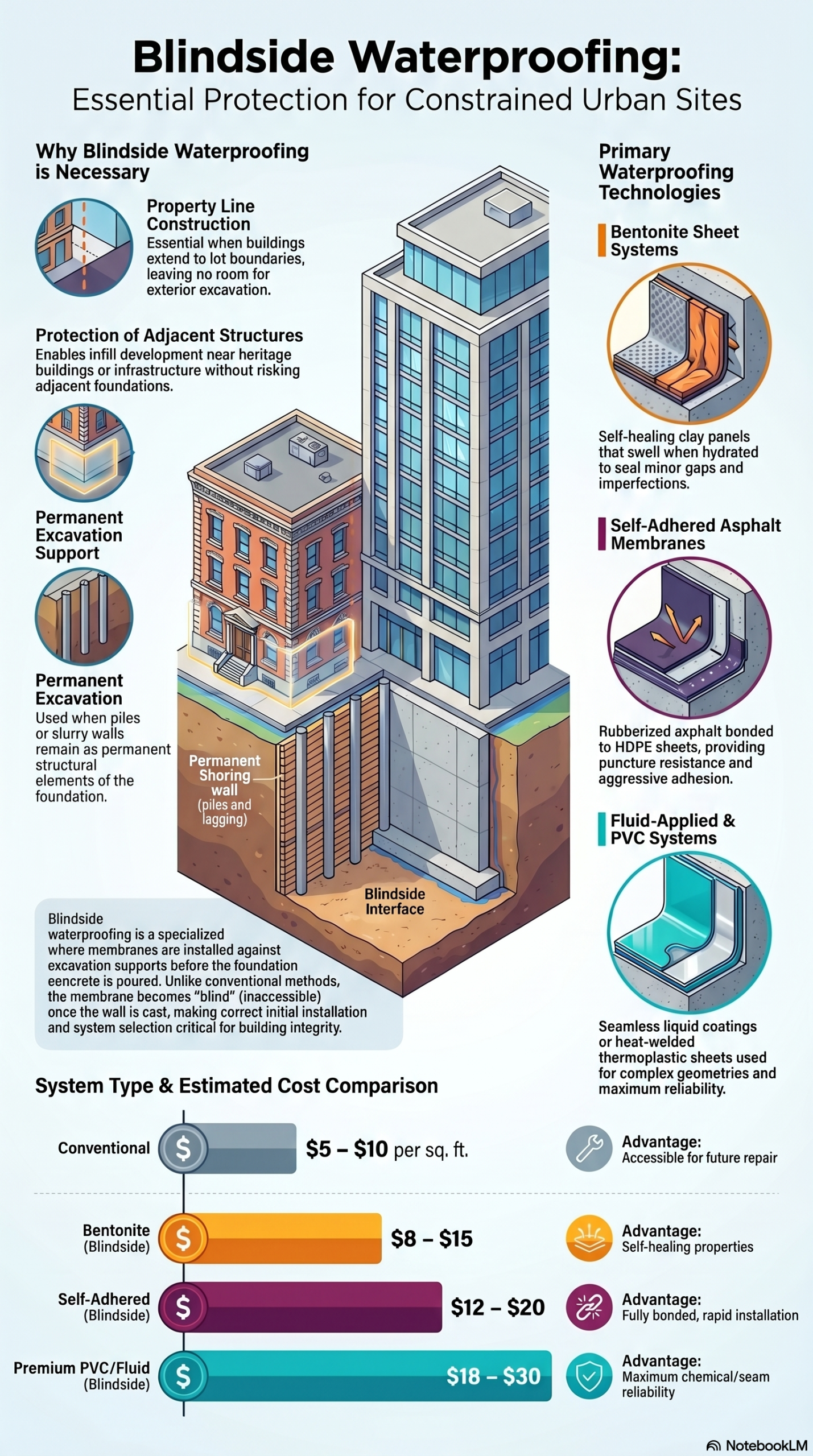
Blindside waterproofing typically costs 50 to 150 percent more than conventional systems due to specialized materials, more complex installation, enhanced quality control, and project risk factors. Bentonite sheet systems range from $8 to $15 per square foot installed versus $5 to $10 per square foot for conventional drainage board and membrane assemblies. Self-adhered rubberized asphalt blindside membranes cost $12 to $20 per square foot. Premium systems like PVC or spray-applied polyurethane reach $18 to $30 per square foot. These costs reflect material premiums for blindside-rated products, more intensive surface preparation, skilled installation labor, protection board requirements, and extensive quality control and documentation. For constrained urban sites where blindside application is necessary, the cost premium represents unavoidable project reality. General contractors should budget appropriately and resist value engineering that compromises blindside waterproofing quality—remediation costs if systems fail far exceed initial installation savings.
Protect Your Below-Grade Investment
Nusite Group has delivered blindside waterproofing solutions on commercial buildings, mixed-use developments, institutional projects, and parking structures across the GTA and Southern Ontario since 1990. Our installations protect below-grade spaces on constrained urban sites where property line construction and adjacent structures necessitate blindside waterproofing approaches.
Fully bonded, licensed across Ontario, and insured to $10 million in liability coverage, Nusite Group operates as a dependable specialty contractor for general contractors, property managers, and developers who require proven expertise and rigorous execution on challenging blindside waterproofing applications.
Request a consultation to discuss your project’s blindside waterproofing requirements or explore how Nusite Group can support your below-grade waterproofing needs with bentonite, self-adhered membrane, or fluid-applied waterproofing systems.