Below-grade waterproofing represents a critical building envelope decision in commercial construction, yet the fundamental differences between blindside and traditional exterior waterproofing applications remain unclear to many property managers and general contractors. While both approaches aim to prevent groundwater infiltration into below-grade spaces, the installation sequences, quality control capabilities, performance characteristics, and long-term risk profiles differ substantially. For property managers, facility directors, and general contractors responsible for commercial office buildings, mixed-use developments, institutional facilities, and urban infill projects across the Greater Toronto Area, understanding these differences ensures appropriate waterproofing system selection, realistic performance expectations, and informed risk management on constrained construction sites where blindside applications may be necessary or where traditional exterior methods provide superior alternatives.

Fundamental Installation Sequence Differences

The defining distinction between blindside and traditional exterior waterproofing lies in when and how membranes are applied relative to foundation wall construction.

Traditional Exterior Waterproofing Sequence

Traditional exterior waterproofing follows a logical, accessible installation progression that has been the standard approach for generations of commercial construction. After excavation creates the building footprint, foundation footings are poured and cured. Foundation walls are then constructed using formed concrete, precast panels, or masonry assemblies. Once walls are complete and forms are removed, the exterior surfaces become accessible for waterproofing membrane application.

This sequence allows contractors to work on vertical concrete surfaces that are fully visible and accessible from the excavation. Waterproofing crews can inspect the substrate, prepare surfaces through cleaning or profiling, apply primer coatings, install waterproofing membranes using their preferred methods, and verify complete coverage before proceeding. After membrane installation and any required testing, protection boards are fastened over the waterproofing, and backfill operations restore soil against the foundation wall.

The critical advantage of this sequence is complete visibility and accessibility during every installation step. Quality control can verify substrate conditions before membrane application, inspect membrane coverage during installation, and test waterproofing integrity before concealment. If defects are discovered, repairs proceed easily while the membrane remains exposed and accessible.

Blindside Waterproofing Sequence

Blindside waterproofing reverses this traditional sequence out of necessity when site conditions prevent conventional approaches. Excavation support systems—sheet piling, soldier piles with lagging, or permanent foundation walls—are installed at the excavation perimeter first. Waterproofing membranes are then applied directly to these temporary support systems before any foundation wall construction occurs.

After membrane installation on the excavation support, structural foundation walls are poured against the waterproofing. Concrete placement occurs with the waterproofing membrane sandwiched between the excavation support and the new foundation wall. The membrane becomes permanently inaccessible once concrete is placed—creating the “blind” installation that defines this approach.

Critical Implications:

This reversed sequence creates fundamental quality control challenges. Once foundation concrete is poured, the waterproofing membrane can never be inspected, tested, or accessed for repair. Any installation defects, damage during concrete placement, or future membrane failures become permanent problems with extremely limited remediation options. Property managers and general contractors must accept higher risk with blindside applications because post-installation verification is impossible.

The approach also constrains material selection since not all waterproofing technologies function reliably when installed to temporary supports and subjected to concrete placement pressures. Systems must be specifically engineered and proven for blindside use rather than assuming any exterior waterproofing product will perform adequately in this demanding application.
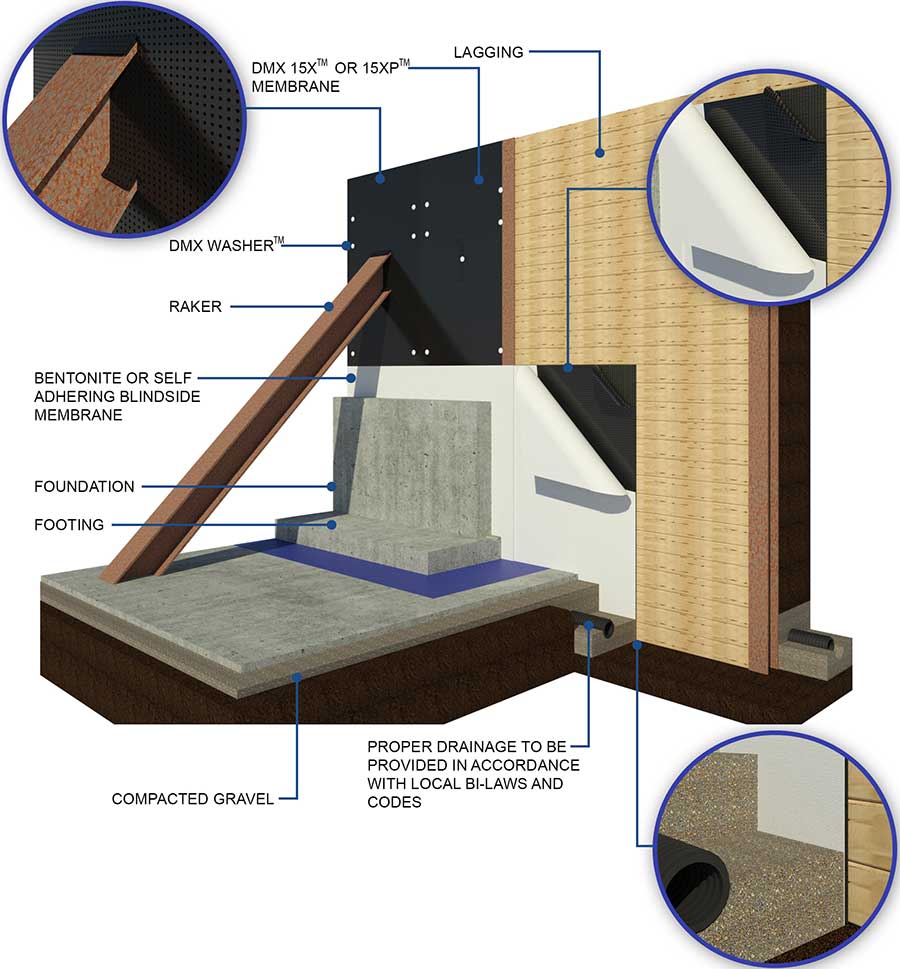
blindside waterproofing diagram

Performance Comparison: Reliability and Longevity

Traditional Exterior Waterproofing Performance

Traditional exterior waterproofing benefits from installation conditions that promote reliable, long-term performance. Membranes applied to cured, stable concrete substrates develop optimal bonds and maintain integrity over decades of service. The concrete surface provides a permanent, dimensionally stable substrate that won’t shift, settle, or change significantly after membrane application.

Waterproofing membranes in traditional applications remain in compression from groundwater pressure, which actually enhances their waterproofing effectiveness. Water pressure pushes membranes against foundation walls rather than attempting to pull them away from substrates. This pressure advantage means minor installation imperfections often self-seal as water pressure compresses membranes into intimate contact with substrates.

Service Life Expectations:

Properly installed traditional exterior waterproofing systems routinely provide 30 to 50 year service life, with some premium membranes exceeding 50 years. Rubberized asphalt sheet membranes, modified bitumen systems, and HDPE or PVC sheet membranes all demonstrate multi-decade performance when installed using conventional methods on stable foundation walls. This proven longevity provides property managers with confidence in lifecycle cost analysis and capital planning.

The systems tolerate normal foundation settlement and structural movement within design parameters without membrane failure. Thermal cycling, freeze-thaw conditions, and hydrostatic pressure variations all occur within the performance envelope of quality exterior waterproofing systems. Protection boards shielding membranes from backfill damage and mechanical impacts further extend service life.

Blindside Waterproofing Performance Challenges

Blindside waterproofing operates under more demanding conditions that can affect long-term performance and reliability. Membranes installed on temporary excavation supports rather than permanent foundation walls face substrate stability concerns. Sheet piling may deflect under soil pressure, wood lagging can warp or deteriorate, and shotcrete surfaces may be irregular—all creating challenging conditions for waterproofing membrane adhesion and continuity.

Concrete placement against waterproofing membranes subjects them to significant pressures and potential mechanical damage. Concrete mix design, placement methods, and consolidation techniques all affect whether membranes survive concrete operations without damage. Even with careful installation and concrete placement procedures, some membrane displacement or damage risk exists that doesn’t occur with traditional exterior applications.

Performance Variables:

The permanent inaccessibility of blindside membranes means any installation defects or concrete-induced damage cannot be identified and corrected. Unlike traditional exterior systems where pre-backfill testing and inspection can verify waterproofing integrity, blindside installations rely entirely on process control during installation. This creates performance uncertainty absent from traditional approaches.

However, when properly executed using proven blindside-rated materials and experienced installation crews, blindside waterproofing can deliver reliable performance approaching traditional systems. Service life expectations of 20 to 40 years are reasonable for quality blindside installations, though the higher risk profile and performance variability compared to traditional methods justifies conservative assumptions in lifecycle planning.

Quality Control and Verification Capabilities

Traditional Exterior Waterproofing Quality Assurance

Traditional exterior waterproofing allows comprehensive quality control throughout installation, providing multiple verification opportunities before membranes become inaccessible. Substrate inspection confirms concrete curing, surface condition, and moisture levels meet waterproofing manufacturer specifications. Surface preparation can be verified ensuring proper profile, cleanliness, and defect repair before membrane application begins.

During membrane installation, continuous inspection monitors proper overlap dimensions, seam sealing techniques, fastener patterns, and membrane terminations at penetrations and transitions. Third-party inspections provide independent verification of installation quality when specified. Any deficiencies identified during installation can be corrected immediately while materials remain exposed and accessible.

Pre-Backfill Testing:

Perhaps most importantly, traditional exterior waterproofing enables pre-backfill performance testing that blindside applications cannot accommodate. Flood testing involves temporarily damming foundation walls and filling excavation zones with water to specified depths, then inspecting interior foundation surfaces for any water infiltration. This definitive waterproofing verification occurs before backfill conceals membranes, allowing repairs if leaks are discovered.

Electronic leak detection can identify membrane defects using low-voltage electrical testing or other non-destructive methods. Pull-off adhesion testing verifies membrane bond strength to substrates. These quality assurance measures provide confidence in waterproofing performance before construction proceeds—eliminating the uncertainty inherent in blindside applications where post-installation verification is impossible.

Photographic documentation establishes complete installation records showing membrane coverage, detail execution, and overall quality before concealment. This documentation supports warranty activation, future reference if building issues arise, and property management asset records.

Blindside Waterproofing Quality Control Limitations

Blindside waterproofing quality control faces fundamental limitations since membrane installation occurs before concrete placement makes verification impossible. Quality assurance must rely entirely on process control—ensuring proper materials, experienced crews, and careful installation procedures—rather than product testing and verification.

Pre-installation material verification confirms that waterproofing products are specifically rated for blindside use rather than standard exterior waterproofing materials. Installation monitoring documents proper surface preparation on excavation supports, correct membrane overlap and sealing, adequate fastening preventing displacement, and protection measures before concrete placement.

Limited Testing Options:

Some limited testing can occur on blindside installations. Small test sections may undergo flood testing before full foundation wall construction, providing some performance verification though not comprehensive system validation. Installation crews can document membrane continuity through visual inspection before formwork and reinforcing steel installation obscures waterproofing.

However, once concrete is placed, absolutely no verification is possible. The membrane becomes permanently inaccessible and untestable. This means any installation errors, concrete placement damage, or material defects go undetected until building occupancy when leaks may appear—years after construction when remediation proves extremely difficult and expensive.

General contractors and property managers must accept this higher risk profile with blindside applications. Mitigation strategies include specifying proven blindside systems with documented performance history, requiring experienced contractors with blindside installation expertise, implementing rigorous process control and documentation, and considering redundant waterproofing approaches providing backup protection.

Blindside Waterproofing Contractors Toronto Project

Cost Comparison and Budget Implications

Material Cost Differences

Waterproofing materials specifically engineered and rated for blindside applications typically command 20 to 50 percent premiums over comparable exterior waterproofing products. This reflects enhanced performance requirements, specialized formulations, and manufacturer liability accepting blindside use. Bentonite panel systems, self-adhered rubberized asphalt membranes, and fluid-applied products designed for blindside installation all cost more than standard versions.

Premium materials for blindside applications include aggressive adhesive systems ensuring bond to diverse excavation support substrates, enhanced puncture resistance surviving concrete placement, proven performance under compression from concrete pressure, and self-healing properties compensating for minor installation imperfections. These performance enhancements justify material cost premiums for the demanding blindside application conditions.

Traditional exterior waterproofing material selection encompasses broader options including economy and mid-range products appropriate for conventional installation conditions. Standard rubberized asphalt membranes, conventional modified bitumen systems, and basic fluid-applied products all function adequately when installed using traditional methods—providing cost flexibility based on project budgets and performance requirements.

Installation Labor and Complexity

Blindside waterproofing installation generally costs 30 to 60 percent more than traditional exterior applications due to increased complexity, challenging working conditions, and enhanced quality control requirements. Waterproofing crews must work on temporary excavation supports that may be irregular, damp, or difficult to access. Installation proceeds in confined excavation spaces before foundation walls provide working platforms.

Protection of installed membranes during subsequent construction activities requires careful coordination and adds labor costs. Reinforcing steel installation, formwork placement, and concrete pumping operations all create membrane damage risk necessitating protection boards, restricted access zones, and construction sequencing that doesn’t apply to traditional exterior work.

Overall Project Cost Impact:

Total project cost comparison must account for excavation and site work differences between approaches. Blindside waterproofing enables construction directly to property lines without exterior working space, potentially eliminating excavation and backfill operations that traditional methods require. For constrained urban sites, this excavation savings may offset waterproofing premium costs.

Property managers should expect blindside waterproofing to cost 50 to 150 percent more than traditional exterior systems when comparing equivalent foundation areas under similar conditions. However, site-specific factors including excavation costs, adjacent property impacts, and schedule considerations affect total project economics. Comprehensive cost analysis comparing all project implications determines whether blindside or traditional approaches provide better value for specific applications.

Risk Assessment and Mitigation Strategies

Traditional Exterior Waterproofing Risk Profile

Traditional exterior waterproofing presents relatively low risk when properly designed and installed using proven systems and qualified contractors. The visible, accessible installation allows real-time quality control identifying and correcting deficiencies before concealment. Pre-backfill testing verifies performance eliminating uncertainty about waterproofing effectiveness.

If waterproofing failures do occur after building occupancy, traditional exterior membranes can theoretically be accessed through excavation for repair. While excavation proves expensive and may face site constraints in developed areas, the possibility exists unlike permanently inaccessible blindside systems. This repairability provides risk mitigation absent from blindside approaches.

Primary Risk Factors:

Traditional exterior waterproofing risks relate primarily to foundation settlement, structural movement exceeding design parameters, and mechanical damage from backfill operations or utility installations. These risks are well-understood with established mitigation strategies including proper protection board installation, controlled backfill procedures, and utility coordination ensuring excavation activities don’t damage waterproofing.

Material selection from established manufacturers with proven track records, experienced contractor installation, and comprehensive quality control protocols reduce traditional exterior waterproofing risk to minimal levels. Property managers can reasonably expect reliable performance when these fundamentals are addressed.

Blindside Waterproofing Risk Mitigation

Blindside waterproofing’s higher inherent risk requires proactive mitigation strategies that property managers and general contractors should implement on all such projects. Material selection should favor proven systems with documented blindside performance history rather than experimenting with unproven products. Manufacturer technical support during design and installation provides valuable expertise.

Contractor qualifications become critical for blindside success. Specification should require demonstrated blindside installation experience, references from previous similar projects, and crew training in blindside techniques. Some manufacturers offer certification programs for contractors installing their blindside systems—these credentials indicate qualified installers.

Enhanced Oversight:

Third-party inspection services provide independent quality verification during critical installation phases. Inspectors monitor substrate preparation, membrane application, protection board installation, and concrete placement procedures ensuring compliance with specifications. While inspectors cannot verify the concealed final result, they document proper installation process providing reasonable confidence in likely performance.

Some projects specify redundant waterproofing approaches combining blindside exterior systems with interior negative-side waterproofing treatments. This belt-and-suspenders strategy provides backup protection if exterior blindside systems develop leaks. While redundancy increases costs substantially, it essentially eliminates waterproofing failure risk for critical applications where moisture infiltration would cause severe consequences.

Contingency planning should address potential waterproofing failures. Interior drainage systems, dehumidification provisions, and moisture monitoring capabilities provide fallback moisture management if blindside waterproofing proves inadequate. These provisions add project cost but reduce long-term risk.

Appropriate Applications: When to Use Each Approach

Traditional Exterior Waterproofing Applications

New construction projects should default to traditional exterior waterproofing unless specific site constraints necessitate blindside approaches. Buildings positioned away from property lines, projects with excavation access around foundation perimeter, and sites without adjacent structures all enable traditional methods providing superior quality control, performance verification, and long-term reliability.

The approach suits all below-grade applications where exterior access exists including parking structures, building foundations with occupied spaces below grade, elevator pits, mechanical vaults, and utility tunnels. Any application where waterproofing integrity is critical and exterior access can be achieved should specify traditional exterior methods over blindside alternatives.

Strategic Advantages:

For property owners with long-term holding strategies and focus on lifecycle performance, traditional exterior waterproofing justifies any incremental site work costs through superior durability, reduced risk, and proven reliability. Buildings housing critical operations, sensitive equipment, or valuable contents benefit from the performance advantages traditional methods provide.

Projects where excavation support systems are temporary and will be removed after foundation construction automatically favor traditional exterior waterproofing since membranes can be applied to completed foundation walls. This represents the vast majority of suburban and low-density commercial construction where property line setbacks provide working space.

Blindside Waterproofing Necessity Indicators

Blindside waterproofing becomes necessary when property line construction prevents exterior access to foundation walls. Urban infill development, downtown Toronto projects, and high-density mixed-use buildings constructed to lot boundaries cannot accommodate traditional exterior waterproofing. Zero-lot-line commercial development, where maximizing building footprint within property limits drives design, requires blindside approaches on property line walls.

Adjacent existing structures create blindside requirements when neighboring buildings have foundations at or near shared property lines. Excavation would undermine adjacent foundations requiring extensive underpinning, making exterior waterproofing access technically infeasible or prohibitively expensive. Party walls, buildings sharing foundations, and structures constructed directly against neighbors all necessitate blindside waterproofing.

Permanent Excavation Support:

Certain geotechnical or site conditions require permanent excavation support systems that preclude traditional exterior waterproofing. Secant pile walls, tangent pile walls, or diaphragm walls that become permanent foundation elements must receive waterproofing on their interior faces before foundation walls are constructed—definitionally a blindside application.

Contaminated soil sites sometimes specify permanent excavation support avoiding soil disturbance during construction. Environmental remediation strategies may require minimal earth moving, driving permanent support systems with interior blindside waterproofing rather than conventional excavation, waterproofing, and backfill sequences.

Heritage buildings or archaeological sites where exterior excavation might damage significant resources favor blindside approaches preserving existing conditions. Occupied buildings remaining operational during foundation work or underpinning projects may use blindside waterproofing minimizing disruption and maintaining existing grade conditions.

Material Options Comparison

Traditional Exterior Waterproofing Material Flexibility

Traditional exterior waterproofing accepts the broadest range of waterproofing technologies, allowing system selection optimized for specific performance requirements, substrate conditions, and budget parameters. Sheet membrane systems including rubberized asphalt, modified bitumen, HDPE, and PVC all perform reliably on vertical concrete substrates installed using conventional methods.

Fluid-applied membranes using polyurethane, modified asphalt emulsion, or cementitious formulations create seamless waterproofing suitable for complex geometries or numerous penetrations. Bentonite waterproofing systems function effectively on traditional exterior applications. Crystalline waterproofing provides integrated concrete treatment approach. This material diversity allows engineers and contractors to select optimal systems for each project’s unique conditions.

Cost Optimization:

Material selection for traditional exterior applications can balance performance and cost across product tiers. Economy materials suitable for low-criticality applications, mid-range systems for typical commercial construction, and premium materials for demanding conditions all have appropriate uses. Project-specific requirements drive system selection rather than limitation to only premium products capable of surviving blindside conditions.

Installation method flexibility further expands options. Self-adhered systems, torch-applied membranes, mechanically fastened assemblies, and spray-applied coatings all function in traditional exterior applications. Contractors can leverage their preferred installation techniques and equipment rather than being constrained to specific methods necessary for blindside work.

Blindside Waterproofing Material Constraints

Blindside applications limit material selection to systems specifically engineered and proven for installation on excavation supports and survival of concrete placement operations. Not all exterior waterproofing products function reliably in blindside conditions—manufacturers must explicitly rate products for blindside use and accept liability for this demanding application.

Common blindside systems include bentonite panel membranes designed for mechanical fastening to sheet piling or lagging, self-adhered rubberized asphalt membranes with aggressive adhesives bonding to diverse substrates, fluid-applied membranes creating seamless barriers on irregular surfaces, and certain PVC or HDPE sheet membranes with appropriate backing and installation methods.

Performance Requirements:

Blindside materials must adhere reliably to varied excavation support substrates including steel sheet piling, wood or steel lagging, shotcrete surfaces, and existing concrete walls. This versatility requirement eliminates many systems optimized only for smooth, dry concrete substrates. Materials must survive concrete placement pressures, heat from concrete hydration, and potential concrete vibration without displacement, damage, or bond failure.

The limited material palette for blindside applications often increases costs and may constrain optimization for specific conditions. However, the available proven systems provide adequate performance when properly installed—the constraint is selection limitation rather than inadequate technology.

Long-Term Maintenance and Accessibility

Traditional exterior waterproofing, once concealed by backfill, becomes largely inaccessible similar to blindside systems. However, at grade transitions where membranes may be partially exposed, traditional systems remain theoretically accessible through excavation. If waterproofing failures occur requiring remediation, excavation can expose traditional exterior membranes for repair or replacement—though this proves expensive and may face site constraints.

Interior spaces can be monitored for any water infiltration indicating waterproofing failure. Moisture mapping, infrared thermography, and visual inspection identify leak locations. For traditional exterior systems, targeted excavation can address specific failure points. Full foundation excavation for complete membrane replacement represents an extreme scenario rarely necessary with quality traditional installations.

Blindside Remediation Limitations:

Blindside waterproofing failures present far more challenging remediation scenarios. Exterior excavation to access membranes proves nearly impossible since the conditions necessitating blindside approaches—property lines, adjacent structures—remain permanent constraints preventing excavation. The membrane sandwiched between excavation support and foundation wall cannot be reached without demolishing the foundation itself.

Interior negative-side waterproofing becomes the primary remediation approach for failed blindside systems. Crystalline waterproofing, cementitious coatings, or cavity drainage systems applied to interior foundation surfaces manage water infiltration from exterior. While these interior treatments control visible leaks, they don’t restore the exterior membrane function or protect foundation walls from moisture exposure.

The remediation difficulty emphasizes the critical importance of quality blindside installation initially. Unlike traditional exterior systems where post-construction repair remains possible though expensive, blindside failures may be essentially irreparable. This permanence drives the enhanced quality control, proven materials, and experienced contractor requirements appropriate for blindside projects.

Frequently Asked Questions

When should I insist on traditional exterior waterproofing instead of accepting blindside approaches?

Insist on traditional exterior waterproofing whenever site conditions reasonably permit exterior foundation access. Buildings housing critical operations, sensitive equipment, archives, or valuable contents justify investment in superior quality control and performance verification traditional methods provide. Properties with long ownership horizons where lifecycle performance outweighs initial cost should specify traditional approaches even if excavation proves challenging. New construction on sites with setbacks from property lines, without adjacent structures, or with removable excavation support systems should default to traditional methods. Accept blindside approaches only when genuine constraints make traditional waterproofing impossible or economically unreasonable—true property line construction, permanent adjacent structures, or permanent excavation support systems. Challenge specifications proposing blindside waterproofing on projects where traditional access exists, as cost savings from reduced excavation may not justify performance and risk trade-offs over building service life.

How much more does blindside waterproofing cost compared to traditional exterior methods?

Blindside waterproofing typically costs 50 to 150 percent more than traditional exterior systems when comparing equivalent foundation areas. Material premiums account for 20 to 50 percent increases, with blindside-rated products costing more than standard exterior waterproofing materials. Installation labor adds 30 to 60 percent due to challenging working conditions, enhanced quality control, and construction coordination requirements. Protection measures, specialized installation techniques, and risk mitigation protocols further increase costs. However, total project economics must consider excavation and site work differences. Blindside applications eliminating exterior working space may reduce or eliminate excavation costs that traditional methods require. For constrained urban sites where property acquisition, underpinning, or excavation support would be necessary for traditional access, blindside approaches may prove more economical overall despite higher waterproofing costs. General contractors should evaluate comprehensive project costs including all site work implications rather than comparing waterproofing installation costs in isolation.

Can blindside waterproofing be as reliable as traditional exterior waterproofing?

When properly designed and installed using proven materials and experienced contractors, blindside waterproofing can approach traditional exterior system reliability, though inherent limitations create higher performance variability and risk. Quality blindside installations using manufacturer-approved systems, qualified installation crews, and rigorous process control deliver 20 to 40 year service life—acceptable for most commercial applications. However, the inability to verify installation quality before concrete placement and permanent inaccessibility for inspection, testing, or repair create uncertainty absent from traditional approaches. Property managers should expect slightly higher failure risk with blindside systems and implement appropriate mitigation including material selection favoring proven products, contractor qualification requirements, third-party inspection, and potentially redundant waterproofing for critical applications. Blindside waterproofing provides essential capability for constrained sites but doesn’t achieve the quality assurance levels that traditional exterior methods with pre-backfill testing deliver.

If blindside waterproofing fails, what remediation options exist?

Remediation options for failed blindside waterproofing are extremely limited since exterior membranes cannot be accessed without foundation demolition. Interior negative-side waterproofing becomes the primary solution including crystalline waterproofing penetrating concrete and blocking water pathways, cementitious waterproofing coatings on interior foundation surfaces, crack injection sealing specific infiltration points, and cavity drainage systems managing water rather than preventing infiltration. These interior treatments control visible leaks protecting occupied spaces but don’t restore exterior waterproofing or protect foundation walls from moisture exposure and potential deterioration. Some buildings install interior drainage systems collecting infiltrating water and directing it to sump pumps for removal. In extreme cases where structural concerns arise from ongoing water exposure, exterior excavation may be attempted if adjacent property access can be negotiated, though this proves prohibitively expensive and often technically impossible. The difficulty of blindside failure remediation emphasizes critical importance of quality initial installation and consideration of redundant waterproofing on buildings where moisture infiltration would cause severe consequences.

Make Informed Waterproofing Decisions

Nusite Group has delivered traditional exterior and blindside waterproofing solutions on commercial office buildings, mixed-use developments, institutional facilities, and urban infill projects across the GTA and Southern Ontario since 1990. Our installations provide reliable below-grade moisture protection using appropriate waterproofing methods matched to site conditions, access constraints, and performance requirements.

Fully bonded, licensed across Ontario, and insured to $10 million in liability coverage, Nusite Group operates as a dependable waterproofing specialist for property managers, facility directors, and general contractors who require expert guidance on below-grade waterproofing strategy selection balancing performance, risk, cost, and practical site constraints on urban commercial projects throughout Toronto and the Greater Toronto Area.

Request a consultation to discuss your below-grade waterproofing requirements or explore how Nusite Group can support your project with traditional exterior membrane systems, blindside waterproofing solutions, or hybrid approaches optimized for your specific building conditions, site constraints, and performance objectives.
Foundation and below-grade waterproofing represents one of the most critical building envelope decisions in commercial construction, yet the fundamental choice between positive side and negative side waterproofing approaches remains poorly understood by many property managers and general contractors. This distinction determines not just installation methodology but also performance expectations, cost implications, and long-term maintenance requirements.

For property managers, facility directors, and general contractors responsible for commercial office buildings, institutional facilities, parking structures, and mixed-use developments across the Greater Toronto Area, understanding when each waterproofing approach is appropriate—and recognizing the limitations of each—ensures successful below-grade moisture control protecting occupied spaces, mechanical systems, and structural elements from water damage.

Defining Positive Side and Negative Side Waterproofing

The distinction between positive and negative side waterproofing relates to where waterproofing systems are installed relative to water pressure direction and the structural element being protected.

Positive Side Waterproofing

Positive side waterproofing places the waterproofing membrane or system on the exterior face of foundation walls or below-grade structures—the side where water pressure acts and where moisture first contacts the building. This represents the conventional and generally preferred approach for below-grade waterproofing. When groundwater or surface water infiltration flows toward a building foundation, it first encounters the waterproofing membrane on the exterior wall surface before reaching the structural concrete or masonry.

This configuration allows the waterproofing membrane to prevent water from ever entering the structural assembly. The membrane remains in compression from water pressure, which actually improves its waterproofing effectiveness. The structural wall remains dry, protecting embedded reinforcing steel from corrosion and concrete from freeze-thaw damage. Any water that reaches the membrane is diverted by the waterproofing and directed to perimeter drainage systems rather than penetrating into building assemblies.

Positive side systems can be applied during new construction after foundation walls are poured and formed, or added to existing buildings through excavation exposing exterior foundation surfaces. The waterproofing membrane is typically protected by drainage boards, insulation, or protection courses before backfill is placed against the foundation.

Negative Side Waterproofing

Negative side waterproofing installs waterproofing systems on the interior face of foundation walls or below-grade structures—the opposite side from where water pressure acts. Water infiltrates through the structural wall, encountering the waterproofing membrane only after passing through concrete or masonry. The membrane operates under tension from water pressure attempting to pull it away from the substrate rather than compress it against the wall.

This approach becomes necessary when exterior access to foundation walls is impossible or impractical. Urban construction on property lines, adjacent existing structures, permanent excavation support systems, and remedial waterproofing on existing buildings without excavation feasibility all create scenarios requiring negative side solutions. While less ideal than positive side waterproofing from a pure performance perspective, negative side systems provide essential waterproofing capability when exterior applications cannot be executed.

The fundamental challenge with negative side waterproofing is that structural elements remain exposed to water infiltration. Concrete or masonry walls become saturated with moisture even though the interior waterproofing prevents visible water entry into occupied spaces. This moisture exposure can cause concrete deterioration, reinforcement corrosion, and reduced structural durability over time, though at slower rates than completely unwaterproofed foundations.

Performance Comparison: Advantages and Limitations

Positive Side Waterproofing Advantages

Positive side waterproofing delivers several performance benefits making it the preferred approach when site conditions permit. The waterproofing membrane prevents water from ever entering the structural wall assembly, keeping concrete and reinforcing steel dry and protected. This eliminates moisture-related deterioration including freeze-thaw damage, reinforcement corrosion, and efflorescence.

Water pressure acts to compress the membrane against the structural wall, improving waterproofing effectiveness rather than stressing the membrane bond. This pressure advantage means positive side systems are less sensitive to minor installation imperfections—water pressure naturally seals the membrane against the substrate. The structural wall remains dry, maintaining its full design strength and durability without moisture-induced degradation.

System Flexibility:

Positive side waterproofing accepts a wider range of membrane technologies and installation methods compared to negative side applications. Sheet membranes, fluid-applied systems, bentonite panels, and cementitious crystalline products all function effectively on positive side applications. Installation quality control is straightforward because membranes can be inspected before protection boards and backfill conceal them. Flood testing can verify waterproofing integrity before construction proceeds.

The approach addresses water at its source—the exterior building envelope—rather than attempting to manage water after it has already penetrated structural elements. This fundamental advantage makes positive side waterproofing more reliable and durable over building service life.

Positive Side Waterproofing Limitations

Despite its performance advantages, positive side waterproofing faces practical limitations in many commercial construction scenarios. Exterior application requires excavation access to foundation walls, which may be impossible on constrained urban sites, against property lines, or adjacent to existing structures. For existing buildings requiring waterproofing remediation, excavation often proves prohibitively expensive or technically infeasible without underpinning adjacent structures.

Installation timing constraints affect construction schedules. Waterproofing cannot proceed until foundation walls are poured and cured. Weather exposure during installation and before protection creates quality control challenges—rain during membrane application can compromise adhesion and performance. Cold weather limits installation seasons for many membrane types.

Once installed and concealed by backfill, positive side waterproofing becomes inaccessible for inspection, testing, or repair. If leaks develop after building occupancy, locating and repairing failures requires excavation, which in urban environments may be impossible or extremely costly. This inaccessibility emphasizes the importance of quality installation initially, but creates risk if problems develop later.

Negative Side Waterproofing Advantages

Negative side waterproofing’s primary advantage is accessibility. Installation proceeds from building interiors without excavation, underpinning, or disruption to adjacent properties. This makes negative side approaches essential for remedial waterproofing on existing buildings experiencing groundwater infiltration where exterior excavation proves impractical.

Application can occur any time after foundation construction, allowing flexibility in construction scheduling. Weather doesn’t affect installation of interior systems. The waterproofing remains accessible throughout building life for inspection, maintenance, and repair if needed. If leaks develop, they can be addressed from inside without excavation.

For buildings on property lines, against existing structures, or in dense urban contexts where exterior access is permanently restricted, negative side waterproofing provides the only viable moisture control option. The approach enables waterproofing of foundations that would otherwise remain unprotected, managing water infiltration and protecting interior spaces even if structural elements remain exposed to moisture.

Negative Side Waterproofing Limitations

The fundamental limitation of negative side waterproofing is that structural elements remain exposed to water infiltration and saturation. Concrete and masonry walls absorb groundwater despite interior waterproofing preventing visible leaks into occupied spaces. This moisture exposure causes several long-term concerns.

Reinforcing steel embedded in concrete remains vulnerable to corrosion from chloride intrusion or carbonation despite interior waterproofing. Over decades, this hidden corrosion can compromise structural capacity even though no visible water appears inside the building. Freeze-thaw cycling affects exterior portions of foundation walls in Toronto’s climate, potentially causing concrete deterioration that progresses from outside inward.

Performance Challenges:

Water pressure acts to pull negative side membranes away from substrates rather than compress them in place. This tension stresses membrane bonds and can cause delamination failures if water pressure becomes sufficient. Hydrostatic pressure management becomes critical—negative side systems must be designed for anticipated pressure levels, and supplemental drainage systems may be necessary controlling pressure.

Installation requires dry interior conditions. Active water infiltration must be stopped before negative side membranes can be applied. Some systems require multiple application stages addressing active leaks before full waterproofing can proceed. The approach treats symptoms—managing water that has already entered building assemblies—rather than preventing water entry at the source.

Material selection is more limited for negative side applications. Many effective positive side membrane technologies don’t function under negative pressure. Systems must be specifically engineered for negative side use with proven performance under tension conditions. This limitation can increase material costs and reduce system options compared to positive side applications.

Material Systems for Each Application

Positive Side Waterproofing Systems

Positive side applications accept the broadest range of waterproofing technologies, allowing system selection optimized for specific project conditions, performance requirements, and budget parameters.

Sheet Membrane Systems:

Rubberized asphalt sheet membranes provide proven waterproofing through self-adhered or torched application, creating flexible membranes accommodating foundation movement. These systems offer excellent water resistance, self-sealing properties at punctures, and cold-weather installation capability with proper formulations.

Modified bitumen membranes using APP or SBS polymers deliver enhanced flexibility and durability. Multi-ply installations create redundant waterproofing layers. Torch application provides reliable adhesion even on damp substrates.

HDPE and PVC sheet membranes create continuous waterproofing through mechanically fastened or adhered installation with heat-welded seams. These systems provide superior chemical resistance valuable in contaminated soil conditions and long service life expectations exceeding 50 years.

Fluid-Applied Membranes:

Spray or roller-applied liquid membranes create seamless waterproofing conforming to any substrate geometry. Polyurethane, modified asphalt emulsion, and polymer-modified cementitious formulations suit various conditions. These systems excel on complex foundation geometries, foundations with numerous penetrations, and situations where sheet membrane installation proves difficult.

Bentonite Waterproofing:

Sodium bentonite clay panels or spray-applied bentonite create waterproofing through clay swelling when exposed to water. The systems provide self-healing properties, accommodation of substrate irregularities, and relatively simple installation. They suit applications with adequate moisture for bentonite hydration but face limitations in very dry soils or aggressive chemical environments.

Cementitious Crystalline Systems:

Crystalline waterproofing applied to concrete surfaces reacts with moisture and concrete chemistry forming crystals that block water pathways. These systems provide permanent waterproofing integrated into concrete matrix, ability to seal hairline cracks through continued crystal growth, and breathable membranes allowing vapor transmission. They particularly suit water tank and reservoir applications but also function effectively on foundation walls.

Negative Side Waterproofing Systems

Negative side applications require materials specifically engineered to function under tension and water pressure pulling membranes away from substrates. System selection is more limited but technologies proven for negative side use deliver reliable performance when properly installed.

Cementitious Crystalline Waterproofing:

Crystalline technology represents one of the most effective negative side approaches. Applied as slurry coat to interior foundation surfaces, these systems penetrate concrete pores and react with moisture forming crystals that block water movement. The crystalline structure integrates into concrete matrix rather than forming a surface film, eliminating delamination concerns.

These systems can be applied to actively damp substrates, continuing to function as long as concrete remains intact. Self-healing capability allows the crystalline structure to seal new hairline cracks that develop after application. Vapor permeability prevents moisture trapping within wall assemblies. The approach particularly suits remedial waterproofing on existing buildings with active groundwater infiltration.

Cementitious Waterproofing Membranes:

Polymer-modified cementitious coatings create waterproof barriers on negative side applications through thick-build application (1/8 to 1/4 inch typically). These systems bond mechanically and chemically to concrete substrates, resist hydrostatic pressure when properly formulated, and provide rigid waterproofing suitable for stable foundations.

Installation involves surface preparation, multiple coat application building specified thickness, and proper curing before water exposure. The systems accommodate minor substrate cracks but lack flexibility for actively moving joints or significant structural movement.

Epoxy and Polyurethane Injection Systems:

For actively leaking cracks or construction joints, injection systems provide targeted waterproofing without full-wall membrane application. Hydrophobic polyurethane foams react with water expanding to fill voids and create flexible waterproof barriers. Epoxy injection creates structural crack repair while stopping water infiltration.

These systems address specific leak locations rather than providing comprehensive foundation waterproofing. They often combine with other negative side approaches—injection stops active leaks allowing membrane application to dry substrates.

Cavity Drainage Membranes:

Dimpled HDPE membranes installed on interior foundation walls create air gaps between concrete and interior finishes. Water infiltrating through foundation walls enters the drainage cavity and flows to collection systems at floor level. Sump pumps remove collected water.

This approach manages water rather than creating a true waterproof barrier. It suits applications with persistent groundwater infiltration where waterproof membranes have failed or prove impractical. The system protects interior finishes and occupied spaces while accepting that foundation walls remain saturated.

Application Decision Framework

When Positive Side Waterproofing Is Appropriate

New construction projects should default to positive side waterproofing unless specific constraints prevent exterior application. Buildings constructed away from property lines, sites with excavation access around full foundation perimeter, and projects without adjacent structure limitations all enable positive side systems delivering optimal long-term performance.

Remedial waterproofing on existing buildings where excavation is feasible and cost-justified benefits from positive side approaches. If foundation excavation can be executed without underpinning requirements, adjacent property impacts, or prohibitive costs, positive side membrane installation provides superior performance justifying the effort.

Critical Applications:

Buildings with occupied spaces directly below grade including retail areas, mechanical rooms, storage facilities, or parking all benefit from positive side waterproofing’s superior moisture protection. Facilities housing sensitive equipment, archival materials, or operations intolerant of any moisture exposure justify investment in positive side systems even if excavation proves challenging.

Properties with long ownership horizons where lifecycle cost analysis favors initial investment in premium waterproofing should specify positive side approaches. The superior durability and reduced long-term maintenance justify higher initial costs over 50 to 100 year building service life.

When Negative Side Waterproofing Becomes Necessary

Urban construction on property lines where foundations align with or extend to property boundaries requires negative side approaches. No excavation space exists externally for positive side application. Toronto’s downtown core, North York Centre, and other intensification zones feature numerous buildings constructed directly to property lines necessitating negative side waterproofing.

Existing buildings adjacent to the construction site preventing excavation access create negative side requirements. Party walls, neighboring structures with foundations at shared property lines, and occupied buildings that cannot be disturbed all eliminate exterior waterproofing access.

Remedial Scenarios:

Existing buildings experiencing groundwater infiltration where excavation proves cost-prohibitive or technically infeasible rely on negative side solutions. Underpinning requirements, adjacent property limitations, or extreme excavation costs often make interior waterproofing the only practical remediation approach.

Buildings with permanent excavation support systems including sheet piling, soldier piles, or diaphragm walls that cannot be removed require interior waterproofing. Heritage structures where exterior excavation might damage character-defining features or disturb archaeological resources favor negative side approaches preserving building fabric.

Interim waterproofing solutions addressing immediate leak problems while deferring comprehensive positive side work sometimes use negative side systems. Emergency repairs during winter months when excavation is impractical may employ interior injection or coating systems until spring allows exterior waterproofing installation.

Hybrid Approaches

Some projects combine positive and negative side waterproofing strategies, applying each where appropriate based on site constraints. Buildings might use positive side waterproofing on accessible foundation walls away from property lines while employing negative side systems on property line walls lacking exterior access.

Redundant waterproofing systems incorporating both positive and negative side protection provide belt-and-suspenders approaches for critical applications. Exterior positive side membranes function as primary waterproofing while interior negative side treatments provide backup protection if exterior systems develop leaks. This redundancy suits applications where waterproofing failure consequences are severe—data centers, critical mechanical rooms, or archives housing irreplaceable materials.

Installation Considerations and Best Practices

Positive Side Installation Methodology

Positive side waterproofing installation begins with foundation wall preparation ensuring clean, sound surfaces. Concrete curing must be complete with adequate moisture levels for membrane adhesion but not excessive wetness preventing bond. Surface defects including honeycomb, form tie holes, or rough spots require repair with compatible patching materials before membrane application.

Membrane installation follows manufacturer specifications regarding substrate moisture limits, ambient temperature ranges, and application techniques. Self-adhered sheet membranes require proper overlap dimensions and seam rolling ensuring continuous waterproofing. Fluid-applied systems need specified thickness build through multiple coats with adequate cure time between applications.

Critical Details:

Foundation penetrations for utilities, mechanical systems, or structural elements require careful waterproofing detailing. Boots, flashings, or membrane wraps around pipes, conduits, and embedments prevent water infiltration at these vulnerable points. Waterstops at construction joints and transition details where membranes terminate or change plane demand attention ensuring continuity.

Protection board installation over waterproofing membranes prevents damage during backfill operations and provides long-term mechanical protection. Drainage boards combining protection with water management create paths for groundwater flow to perimeter drains rather than accumulating against membranes.

Backfill procedures must avoid membrane damage from rocks, equipment impact, or excessive compaction force against protection boards. Controlled backfill using appropriate materials and compaction methods preserves waterproofing integrity while achieving geotechnical requirements.

Negative Side Installation Requirements

Negative side waterproofing faces unique installation challenges requiring different approaches than positive side work. Active water infiltration must be addressed before membrane application can proceed. Crack injection or other leak sealing techniques stop water flow creating dry substrate conditions necessary for waterproofing adhesion.

Surface preparation on interior foundation walls often proves more extensive than positive side work. Existing finishes, coatings, or concrete laitance require removal exposing sound concrete suitable for waterproofing bond. Mechanical preparation through sandblasting, scarification, or grinding achieves specified surface profile.

Moisture Management:

Even after active leaks are stopped, interior foundation surfaces may retain moisture from saturated concrete. Some negative side systems tolerate damp substrates while others require complete drying before application. Dehumidification, surface heaters, or extended wait times may be necessary achieving specified moisture limits.

Application techniques for negative side membranes must ensure proper coverage and thickness achieving water pressure resistance. Cementitious systems typically require multiple coats building total thickness to 1/8 or 1/4 inch depending on anticipated hydrostatic pressure. Crystalline systems need proper saturation and curing ensuring crystal formation throughout intended depth.

Interior drainage systems often supplement negative side waterproofing, collecting any water that infiltrates through foundation walls and directing it to sump basins for pump discharge. These systems provide redundancy recognizing that negative side membranes may not achieve complete waterproofing under high hydrostatic pressure conditions.

Performance Expectations and Limitations

Property managers should maintain realistic performance expectations for both waterproofing approaches. Positive side waterproofing, when properly designed and installed, should prevent groundwater infiltration throughout building service life with minimal maintenance. Periodic inspection of exposed membrane areas at grade transitions, monitoring for settlement or structural movement affecting waterproofing, and maintaining perimeter drainage systems constitute primary maintenance requirements.

Negative side waterproofing provides moisture control preventing visible water entry into occupied spaces but may not achieve complete dryness in all conditions. Residual dampness in concrete walls, occasional seepage during extreme weather events, and gradual moisture transmission through even well-installed systems represent limitations inherent to the approach. Dehumidification in below-grade spaces may be necessary controlling humidity from moisture transmission.

Service Life Considerations:

Positive side membrane systems properly installed typically provide 30 to 50+ year service life depending on membrane type and exposure conditions. Sheet membranes, bentonite systems, and fluid-applied products all deliver multi-decade performance when foundation settlement and structural movement remain within design parameters.

Negative side systems face more variable service life expectations. Cementitious coatings may last 15 to 30 years before requiring maintenance or renewal. Crystalline systems potentially provide indefinite service as long as concrete remains intact, though surface reapplication may be necessary if concrete surface deterioration exposes underlying material. Cavity drainage systems have mechanical components (pumps, drainage boards) requiring periodic maintenance and eventual replacement.

Frequently Asked Questions

Can negative side waterproofing be as effective as positive side waterproofing?

Negative side waterproofing manages water infiltration and prevents visible leaks into occupied spaces but cannot match positive side waterproofing’s comprehensive protection. Structural elements remain exposed to moisture saturation with negative side approaches, creating long-term durability concerns absent from positive side installations. However, properly designed and installed negative side systems effectively control interior water infiltration and protect occupied spaces from damage. For applications where positive side waterproofing proves impossible due to site constraints, negative side systems provide essential moisture control. Property managers should recognize negative side as a pragmatic solution for constrained conditions rather than an equivalent alternative to positive side waterproofing. When exterior access exists, positive side approaches deliver superior performance justifying their specification.

What happens if positive side waterproofing fails after backfill?

Positive side waterproofing failures after backfill presents significant remediation challenges. Locating leak sources requires careful investigation since membranes are concealed by backfill and protection boards. Excavation to access failed membranes proves expensive and may be impossible in developed urban areas with adjacent structures, utilities, or property constraints. Some failures can be addressed through negative side remediation—applying interior waterproofing managing water that infiltrates through failed exterior systems. Crack injection from interior may seal specific leak pathways. However, comprehensive repair typically requires excavation, membrane repair or replacement, and restoration of protection boards and backfill. This emphasizes the critical importance of quality positive side installation initially and consideration of negative side backup systems for critical applications where failure consequences are severe.

How do you choose between positive side and negative side waterproofing for an existing building with water infiltration?

The decision depends primarily on excavation feasibility and cost-effectiveness. Evaluate exterior access considering adjacent property constraints, required underpinning if excavation would undermine neighboring structures, utility interference and relocation requirements, and landscaping, hardscaping, or site feature restoration costs. Compare total excavation and positive side waterproofing costs against negative side installation expenses. For small leak areas or localized infiltration, negative side approaches often prove more economical. For widespread foundation waterproofing failures or situations where structural durability concerns exist, positive side remediation may justify excavation investment. Property managers should obtain comprehensive assessments and cost estimates for both approaches. Buildings with long remaining service life and significant occupied space below grade generally justify positive side investment. Near-term redevelopment candidates or buildings with limited below-grade use may accept negative side solutions minimizing remediation costs.

Can you combine positive side and negative side waterproofing on the same building?

Yes, hybrid approaches combining both waterproofing types prove effective and increasingly common on complex urban projects. Buildings might use positive side waterproofing on accessible foundation walls while employing negative side systems on property line walls lacking exterior access. This optimizes performance where possible while accommodating site constraints. Some critical applications specify redundant waterproofing with both positive side primary membranes and negative side backup systems providing fail-safe protection. The belt-and-suspenders approach suits facilities housing sensitive equipment, archival materials, or operations intolerant of any moisture exposure. Installation coordination ensures transition details between positive and negative side systems maintain waterproofing continuity. General contractors managing hybrid installations should engage experienced waterproofing specialists understanding both system types and their integration requirements. While redundant systems increase initial costs, they effectively eliminate waterproofing failure risk for critical applications.

Protect Your Below-Grade Investment

Nusite Group has delivered positive side and negative side waterproofing solutions on commercial office buildings, institutional facilities, parking structures, and mixed-use developments across the GTA and Southern Ontario since 1990. Our installations protect below-grade spaces, structural elements, and building systems from groundwater infiltration using appropriate waterproofing approaches matched to site conditions and performance requirements.

Fully bonded, licensed across Ontario, and insured to $10 million in liability coverage, Nusite Group operates as a dependable waterproofing specialist for property managers, facility directors, and general contractors who require proven expertise on below-grade moisture control challenges including constrained urban sites, property line construction, and remedial waterproofing on existing buildings.

Request a consultation to discuss your below-grade waterproofing requirements or explore how Nusite Group can support your project with positive side membrane systems, negative side waterproofing solutions, or hybrid approaches optimized for your specific building conditions and performance objectives.

Surface parking lots represent significant capital investments for commercial properties, retail centers, office complexes, and institutional facilities across the Greater Toronto Area. These paved surfaces must accommodate daily vehicular traffic, withstand Ontario’s freeze-thaw cycling and de-icing chemical exposure, maintain clear line markings for traffic control, and present professional aesthetics reflecting property quality. For property managers, facility directors, and general contractors responsible for parking lot maintenance and rehabilitation throughout Toronto and the GTA, selecting appropriate parking lot coatings determines whether these assets provide decades of reliable service or deteriorate prematurely requiring costly replacement. Unlike parking garages with structural waterproofing imperatives, surface parking lot coating decisions balance protection, aesthetics, functionality, and lifecycle costs across diverse substrate conditions and use patterns.

Established in 1990, Nusite Group has delivered durable parking lot coatings and surface protection systems on commercial, institutional, and retail properties throughout the GTA and Southern Ontario. This technical overview explains parking lot coating technologies, selection criteria based on substrate type and traffic patterns, integration with line markings and traffic control, performance requirements for Toronto’s climate, and decision frameworks helping property managers choose optimal systems for their specific applications.

Understanding Parking Lot Coating Objectives

Parking lot coatings serve multiple functions beyond simple surface protection. Understanding these objectives helps property managers evaluate which coating characteristics matter most for their specific facilities and make informed selections when working with parking lot contractors in Toronto and the GTA.

Surface Protection and Longevity Extension

The primary function of parking lot coatings is protecting underlying substrates—asphalt or concrete—from environmental degradation and mechanical wear. Asphalt parking lots face UV oxidation causing surface brittleness and raveling, water infiltration accelerating freeze-thaw damage, chemical exposure from automotive fluids and de-icing salts, and surface wear from tire abrasion. Concrete parking lots experience freeze-thaw spalling, de-icing salt causing reinforcement corrosion, surface scaling from weathering, and chemical attack from petroleum products.

Protective coatings create barriers between substrates and these deterioration mechanisms. Effective parking lot coatings seal surface pores preventing water and chemical infiltration, reflect UV radiation reducing thermal stress, provide sacrificial wearing surfaces absorbing abrasion, and accommodate thermal movement without cracking. Property managers implementing coating programs typically extend parking lot service life 30 to 50 percent compared to uncoated surfaces, deferring costly replacement or reconstruction.

Aesthetic Enhancement and Property Image

Parking lots form visitors’ first impressions of commercial properties. Fresh, well-maintained parking surfaces with crisp line markings communicate property quality and management attention to detail. Conversely, deteriorated parking lots with faded markings, stained surfaces, and visible distress create negative perceptions affecting tenant attraction, customer confidence, and property values.

Parking lot coatings in various colors allow aesthetic customization beyond standard asphalt black or concrete gray. Colored surfaces can designate different parking zones, create visual interest, or coordinate with building architecture and branding. High-visibility colors improve safety by defining pedestrian pathways, loading zones, or restricted areas. For retail centers, corporate campuses, and hospitality properties where curb appeal matters, coating aesthetic contributions justify investment beyond pure protection benefits.

Line Marking Visibility and Traffic Control

Clear, durable line markings are essential for parking lot functionality and safety. Coatings provide backgrounds enhancing marking visibility and can integrate marking systems into coating application. Some coating technologies accept standard traffic paint directly while others require compatible marking materials. Color-contrasted coating systems can delineate parking zones, accessible spaces, or visitor areas reducing reliance on painted markings that require frequent maintenance.

The relationship between parking lot coatings and line markings significantly affects long-term maintenance costs. Durable coating surfaces protect line markings from substrate deterioration, extending marking service life. Conversely, deteriorated substrates cause premature marking failure regardless of paint quality. Comprehensive parking lot rehabilitation coordinating substrate repair, protective coatings, and line marking renewal delivers optimal long-term performance and appearance.

parking deck repairs and waterproofing toronto

Parking Lot Coating Technologies

Asphalt Seal Coating (Coal Tar and Asphalt Emulsions)

Seal coating represents the most common parking lot coating approach for asphalt surfaces throughout the GTA. These thin-film coatings use coal tar emulsion or asphalt emulsion formulations with mineral fillers creating protective barriers over asphalt substrates.

Coal tar emulsions have historically dominated seal coating applications through superior resistance to petroleum products and chemicals, excellent UV protection preventing asphalt oxidation, and good water resistance with proper formulation. However, environmental concerns and health considerations have driven many jurisdictions and property owners toward asphalt emulsion alternatives.

Asphalt emulsion seal coatings use refined asphalt suspended in water with polymer modifications improving performance. These systems provide environmentally preferable alternatives to coal tar with adequate UV and weather protection, compatibility with underlying asphalt substrates, and lower material costs than many alternatives. Modern polymer-modified formulations approach coal tar performance while avoiding environmental and health concerns.

Application and Performance:

Seal coating applies in one or two thin coats totaling 20 to 40 mils wet thickness using spray equipment or squeegee application. Proper surface preparation including cleaning and crack filling precedes coating application. Cure time typically extends 24 to 48 hours before traffic access, though weather-dependent. Service life ranges from 2 to 5 years depending on traffic intensity, climate exposure, and coating quality, requiring periodic reapplication maintaining parking lot protection.

These coatings suit standard commercial parking lot applications where substrate waterproofing isn’t required—surface lots on grade without occupied spaces below. Cost-effectiveness makes seal coating the baseline approach for routine asphalt parking lot maintenance in Toronto. However, for lots over occupied spaces, premium applications, or concrete substrates, more robust coating systems provide necessary performance.

Acrylic and Latex Parking Lot Coatings

Acrylic-based parking lot coatings offer enhanced durability and aesthetic options compared to conventional seal coatings. These water-based coatings use acrylic polymers providing superior UV resistance, color stability, flexibility accommodating substrate movement, and better adhesion to various substrates including aged or oxidized asphalt.

Available in multiple colors beyond standard black, acrylic coatings enable aesthetic customization supporting property branding or wayfinding strategies. Textured formulations provide slip resistance for pedestrian walkways or ramps. Some products integrate line marking capability—white or colored markings applied during coating application eliminating separate striping operations.

Application proceeds through thorough surface cleaning and crack repair, primer application if specified, acrylic coating spray or roller application in multiple coats, and cure time of 24 to 48 hours before traffic. Total dry film thickness reaches 30 to 60 mils with multiple coats. Service life extends 3 to 7 years depending on traffic and exposure conditions—generally longer than conventional seal coatings due to more durable polymer formulation.

These systems suit applications where aesthetic appearance matters including retail center parking, corporate campus lots, and hospitality properties. Premium acrylic formulations justify higher material costs through extended service life and enhanced appearance. For property managers prioritizing parking lot aesthetics alongside protection, acrylic coatings provide compelling value.

Polyurethane and Polyurea Traffic Coatings

Polyurethane and polyurea traffic coatings provide maximum durability for demanding parking lot applications or specialized conditions requiring waterproofing protection. These thick-build elastomeric systems (60 to 120 mils) create substantial protective barriers over concrete or asphalt substrates.

The installation process mirrors parking garage applications with substrate preparation, primer application, flexible polyurethane or polyurea base coat, broadcast aggregate for wear resistance and texture, and topcoat layers sealing the system. The result is a durable, flexible, waterproof membrane protecting underlying substrates from water infiltration, chemical exposure, freeze-thaw damage, and mechanical wear.

Appropriate Applications:

Parking lots over occupied spaces including retail areas, storage, or mechanical rooms where substrate waterproofing is critical; concrete parking lots requiring maximum protection from de-icing salt penetration and freeze-thaw damage; high-traffic lots serving major retail centers or transportation facilities; and premium properties where extended service life (15 to 25 years) justifies higher initial investment.

Material and installation costs substantially exceed conventional seal coating—typically $12 to $25 per square foot for complete systems versus $0.50 to $2.00 per square foot for seal coating. However, lifecycle cost analysis often favors polyurethane systems through eliminated recoating cycles, extended service life, and superior substrate protection. These systems require professional parking lot contractors with traffic coating expertise rather than general seal coating contractors.

Epoxy and Urethane Concrete Sealers

Concrete parking lots benefit from penetrating or film-forming sealers protecting against moisture infiltration, de-icing chemical penetration, staining from automotive fluids, and surface scaling. Available chemistries include penetrating silane/siloxane water repellents that don’t form surface films but reduce concrete permeability, acrylic film-forming sealers providing moderate protection and aesthetic enhancement, and epoxy or polyurethane sealers creating durable surface films with excellent chemical resistance.

For standard concrete parking lot protection, penetrating sealers offer non-slip, natural appearance, and easy reapplication maintenance. Film-forming sealers provide aesthetic enhancement through satin or gloss finishes and better stain resistance but may require slip resistance additives. Premium epoxy or polyurethane systems deliver maximum protection and durability suitable for high-traffic concrete lots or specialized applications.

Application typically involves surface cleaning and repair, sealer application via spray or roller, and cure time before traffic exposure. Service life varies widely—penetrating sealers may last 3 to 5 years, acrylic sealers 2 to 4 years, and premium urethane systems 5 to 10 years. Cost ranges from $1 to $5 per square foot depending on sealer type and substrate condition.

Selection Criteria for Parking Lot Coatings

Substrate Type: Asphalt vs. Concrete

Substrate material fundamentally determines appropriate coating options. Asphalt parking lots typically use seal coating (coal tar or asphalt emulsion), acrylic coatings for enhanced aesthetics, or polyurethane/polyurea for waterproofing applications. Coating selection should match asphalt substrate chemistry—asphalt emulsion seal coats provide better substrate compatibility than coal tar for recently placed asphalt.

Concrete parking lots use penetrating sealers for basic protection, acrylic or polyurethane film-forming sealers for enhanced protection, or polyurethane/polyurea traffic coatings for waterproofing and maximum durability. The decision depends on whether waterproofing is required (lots over occupied spaces), desired service life, aesthetic requirements, and budget parameters.

Mixed substrate parking lots containing both asphalt and concrete sections require coating systems compatible with both materials or separate systems for each substrate type. Property managers should discuss substrate conditions with parking lot contractors during planning to ensure appropriate system selection.

Traffic Volume and Loading

Traffic intensity drives coating durability requirements and recoating frequency expectations. Light traffic parking lots (under 50 vehicles per day) serving small office buildings, low-density residential, or limited-use facilities achieve adequate performance from standard seal coating on asphalt or basic sealers on concrete. Recoating every 3 to 5 years maintains adequate protection.

Moderate traffic lots (50 to 200 vehicles per day) characterizing typical commercial properties, retail centers, and institutional facilities benefit from premium seal coatings, acrylic coatings, or enhanced sealers providing extended service life between maintenance cycles. High traffic lots (200+ vehicles per day) including major retail centers, transportation facilities, and high-density commercial properties justify premium polyurethane or polyurea systems delivering maximum durability and extended service intervals.

Truck traffic or heavy vehicle loading requires more robust coating systems than passenger vehicle-only lots. Loading zones, delivery areas, and bus stops experience concentrated wear necessitating premium coatings or more frequent maintenance. Property managers should communicate actual traffic patterns and intensity to parking lot contractors ensuring system selection matches use conditions.

Waterproofing Requirements

The critical distinction in parking lot coating selection involves whether waterproofing protection is required. Surface parking lots on grade without occupied spaces below need only surface protection—standard seal coating or sealers suffice. These applications prioritize cost-effectiveness and routine maintenance over maximum durability.

Parking lots over occupied spaces including retail areas, storage facilities, mechanical rooms, or parking structures require waterproofing membranes preventing water infiltration and protecting spaces below. This necessitates polyurethane, polyurea, or modified bitumen traffic coating systems providing reliable waterproof barriers. These applications justify premium coating investment through occupied space protection and prevention of interior water damage costs far exceeding coating expenses.

Parking lots integrated with building plazas, rooftop deck systems, or elevated platforms similarly require waterproofing-grade coatings. Property managers must clearly identify whether waterproofing is required when soliciting proposals from parking lot contractors—the cost differential between surface protection and waterproofing systems is substantial, and misunderstanding waterproofing requirements leads to inadequate system specification.

Climate and Environmental Exposure

Toronto’s climate creates specific parking lot coating performance requirements. Freeze-thaw cycling demands coatings that remain flexible at low temperatures and resist ice expansion damage. De-icing salt exposure requires chemical-resistant formulations tolerating chloride salt contact without degradation. UV exposure affects coating degradation rates, particularly for asphalt-based seal coatings sensitive to sunlight.

Climate-Appropriate Selection:

For open, fully exposed parking lots in Toronto, UV-resistant formulations prevent accelerated degradation. Coal tar seal coating traditionally performed well in this application, though environmental considerations favor polymer-modified asphalt emulsions or acrylic coatings with UV inhibitors. Shaded parking areas beneath trees or structures experience less UV stress but may have moisture and organic debris accumulation requiring more frequent cleaning.

Parking lots with southern exposure experience maximum solar heating and UV stress. Northern exposures remain cooler with slower thaw cycles during spring. Eastern and western exposures receive moderate sun but may accumulate snow drifts against building walls. These microclimate factors affect coating degradation patterns and maintenance requirements. Experienced parking lot contractors in the GTA understand these regional factors and recommend appropriate systems.

Budget and Lifecycle Cost Considerations

Initial coating costs vary dramatically across system types:

  • Standard seal coating (asphalt lots): $0.50 – $2.00 per square foot
  • Premium acrylic coatings: $2 – $5 per square foot
  • Concrete sealers: $1 – $5 per square foot
  • Polyurethane/polyurea traffic coatings: $12 – $25 per square foot

However, lifecycle cost analysis over 15 to 20 year horizons often reveals different value propositions. Standard seal coating requiring reapplication every 2 to 3 years accumulates costs through repeated mobilizations, surface preparation, and application cycles. Premium coatings or traffic systems with 7 to 15 year service life require fewer interventions, potentially lower total cost, and reduce operational disruption.

Property managers should request lifecycle cost projections from parking lot contractors comparing alternatives. For properties with long ownership horizons, premium systems often provide superior value despite higher initial investment. For properties planned for near-term redevelopment or sale, cost-effective seal coating programs make more sense. Budget alignment with property strategy drives optimal coating selection.

Line Markings Integration for Parking Lots

Marking Types and Durability Requirements

Parking lot line markings include stall striping defining individual parking spaces, directional arrows guiding traffic flow, stop bars at intersections, accessible parking symbols and signage, fire lanes and no parking zones, and pedestrian crosswalks. Each marking type experiences different wear patterns and visibility requirements affecting material selection.

Standard traffic paint remains the most common marking material through low cost, adequate durability (1 to 3 years in moderate traffic), and straightforward application. Thermoplastic markings provide enhanced durability (3 to 7 years) through thicker application and superior abrasion resistance. Preformed tape markings deliver maximum durability and retroreflectivity but command premium pricing. Epoxy markings offer chemical resistance and durability for demanding applications.

For parking lots in Toronto with seasonal plow operations, marking durability becomes particularly important. Snow plow blade contact abrades surface markings, and chemical de-icers accelerate paint degradation. Property managers should specify durable marking materials in snow removal zones and budget for more frequent remarking cycles compared to mild climate facilities.

Timing and Sequencing with Coating Application

Optimal timing sequences coating application before line marking installation. Fresh coating surfaces provide clean, uniform backgrounds maximizing marking visibility and adhesion. Most parking lot coatings require 24 to 48 hour cure before line marking application, though specific timing depends on coating chemistry and ambient conditions.

Some integrated coating systems incorporate line marking during coating application. White or colored acrylic coatings applied in striping patterns create durable permanent markings exceeding painted line service life. These approaches suit applications prioritizing minimal maintenance, though flexibility for layout changes is sacrificed. More commonly, conventional line marking follows coating cure using standard traffic paint or thermoplastic materials.

Coordination Strategies:

Property managers planning comprehensive parking lot rehabilitation should coordinate with parking lot contractors to ensure proper sequencing. Substrate repair and crack sealing precede coating application. Coating cures completely before marking. Final inspection verifies both coating quality and marking visibility. This systematic approach delivers optimal appearance and performance.

For parking lots undergoing routine seal coating maintenance, existing line markings may be preserved if in good condition or require complete remarking if faded. Contractors should clarify whether proposals include line marking or if this represents separate scope. Comprehensive proposals specifying all work elements prevent surprises and ensure complete parking lot restoration.

ADA Compliance and Accessibility Requirements

Accessible parking spaces in Ontario must comply with Accessibility for Ontarians with Disabilities Act (AODA) requirements and Ontario Building Code provisions. This includes minimum space dimensions (2.4 meters wide with 1.5 meter wide access aisle), appropriate signage (International Symbol of Access), and compliant pavement markings with proper colors and dimensions.

Parking lot coating and marking projects must maintain or improve accessibility compliance. Faded accessible parking markings require renewal using high-visibility paint or thermoplastic materials. Access aisles should use contrasting colors (typically white or yellow against darker coating backgrounds) maximizing visibility. Vertical signage must accompany pavement markings per code requirements.

Property managers should audit accessible parking compliance during parking lot rehabilitation planning. Non-compliant spaces create liability exposure and fail accessibility obligations. Parking lot contractors familiar with AODA and OBC requirements ensure compliant installations.

Substrate Preparation and Repair Requirements

Asphalt Parking Lot Preparation

Effective coating performance on asphalt parking lots depends on proper substrate preparation. Surface cleaning removes dirt, oil, vegetation, and loose material preventing coating adhesion. Power washing or sweeping addresses light contamination while heavy oil staining may require degreasing chemicals or surface scarification.

Crack sealing represents critical preparation work. Cracks wider than 1/4 inch should be cleaned, filled with hot-applied rubberized asphalt crack filler, and properly finished. Unsealed cracks allow water infiltration undermining coating effectiveness and accelerating substrate deterioration. Some parking lot contractors include crack sealing in coating proposals while others quote this separately—clarification prevents misunderstandings.

Pothole repair using hot or cold asphalt patch materials restores structural integrity before coating. Failed areas with extensive alligator cracking or rutting may require saw-cutting and replacement rather than surface patching. Sunken catch basins or utility covers require adjustment to final grade. These substrate repairs significantly affect project costs but are essential for coating success.

Concrete Parking Lot Preparation

Concrete parking lot coating requires clean, sound surfaces free from contaminants. Oil staining requires degreasing with appropriate chemicals. Existing sealers or coatings may need removal through mechanical methods if incompatible with new coating systems. Surface laitance or weak concrete should be removed exposing sound substrate.

Crack repair on concrete lots uses epoxy or polyurethane injection for structural cracks and flexible sealants for non-structural cracks. Joint sealants in control joints and expansion joints require inspection and replacement if deteriorated. Spalled areas need patching with polymer-modified repair mortars before coating application.

For concrete lots receiving premium polyurethane or polyurea traffic coatings, surface profiling through shotblasting or grinding may be required achieving mechanical bond profile. This preparation level exceeds what’s necessary for penetrating sealers but ensures proper adhesion for thick-build coating systems.

Maintenance Programs for Parking Lot Coatings

Regular maintenance extends parking lot coating service life and preserves appearance between major recoating cycles. For seal-coated asphalt lots, annual cleaning removes accumulated dirt and debris, prompt crack filling prevents water infiltration and substrate damage, oil stain treatment addresses spills before they penetrate coatings, and periodic inspection identifies areas needing attention before failures propagate.

Line marking touch-up maintains traffic control and aesthetics. High-wear areas including entrance/exit lanes and turning zones may require annual remarking while parking stall stripes last 2 to 4 years. Property managers should budget for incremental line marking maintenance rather than allowing complete degradation requiring total remarking.

Snow removal practices during Toronto winters significantly affect parking lot coating longevity. Plastic plow blade edges reduce coating abrasion compared to metal blades. Proper plow height prevents blade contact with coating surfaces. Chemical de-icer selection affects coating chemical exposure—calcium magnesium acetate causes less coating degradation than rock salt though at higher cost. Post-winter cleaning removes accumulated salt residue reducing chemical exposure during subsequent seasons.

Recoating Schedules:

Seal-coated asphalt lots typically require recoating every 2 to 4 years depending on traffic, climate exposure, and coating quality. Visual indicators triggering recoating include faded appearance with substrate color showing through, surface texture becoming rough or raveled, water no longer beading on surface, and cracks developing in coating film. Scheduled recoating before severe deterioration prevents substrate damage and maintains appearance.

Premium acrylic or polyurethane coated lots extend maintenance intervals to 5 to 10 years or longer. These systems justify premium cost through reduced maintenance frequency and lower lifecycle costs. Property managers should maintain coating records including installation dates, contractor information, and maintenance history supporting informed recoating decisions.

Nusite Group’s Parking Lot Coating Expertise

With over 30 years of experience delivering parking lot coatings and surface protection systems, Nusite Group has served commercial, institutional, and retail properties throughout Toronto and the GTA. Our installations provide durable surface protection, aesthetic enhancement, and long-term value across diverse parking lot applications and substrate conditions.

We provide comprehensive parking lot coating solutions including seal coating systems for asphalt surfaces, acrylic coatings for enhanced aesthetics and durability, concrete sealers and protective systems, polyurethane and polyurea traffic coatings for waterproofing applications, and line marking coordination and installation. Our approach as experienced parking lot contractors in Toronto matches system selection to substrate conditions, traffic patterns, waterproofing requirements, aesthetic objectives, and budget parameters.

Our project teams coordinate substrate repair including crack sealing, pothole patching, joint treatment, and surface preparation; coating system installation with proper curing and quality control; line marking application with ADA compliance; and maintenance planning supporting long-term coating performance. We work with property managers, facility directors, and general contractors delivering parking lot solutions balancing protection, appearance, functionality, and lifecycle costs.

As parking lot contractors serving the GTA, we understand Toronto’s climate challenges and specify durable coatings proven in Ontario’s freeze-thaw cycling, de-icing chemical exposure, and temperature extremes. Our installations maintain professional appearance, ensure clear line markings for traffic control, and extend parking lot service life protecting property investments.

Frequently Asked Questions

How often should parking lot coatings be reapplied in Toronto?

Recoating frequency depends on coating type, traffic intensity, and maintenance quality. Standard seal coating on asphalt parking lots typically requires reapplication every 2 to 4 years in GTA climate conditions. High-traffic commercial lots may need 2 to 3 year cycles while low-traffic facilities extend to 4 to 5 years. Premium acrylic coatings last 3 to 7 years. Concrete sealers range from 2 to 5 years for film-forming types to 3 to 7 years for penetrating sealers. Premium polyurethane traffic coatings provide 10 to 20 year service life. Visual inspection guides recoating timing—when substrate color shows through, surface becomes rough, or water absorption increases, recoating should proceed. Property managers implementing preventative maintenance including crack sealing and cleaning extend coating life 20 to 40 percent beyond baseline expectations. Experienced parking lot contractors in Toronto recommend recoating schedules based on actual coating performance rather than arbitrary time intervals.

What is the cost difference between seal coating and premium parking lot coatings?

Standard seal coating costs $0.50 to $2.00 per square foot including surface preparation, crack sealing, and two coating applications—most economical for routine asphalt parking lot maintenance. Premium acrylic coatings range $2 to $5 per square foot offering enhanced durability and aesthetics. Concrete sealers run $1 to $5 per square foot depending on sealer type. Premium polyurethane or polyurea traffic coatings cost $12 to $25 per square foot providing waterproofing and maximum durability. While premium systems cost 6 to 12 times more initially, lifecycle cost analysis over 15 to 20 years narrows this gap. Seal coating requiring reapplication every 2 to 3 years accumulates to $2.50 to $6.00 per square foot over 15 years. Premium polyurethane lasting 15 years costs $12 to $25 per square foot one time. For waterproofing applications or long-term property holdings, premium systems provide superior value despite higher initial investment. Budget-conscious properties or near-term redevelopment scenarios favor cost-effective seal coating.

Should line markings be included in parking lot coating projects?

Line marking coordination with coating application delivers optimal results and appearance. Fresh coatings provide uniform backgrounds maximizing marking visibility. Timing coating and marking together minimizes project duration and facility disruption. However, marking scope should be clearly defined in contractor proposals—some parking lot contractors include basic line marking while others quote this separately. Comprehensive parking lot rehabilitation should include complete remarking after coating application. Routine seal coating maintenance may preserve existing markings if in acceptable condition, reducing project costs. Property managers should specify line marking requirements including marking types (stalls, arrows, accessible spaces, fire lanes), marking materials (paint, thermoplastic, tape), and color specifications. ADA-compliant accessible parking markings must meet dimensional and color requirements. Clear scope definition prevents confusion about what’s included. For parking lots in Toronto with harsh winter conditions and plow traffic, durable line markings using thermoplastic or premium paints justify investment through extended service life and reduced remarking frequency.

Can parking lot coatings be applied in cold weather or must we wait until spring?

Most parking lot coatings require minimum temperatures of 10°C to 15°C during application and initial cure, limiting installation season in Toronto. Seal coatings (coal tar and asphalt emulsion) typically require temperatures above 10°C for proper application and curing. Acrylic coatings need similar conditions. Concrete sealers vary—some penetrating sealers tolerate cooler conditions while film-forming sealers require warmer temperatures. Premium polyurethane systems often specify 15°C minimums. Substrate temperature matters as much as air temperature—cold concrete or asphalt may not accept coatings properly even if air temperature is acceptable. Optimal installation windows in Toronto span late April through October. Spring application (May-June) allows full summer curing before winter exposure. Late summer/early fall (August-September) provides another favorable window with adequate cure time before freeze-thaw cycling begins. Winter coating application from November through March faces significant challenges and generally should be avoided unless emergency repairs necessitate specialized materials and methods. Property managers planning parking lot coating projects should schedule during favorable weather seasons ensuring quality installation and manufacturer warranty compliance.

Protect and Enhance Your Parking Lot Investment

Nusite Group has delivered durable parking lot coatings, surface protection, and line marking systems on commercial, institutional, and retail properties across Toronto and the GTA since 1990. Our installations extend parking lot service life, enhance property appearance, and provide long-term value through appropriate system selection and quality execution.

Fully bonded, licensed across Ontario, and insured to $10 million in liability coverage, Nusite Group operates as dependable parking lot contractors for property managers, facility directors, and general contractors who require proven expertise and comprehensive solutions for parking lot coating and maintenance needs throughout Toronto and the Greater Toronto Area.

Request a consultation to discuss your parking lot coating requirements or explore how Nusite Group can support your project with seal coating, acrylic coatings, concrete sealers, traffic coating systems, and line marking services designed for durable performance in Toronto’s demanding climate conditions.

Traffic coatings protecting parking garages, parking lots, and vehicular surfaces across the Greater Toronto Area must withstand some of the most demanding environmental and mechanical stresses encountered in commercial construction. Ontario’s freeze-thaw cycling, de-icing chemical exposure, temperature extremes ranging from -30°C to +35°C, and relentless vehicular traffic create conditions that rapidly degrade inadequate coating systems. For property managers, facility directors, and general contractors responsible for multi-level parkades, surface parking facilities, loading docks, and vehicular access areas on commercial, institutional, and mixed-use properties throughout Toronto and the GTA, selecting traffic coatings engineered specifically for cold climate performance determines whether installations provide decades of reliable service or fail within years requiring costly premature replacement.

Cold Climate Challenges for Traffic Coating Systems

Freeze-Thaw Cycling and Thermal Shock

The GTA experiences 30 to 50 freeze-thaw cycles annually, subjecting traffic coatings to repeated expansion and contraction as temperatures fluctuate above and below freezing. Water that infiltrates coating defects, substrate cracks, or membrane seams expands approximately 9 percent upon freezing, creating internal pressure that can rupture coating bonds, propagate substrate cracks, and delaminate membranes from concrete surfaces.

Daily temperature swings during spring and fall shoulder seasons create particularly aggressive conditions. Daytime temperatures reaching 10°C to 15°C melt accumulated snow and ice, allowing water infiltration into any coating imperfections. Nighttime temperatures dropping to -5°C to -10°C freeze this moisture, stressing coating systems through ice crystal formation and volumetric expansion. This cycle repeating dozens of times per season accelerates coating deterioration far beyond what occurs in milder climates with fewer freeze-thaw events.

Thermal shock from rapid temperature changes stresses coating flexibility and substrate adhesion. Winter cold snaps can drop temperatures 15°C to 20°C within hours. Spring warm spells reverse this pattern with equally rapid warming. Traffic coatings must accommodate these thermal movements without cracking, losing adhesion, or developing surface defects that allow water infiltration initiating freeze-thaw damage cycles.

De-Icing Chemical Exposure

Parking garages and parking lots in Toronto face intensive de-icing chemical exposure from November through April. Municipal snow removal programs use sodium chloride, calcium chloride, magnesium chloride, and increasingly calcium magnesium acetate or potassium acetate formulations. Vehicles entering parking facilities carry these chemicals on tires and undercarriages, depositing concentrated salt solutions onto traffic coating surfaces.

Chemical attack mechanisms vary by de-icer type but universally stress coating systems. Chloride salts create osmotic pressure drawing moisture through coatings to substrate interfaces, causing blistering and delamination. Acetate-based de-icers attack certain coating chemistries directly, softening or degrading polymer bonds. Repeated wetting and drying cycles with concentrated salt solutions accelerate coating surface erosion. For parking structures, salt-laden runoff concentrates at floor drains creating localized areas of extreme exposure.

Beyond direct coating damage, de-icing chemicals penetrate through any coating defects reaching concrete substrates where chloride ions initiate steel reinforcement corrosion. This creates a cascading failure mechanism—minor coating imperfections allow chloride penetration, reinforcement corrosion causes concrete spalling, spalling damages larger coating areas, and accelerated deterioration progresses. Traffic coatings in cold climates must provide effective barrier protection preventing chloride ingress to structural concrete.

Low-Temperature Flexibility Requirements

Traffic coating systems operating in Toronto’s climate must maintain flexibility and physical properties at temperatures well below freezing. Many coating materials become brittle when cold, losing the elasticity necessary to accommodate substrate thermal contraction, vehicular traffic impacts, and building movement. Brittle coatings crack under stress, creating pathways for water and chemical infiltration.

Low-temperature performance testing reveals significant differences between coating formulations. Some materials maintain flexibility to -40°C while others become rigid at -10°C. For parking garage and parking lot applications in the GTA, minimum low-temperature flexibility of -30°C represents a reasonable specification threshold ensuring performance during typical winter conditions with margin for occasional extreme events.

Tire traffic on cold coating surfaces creates localized heating from friction followed by rapid cooling, cycling coatings through temperature changes that stress polymer bonds. Coatings must resist these repetitive thermal cycles without developing surface cracks, checking patterns, or loss of aggregate bond that would accelerate wear and allow moisture infiltration.

traffic coatings toronto

Traffic Coating Technologies for Cold Climate Applications

Polyurethane Traffic Deck Systems

Polyurethane traffic coatings represent the gold standard for cold climate parking garage applications due to superior flexibility, proven durability, and balanced performance across Toronto’s temperature extremes. These systems use two-component aliphatic or aromatic polyurethane resins creating elastomeric membranes that accommodate substrate movement while providing waterproofing and chemical resistance.

The typical system consists of concrete substrate preparation and repair, epoxy or polyurethane primer penetrating and sealing concrete, flexible polyurethane base coat membrane (40-60 mils), broadcast silica sand or aggregate for wear resistance, intermediate polyurethane coat embedding and sealing aggregate, and UV-resistant aliphatic polyurethane topcoat providing final wearing surface and color. Multiple coats build total system thickness to 80 to 120 mils, providing substantial material depth for long-term durability.

Cold Climate Performance Advantages:

Flexibility maintained to -40°C prevents cracking during extreme cold events. Elongation properties of 100 to 200 percent accommodate concrete substrate cracking and thermal movement without membrane failure. Excellent chemical resistance tolerates de-icing salt exposure without degradation. UV-stable aliphatic formulations resist yellowing and maintain color in sunlight exposure on rooftop parking levels. Service life expectations of 15 to 25 years in parking garage applications justify higher initial investment through reduced lifecycle costs.

These systems suit open-air parking garage levels, rooftop parking decks, elevated parking structures, and ramps exposed to full weather and de-icing chemical exposure. For enclosed parking levels with temperature moderation, polyurethane systems provide performance insurance against occasional cold exposure and chemical tracking from vehicles entering from exterior areas.

Polyurea Traffic Coatings

Polyurea systems offer enhanced durability and rapid cure times valuable for parking garage and parking lot projects requiring minimal downtime. These two-component aliphatic polyurea formulations cure through extremely fast chemical reactions, often achieving traffic-ready hardness within 2 to 4 hours.

Spray application builds specified thickness rapidly, with experienced contractors completing thousands of square feet per day. The seamless monolithic membrane eliminates joints vulnerable to water infiltration and de-icing chemical attack. High tensile strength and abrasion resistance provide maximum durability under heavy vehicular traffic. Temperature insensitive cure allows installation across wider temperature ranges than conventional polyurethane systems, valuable for extending construction season in Toronto’s climate.

Application Considerations:

Very short pot life (measured in seconds to minutes) requires specialized spray equipment and highly skilled installation crews. Material costs exceed standard polyurethane systems by 20 to 40 percent. Surface preparation requirements are more stringent since rapid cure limits membrane penetration into substrate. However, for parking structures where operational downtime must be minimized or where maximum durability justifies premium investment, polyurea systems deliver compelling performance.

Cold climate testing demonstrates polyurea maintains flexibility and bond strength to -35°C with proper formulation selection. Chemical resistance to common de-icing agents equals or exceeds polyurethane performance. The system particularly suits parking garage rehabilitation projects where phased installation maintaining partial facility operation is critical—weekend installations using rapid-cure polyurea minimize revenue loss from parking space closures.

Methyl Methacrylate (MMA) Traffic Coatings

MMA traffic coating systems provide unique cold-weather installation capabilities and rapid cure characteristics particularly valuable for Toronto parking structure applications with challenging construction windows. These reactive resin systems cure through free-radical polymerization unaffected by temperature or moisture, enabling installation at temperatures well below freezing when conventional systems cannot be applied.

Installation proceeds through substrate preparation, MMA primer application creating substrate bond, MMA base coat with broadcast aggregate for texture and wear, and MMA topcoat sealing the system. Total application thickness typically reaches 60 to 100 mils. The entire installation including cure can be completed in 2 to 4 hours, allowing same-day return to traffic in many applications.

Cold Climate Advantages:

Cure capability at -30°C and below enables winter installation when parking garage repairs cannot be deferred until spring. Rapid cure minimizes weather exposure risk during installation—systems achieve waterproof integrity and mechanical properties before weather conditions can compromise installation. Moisture tolerance allows application to damp substrates where residual moisture from snow melt or precipitation would prevent other coating systems. These characteristics make MMA ideal for emergency repairs during winter months when parking structure leaks cause urgent problems.

Limitations include strong odor during installation requiring ventilation and potentially occupant evacuation in enclosed structures. Material costs are highest among traffic coating options, typically 40 to 60 percent above polyurethane systems. Specialized installation expertise limits contractor availability. However, for projects where installation timing constraints, rapid cure requirements, or cold-weather capability justify premium costs, MMA systems deliver reliable performance.

Modified Bitumen Systems for Parking Lots

Surface parking lots experience similar cold climate stresses as elevated parking structures but often operate under different budget constraints and aesthetic requirements. Modified bitumen systems using SBS (styrene-butadiene-styrene) polymer modifiers provide cost-effective traffic coating solutions for parking lot applications throughout the GTA.

These systems apply in multiple layers creating redundant waterproofing, use torch application or cold adhesives depending on formulation, incorporate reinforcing fabrics for strength and crack resistance, and provide granulated cap sheet surfaces in various colors. Total system thickness reaches 120 to 200 mils, delivering substantial waterproofing protection.

SBS modification maintains flexibility at low temperatures superior to standard asphalt, preventing cracking during Toronto winters. Self-healing properties allow minor punctures to seal through bitumen flow. Multi-ply construction provides redundancy—damage to surface plies doesn’t immediately compromise waterproofing if base plies remain intact. Cost competitiveness compared to polyurethane systems suits parking lot projects where budget constraints drive decisions.

However, surface texture from granulated cap sheets may not suit all aesthetic requirements. UV degradation over time requires periodic maintenance through coating or overlays. Installation weather sensitivity limits construction season—torch application requires dry substrates and moderate temperatures. For parking lots on concrete or existing asphalt substrates requiring waterproofing and protection from de-icing chemicals, modified bitumen systems provide proven performance at competitive lifecycle costs.

traffic coating flooring toronto

Parking Garage-Specific Performance Requirements

Structural Protection and Waterproofing

Traffic coatings in parking garages serve critical waterproofing functions protecting structural concrete and steel reinforcement from moisture and chloride intrusion. Unlike surface parking lots where substrate deterioration primarily affects aesthetics and function, parking garage concrete degradation threatens structural integrity and potentially building safety.

Effective waterproofing membranes must achieve complete substrate coverage eliminating pathways for water infiltration, accommodate structural deck movement without losing waterproof integrity, resist hydrostatic pressure from ponded water at drains or low spots, and integrate properly with expansion joints allowing movement without membrane failure. These requirements drive specification of proven elastomeric systems like polyurethane or polyurea rather than less robust alternatives.

Parking structures in the GTA built during the 1960s through 1980s often lack waterproofing entirely or contain failed original systems. Concrete restoration programs addressing spalled concrete and corroded reinforcement must integrate with new traffic coating installation. Nusite Group’s combined expertise in concrete restoration and traffic coatings contractor services enables comprehensive parking garage rehabilitation coordinating structural repairs with waterproofing system installation.

Traffic Loading and Abrasion Resistance

Vehicular traffic in parking garages subjects coatings to concentrated mechanical stresses. Tire abrasion from cars entering, circulating, and parking creates wear patterns in traffic lanes and turning areas. Point loads from stationary vehicles stress coatings, particularly in stacked parking arrangements or valet operations where vehicles remain parked long-term. Tire chains during winter months create extreme abrasion accelerating coating wear.

Durability Enhancement Strategies:

Heavy aggregate broadcast during installation creates substantial wear layer thickness. Silica sand, aluminum oxide, or specialty aggregates provide abrasion resistance extending service life in high-traffic zones. Multiple topcoat layers over broadcast aggregate build coating thickness and surface density. Some specifications call for additional topcoat application in anticipated high-wear areas including entry ramps, intersections, and approach zones to parking stalls.

Premium polyurea systems provide maximum abrasion resistance where traffic intensity justifies higher initial costs. For parking garages serving commercial office buildings, retail centers, or residential towers with consistent daily traffic, investing in durable coating systems reduces long-term maintenance costs and extends recoating intervals. Property managers should evaluate traffic patterns and intensity when selecting coating systems with traffic coatings contractors, matching system durability to actual use conditions.

Drainage Integration and Slope Requirements

Effective parking garage waterproofing depends fundamentally on positive drainage preventing water accumulation. Traffic coating systems cannot compensate for poor substrate drainage—standing water accelerates coating wear, creates slip hazards, and eventually finds infiltration pathways through any coating imperfections.

Proper drainage design requires minimum 1 to 2 percent slope throughout parking deck surfaces, clear pathways to floor drains without low spots or reverse slopes, adequate drain capacity for design storm events and snow melt, and overflow provisions preventing catastrophic flooding if drains become blocked. Concrete restoration programs often include slope correction through self-leveling underlayments or structural overlays before traffic coating installation.

Floor drain detailing represents critical waterproofing vulnerability points. Traffic coating membranes must turn up and secure to drain flanges with mechanical clamping rings or termination bars. Fabric reinforcement around drain perimeters provides additional strength at these stress concentration points. Proper drain flashing prevents the most common parking garage leak location—the membrane-to-drain connection where improper detailing allows water bypass.

Parking Lot Coating Considerations

Asphalt vs. Concrete Substrate Requirements

Surface parking lots use either asphalt or concrete substrates, each requiring different traffic coating approaches and performance characteristics. Asphalt parking lots benefit from seal coating programs using asphalt emulsion-based materials protecting from UV degradation, oxidation, and weather exposure. These coatings aren’t waterproofing membranes but rather surface treatments extending asphalt life. For asphalt parking lots requiring true waterproofing—over occupied spaces, integrated into building plaza systems—modified bitumen or compatible elastomeric systems must be specified.

Concrete parking lots may use traffic coatings for waterproofing elevated decks over occupied spaces, aesthetic enhancement through colored surfaces, or protection from chemical exposure and freeze-thaw damage. The same polyurethane and polyurea systems used in parking garages suit concrete parking lot applications. Substrate preparation through mechanical profiling, crack repair, and joint treatment parallels parking garage requirements.

For parking lots on grade without occupied spaces below, coating decisions balance protection benefits against costs. High-value properties in urban Toronto environments often justify traffic coating investment protecting concrete from salt damage and extending service life. Suburban or industrial parking lots may defer coating until concrete deterioration necessitates surface restoration.

Line Striping and Marking Integration

Parking lot functionality depends on clear traffic markings including parking stall striping, directional arrows, accessible parking designations, and wayfinding graphics. Traffic coating installation must coordinate with line striping programs ensuring compatible materials and proper application sequencing.

Some traffic coating systems allow direct application of standard traffic paint over cured coatings. Others require specialized primers or compatible striping materials. Color-contrasted coatings can delineate different parking zones, visitor areas, or accessible parking spaces, reducing reliance on painted markings. For premium installations, stenciled patterns or colored aggregate delineation creates durable permanent markings exceeding painted line service life.

Property managers planning parking lot traffic coating projects should discuss marking requirements with traffic coatings contractors during design phases. Integrated color and marking strategies deliver better aesthetics and longer-lasting traffic control than basic coatings with conventional paint striping.

De-Icing Strategy Integration

Parking lot maintenance during Toronto winters directly affects traffic coating performance and longevity. Snow removal equipment including plow blades, snow blowers, and loaders can damage coatings through impact, abrasion, or scraping. De-icing chemical application rates vary widely based on property management snow removal contracts and tenant expectations.

Coating-Friendly Maintenance Practices:

Plastic plow blade edges reduce coating damage compared to metal blades. Proper plow height adjustment prevents blade contact with coating surfaces. Sand or aggregate application for traction should be minimized as abrasive particles accelerate coating wear. When chemical de-icing is necessary, calcium magnesium acetate or potassium acetate formulations cause less coating degradation than sodium chloride rock salt, though at higher material costs.

Traffic coatings contractors experienced with GTA parking lot applications understand these maintenance realities and can recommend system specifications appropriate to anticipated winter maintenance practices. Premium coatings with enhanced chemical resistance and abrasion tolerance justify their cost on parking lots subject to aggressive snow removal operations.

Concrete Restoration Integration

Pre-Coating Concrete Repair Requirements

Traffic coating installation on parking garages and parking lots requires sound concrete substrates capable of supporting bonded membrane systems. Deteriorated concrete must be restored before coatings can be applied, making concrete restoration an integral component of comprehensive parking structure rehabilitation programs.

Common concrete deficiencies requiring repair include spalled areas where concrete cover has separated from reinforcement, cracked slabs from structural movement or settlement, delaminated concrete detected through sounding surveys, and corroded reinforcing steel exposed through concrete loss. Repair methodologies include complete removal of deteriorated concrete to sound substrate, reinforcing steel cleaning and corrosion treatment, polymer-modified repair mortar application matching substrate properties, and proper curing before coating installation.

The scope of concrete restoration directly affects traffic coating project budgets and timelines. Minor repairs affecting 5 to 10 percent of surface area add manageable costs and schedules. Extensive deterioration requiring repairs to 30 to 50 percent of deck area substantially increases project complexity and cost. Property managers should conduct comprehensive condition assessments before budget development, establishing realistic concrete restoration scope alongside traffic coating costs.

Nusite Group’s integrated concrete restoration and traffic coating capabilities provide single-source project execution eliminating coordination challenges between structural repair and waterproofing contractors. This approach ensures substrate preparation meets coating manufacturer requirements and maintains unified warranty coverage for the complete parking structure rehabilitation.

Structural Strengthening Coordination

Some parking garage rehabilitation projects require structural strengthening in addition to concrete restoration and traffic coating installation. This occurs when original structural capacity proves inadequate for current use, building codes have changed requiring upgrades, or concrete deterioration has compromised load-bearing capacity. Carbon fiber reinforcement, steel reinforcement additions, and post-tensioning installation all represent structural strengthening approaches.

Traffic coating installation must coordinate with strengthening work since structural modifications may affect concrete surface conditions, create additional penetrations through deck requiring waterproofing details, or alter deck profiles affecting drainage. General contractors managing comprehensive parking garage rehabilitation should sequence structural work before traffic coating installation, allowing proper substrate preparation on strengthened elements.

Installation Timing and Weather Considerations

Optimal Installation Windows in Toronto

Traffic coating installation success depends heavily on weather conditions during application and initial cure. Toronto’s climate provides limited optimal installation windows requiring careful project scheduling. Spring installation from late April through June offers moderate temperatures, lower precipitation probability, and sufficient cure time before winter exposure. However, spring moisture from snow melt and rain events can create substrate dampness preventing coating adhesion.

Summer installation from July through early September provides the most reliable weather window with warm temperatures accelerating cure, lower precipitation frequency, and reduced schedule risk. However, extreme heat above 35°C can cause rapid solvent evaporation affecting coating application and finish quality. Fall installation from September through October offers another favorable window before winter onset, though progressively shorter days and cooling temperatures narrow the installation season as November approaches.

Winter installation from November through March faces significant challenges for conventional polyurethane and polyurea systems. Low temperatures below 10°C affect material viscosity, cure rates, and ultimate coating properties. Substrate temperatures below manufacturer minimum specifications void warranties. Precipitation as snow or freezing rain creates substrate moisture incompatible with coating adhesion. Only specialized systems like MMA coatings accommodate winter installation, and even those face practical challenges from substrate preparation in cold conditions.

Cold Weather Installation Strategies

When parking garage or parking lot traffic coating projects must proceed during marginal weather conditions, several strategies improve installation success. Temporary enclosures with heating systems create controlled environments around work zones, maintaining substrate and air temperatures within specification limits. This approach suits smaller repair areas or phased installation projects.

Substrate preheating using propane or electric heating blankets raises concrete surface temperatures above minimum requirements for coating application. This technique requires several hours of preheating before coating work begins and must continue during application and initial cure. Enhanced quality control including more frequent temperature monitoring, extended cure times before exposing coatings to traffic or weather, and modified coating formulations with improved cold-weather performance all reduce cold weather installation risks.

However, property managers should carefully evaluate whether cold weather installation truly provides value or simply creates risk. Delaying projects until favorable weather conditions often delivers better outcomes at lower total cost than forcing installation during challenging periods requiring extensive weather protection, extended schedules, and increased quality control.

Maintenance Programs for Cold Climate Durability

Annual inspection protocols should be implemented on all parking garage and parking lot traffic coating installations. Spring inspections following winter weather identify ice damage, plow impacts, and de-icing chemical effects requiring repair. Fall inspections before winter ensure drainage systems function properly and coatings can withstand approaching freeze-thaw conditions.

Key Inspection Elements:

Surface condition documenting cracks, blisters, delamination, or wear patterns; joint sealant condition at control joints and expansion joints; floor drain function and membrane termination integrity; aggregate retention in broadcast systems; and color consistency and UV degradation in exposed areas. These inspections identify minor defects requiring repair before they propagate into major failures.

Preventative maintenance extends traffic coating service life significantly in Toronto’s demanding climate. Regular cleaning removes accumulated salt residue reducing chemical exposure. Prompt crack or damage repair prevents water infiltration initiating freeze-thaw deterioration. Joint sealant replacement maintains movement accommodation preventing stress concentration at coating terminations. Topcoat renewal every 5 to 10 years in high-traffic areas provides fresh surface protection without complete system replacement.

Salt management during winter months affects coating longevity. Minimizing salt application rates consistent with safe conditions, using less aggressive de-icer formulations where feasible, and spring flushing removing accumulated salt deposits all reduce coating degradation. Property managers implementing comprehensive maintenance programs achieve coating service life approaching or exceeding design expectations, while deferred maintenance accelerates deterioration requiring premature replacement.

Nusite Group’s Cold Climate Traffic Coating Expertise

With over 30 years of traffic coating and concrete restoration experience, Nusite Group has delivered durable parking garage and parking lot waterproofing solutions on commercial, institutional, and mixed-use properties throughout the GTA and Toronto. Our installations provide reliable performance under Ontario’s demanding freeze-thaw cycling, de-icing chemical exposure, and temperature extremes.

We provide comprehensive traffic coating systems specifically engineered for cold climate applications including polyurethane traffic deck systems, rapid-cure polyurea coatings, MMA systems for challenging installation conditions, and modified bitumen systems for parking lot applications. Our integrated concrete restoration capabilities address deteriorated substrates before traffic coating installation, ensuring sound foundations for long-term waterproofing performance.

As an experienced traffic coatings contractor in Toronto and the GTA, our project teams understand the unique challenges parking structures and parking lots face in Canadian climate conditions. We execute installations maintaining facility operations through phased construction, coordinate with property management minimizing operational disruption, and implement quality control protocols ensuring cold climate durability.

Our technical approach matches system selection to specific application requirements including exposure severity, traffic intensity, substrate conditions, budget parameters, and operational constraints. We work with property managers, facility directors, and general contractors delivering traffic coating solutions balancing performance requirements with lifecycle cost objectives.

Frequently Asked Questions

What makes a traffic coating system suitable for Toronto’s cold climate?

Cold climate suitability requires three critical characteristics: low-temperature flexibility maintaining elasticity to -30°C or lower preventing brittle failure during winter extremes; chemical resistance tolerating de-icing salt exposure without degradation, softening, or loss of adhesion; and proven freeze-thaw durability surviving 30 to 50 annual cycles without cracking or delamination. Polyurethane and polyurea systems engineered specifically for cold climates provide these properties. Economy coatings designed for milder regions often fail within 3 to 5 years in GTA conditions despite lower initial costs. Property managers should specify cold climate rated systems from manufacturers with documented Canadian installations and require material testing data confirming low-temperature performance. Experienced traffic coatings contractors in Toronto can verify system suitability based on local installation experience.

When should parking garage traffic coatings be replaced rather than recoated?

Complete replacement becomes necessary when base coat membrane shows widespread delamination from substrate, coating exhibits extensive cracking throughout deck areas, substrate concrete requires significant restoration before recoating, or accumulated coating layers exceed structural load capacity. However, many parking garage coatings showing surface wear, topcoat degradation, or localized damage in traffic lanes can be restored through cleaning, repairs, and new topcoat application at 30 to 50 percent of replacement cost. Comprehensive condition assessment by qualified traffic coatings contractors determines whether recoating suffices or complete replacement is required. Generally, systems under 15 years old with intact base coats favor recoating while systems exceeding 20 years or showing base membrane failure require replacement. For parking structures in Toronto with significant concrete restoration needs, coordinating complete coating replacement with structural repairs often provides best value.

Can traffic coatings be applied to existing parking lots or garages without removing old coatings?

Compatibility between existing and new coatings determines whether removal is necessary. Well-bonded existing coatings of compatible chemistry can sometimes be recoated after cleaning and light surface preparation. However, deteriorated coatings showing delamination, incompatible coating types, or multiple unknown coating layers typically require complete removal to bare concrete ensuring proper adhesion and performance. Adhesion testing determines existing coating bond quality. Property managers considering overlay approaches should engage traffic coatings contractors for condition assessment and adhesion testing before proceeding. Complete removal and replacement often proves more cost-effective than overlay failures requiring emergency remediation. Toronto’s climate creates particular risk with overlay systems since any existing coating imperfections become paths for freeze-thaw damage affecting both old and new coating layers.

Protect Your Parking Investment in Toronto’s Climate

Nusite Group has delivered traffic coating systems and concrete restoration on parking garages, parking lots, and vehicular surfaces across the GTA and Toronto since 1990. Our installations provide durable waterproofing and surface protection engineered specifically for Ontario’s freeze-thaw cycling, de-icing chemical exposure, and temperature extremes.

Fully bonded, licensed across Ontario, and insured to $10 million in liability coverage, Nusite Group operates as a dependable traffic coatings contractor for property managers, facility directors, and general contractors who require proven cold climate expertise and quality execution on parking structure and parking lot projects throughout Toronto and the Greater Toronto Area.

Request a consultation to discuss your parking garage or parking lot traffic coating requirements or explore how Nusite Group can support your project with cold climate-rated polyurethane, polyurea, MMA, or modified bitumen systems integrated with comprehensive concrete restoration services.